

AI CERTS
1 hour ago
Smartphones Enable Remote Robot Control Revolution
Georgia Tech’s COBALT platform, for example, logged over 7,500 demonstrations from global smartphone users. Meanwhile, Honor teased a handset with a fold-out manipulator at Mobile World Congress. Analysts now wonder how quickly phone driven robotics will penetrate mainstream workflows. The following report dissects technology enablers, market forces, and open risks. Moreover, it offers guidance for professionals keen to ride the coming wave.
Market Landscape Overview Today
Industrial robots already number about 4.28 million units worldwide, according to the IFR. Annual installations surpassed 540,000 units in 2023 and maintain high single-digit growth. Consequently, the robotic arms market could reach USD 40 billion by early next decade. Remote Robot Control promises to widen adoption beyond skilled technicians. Moreover, almost 5.8 billion people already own smartphones, giving industry unparalleled reach.
- Latency improvements through global 5G and edge data centers.
- Cloud GPU prices falling, enabling large simulation farms.
- Consumer familiarity with smartphone control reducing training costs.
- Growing demand for flexible automation in small enterprises.
These factors collectively create fertile ground for phone based robotics. However, competitive positioning still hinges on software ecosystems and standards. Market momentum appears strong given both supply and demand indicators. Therefore, understanding the underlying technology becomes essential.
Technical Building Blocks Today
Smartphones communicate with robotic arms through codecs, sensors, and networking stacks. WebRTC supplies low-latency video and bidirectional data channels over ordinary browsers. Additionally, adaptive bitrate keeps visual feedback responsive during bandwidth dips. In contrast, TCP based streams often exceed acceptable lag for smartphone control of delicate tasks. Georgia Tech engineers measured end-to-end delays under 100 milliseconds on the COBALT prototype. Such latency enables Remote Robot Control sessions to feel almost local for routine pick-and-place tasks. Moreover, smartphones contribute inertial data, haptics, and depth sensing that expand input richness.
Edge computation handles perception, while cloud servers distribute physics simulations across multiple GPUs. Consequently, hundreds of virtual clients can train manipulation policies simultaneously. COBALT recently ran 256 simulated arms from eight GPUs at 20 Hertz control. Nevertheless, achieving deterministic timing across heterogeneous phones demands careful buffering and clock sync.
Furthermore, developers integrate on-device machine learning to predict operator intent and smooth trajectories. Robust low-latency pipelines therefore underpin the promise of scalable phone robotics. With architecture explained, the next section reviews leading academic initiatives.
Academic Projects Drive Scale
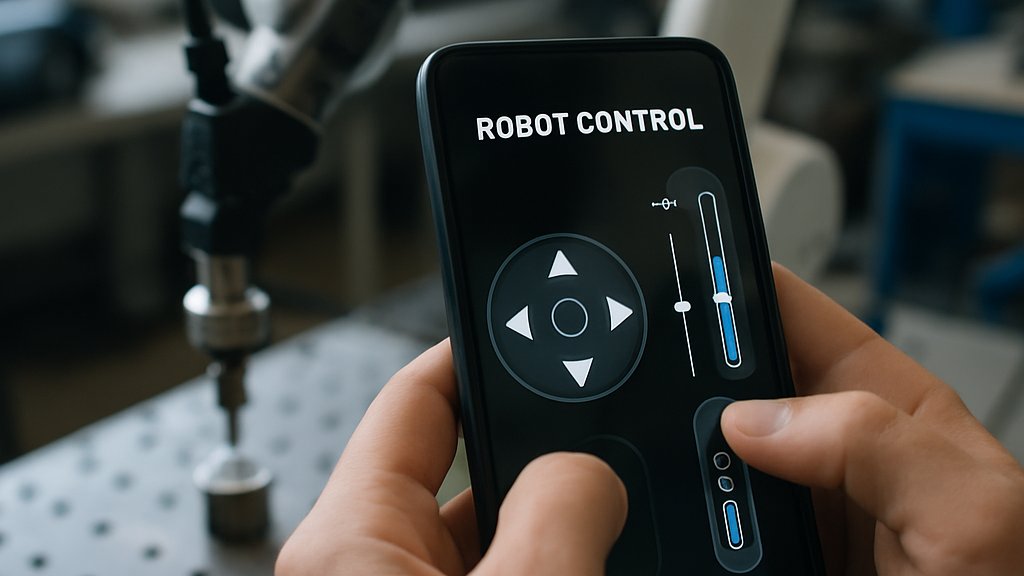
Universities spearhead experimentation because they marry cutting-edge research with open data sharing. Georgia Tech launched COBALT to crowdsource demonstrations for imitation learning. The pilot produced 7,500 sequences, totaling over 50 hours of human guiding. Moreover, participants reported that smartphone control felt more intuitive than VR gloves or gamepads. Remote Robot Control through phones therefore lowers the entry barrier for large volunteer pools.
See-Control introduced the Embodied Smartphone Operation benchmark containing 155 structured tasks. Additionally, the project showed how multimodal language models can generate control policies from text prompts. Moreover, student competitions using the dataset are accelerating algorithmic benchmarking for dexterous tasks. In contrast, earlier frameworks required hand coded finite-state machines. Together, these academic efforts validate scale and inspire commercial ventures. Research momentum continues to grow at conferences like ICRA. Subsequently, hardware makers are stepping in with tangible products.
Commercial Devices Emerge Now
Honor grabbed headlines by unveiling a prototype phone with a retractable gimbal arm. The company claims the gadget can dance, film vlogs, and pass small objects. Nevertheless, safety certification and durability testing remain unfinished. Meanwhile, educational vendors like DOBOT and UFactory ship desktop robotic arms with polished mobile apps. These solutions already support Remote Robot Control via Bluetooth or Wi-Fi inside classrooms.
Furthermore, integrators bundle phone dashboards into field service cobots for warehouse picking. Analysts expect early adopters to focus on inspection, packaging, and light assembly workloads. Pricing still varies widely, yet volumes should push costs downward. Commercial momentum confirms that phone driven manipulation is no longer academic fantasy. However, benefits arrive hand in hand with tangible risks.
Benefits And Challenges Balanced
Remote Robot Control democratizes access to costly hardware for schools, makers, and researchers. Moreover, companies can hire distributed operators on demand, trimming downtime when automation stalls. Crowdsourced demonstrations enrich training data, consequently improving policy robustness. However, teleoperation platforms must guarantee secure authentication and encrypted media channels. WebRTC still leaks certain metadata; attackers could target exposed IP addresses.
Latency spikes pose safety threats because unexpected delays amplify kinetic energy. In contrast, local fallback autonomy can catch dangerous trajectories. Industry associations now draft guidelines for remote liability, data retention, and operator training. Professionals can enhance expertise with the AI Engineer™ certification, covering safety, ethics, and deployment. Remote Robot Control adoption therefore depends on equal focus toward governance and user experience. Balancing opportunity and risk guides sustainable market expansion. Next, we examine emerging regulatory contours.
Future Outlook And Regulation
Governments increasingly recognize robots as cyber-physical systems requiring layered oversight. The European Union discusses a distinct machinery directive amendment covering connected manipulators. Meanwhile, United States agencies draft sandbox programs for teleoperation startups inside healthcare and defense. Consequently, compliance experts with robotics fluency will command premium salaries. Remote Robot Control vendors must adopt stringent audit logging and emergency stop mechanisms.
Standardization could also simplify cross-brand interoperability, stimulating broader automation uptake. Georgia Tech researchers propose open schemas for timestamps, calibration, and haptic profiles. Additionally, mature insurance products will likely emerge once risk models solidify. Meanwhile, industry consortia assemble testbeds to validate cross-vendor safety interlocks. Regulatory clarity can unlock capital while protecting end users. Therefore, stakeholders should engage policymakers early and often.
Key Takeaways
Remote Robot Control is shifting from academic experiment to everyday toolkit. Smartphone control, robust teleoperation stacks, and falling hardware costs drive this acceleration. Georgia Tech projects, commercial prototypes, and global automation demand all reinforce the trajectory. However, security, safety, and regulatory factors remain unresolved. Nevertheless, early adopters confirm that simple pick-and-place scenarios return measurable productivity gains.
Consequently, professionals must acquire interdisciplinary knowledge covering networking, compliance, and human factors. You can build that edge through the linked AI Engineer™ certification and ongoing workshops. Explore project repositories, experiment with desktop robotic arms, and join standards discussions today. Moreover, share your findings to strengthen the Remote Robot Control community worldwide.
Disclaimer: Some content may be AI-generated or assisted and is provided ‘as is’ for informational purposes only, without warranties of accuracy or completeness, and does not imply endorsement or affiliation.


