

AI CERTS
56 minutes ago
Quadruped Navigation Speeds Up In Crowded Scenes
Crowded Scene Learning Advantage
Training data volume often limits progress. Moreover, cluttered and crowded environments supply rich visual diversity that improves robustness. Researchers at ICRA 2026 fed casual videos of busy stairwells to a Unitree simulator. Subsequently, sample efficiency jumped by 35% over sparse-scene baselines. In contrast, clean laboratory clips produced brittle gaits under occlusion.
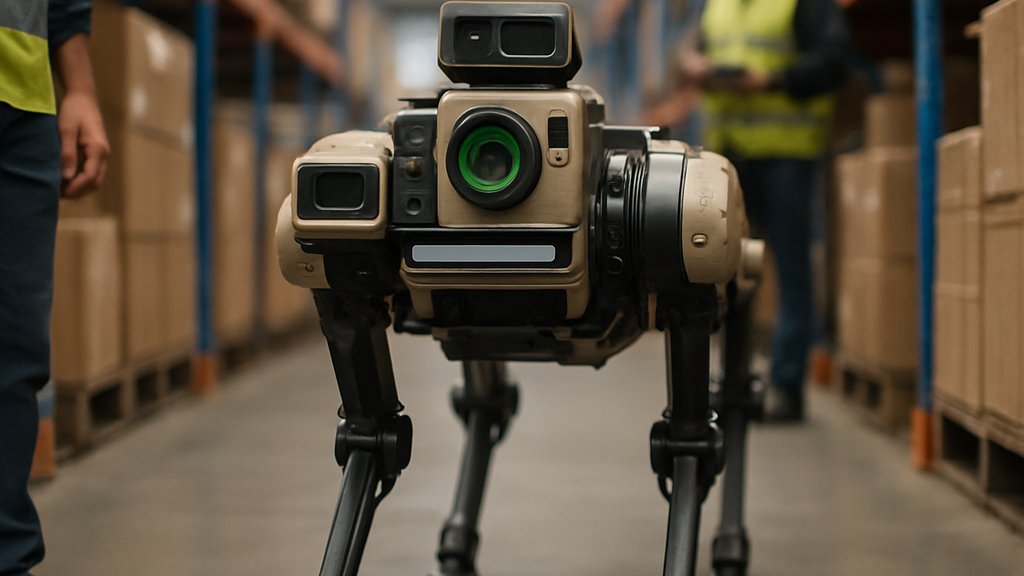
Animal studies offer parallel insights. Social mammals learn faster when peers surround them. Similarly, robot agents benefit from diverse distractors because controllers confront real-world noise early. Therefore, perception filters mature sooner, and policy gradients stabilize.
Key accelerators include:
- More occlusions force better keypoint tracking
- Frequent motion blur fosters resilient 2D-3D reconstruction
- Dynamic obstacles refine collision avoidance logic
These gains outweigh extra labeling work. Nevertheless, engineers must still address depth ambiguity and tracking drift. These challenges highlight critical gaps. However, fresh perception algorithms are closing the distance rapidly.
Market Forces Shape Demand
Money follows performance. Research & Markets pegs the robot-dog segment at roughly $280 million for 2026. Furthermore, compound annual growth sits in the low teens through 2030. Consequently, vendors race to commercialize agile robotics platforms that thrive within malls, warehouses, and disaster zones.
Several forces drive adoption:
- Labor shortages raise interest in autonomous movement
- Edge AI chips cut energy costs for field robots
- Open APIs, such as Boston Dynamics’ research interface, lower experimentation barriers
Investors now ask whether training pipelines scale beyond single labs. Meanwhile, enterprises demand metrics on mean-time-to-failure within crowded environments. Therefore, research momentum aligns tightly with commercial pressure. These dynamics signal robust opportunity. Subsequently, technical strategy must balance speed, safety, and cost.
Biology Inspires Robot Design
Nature still informs synthetic legs. Mammals display fluid gaits because neural layers separate vision and reflexes. Moreover, social animals adjust steps by watching neighbors, illustrating embodied imitation. Consequently, engineers translate these patterns into code.
Video-imitation pipelines mimic observational learning. Authors of the npj Robotics 2025 paper reconstructed 3D trajectories from single-camera zoo footage. Subsequently, AlienGo executed gallops and backflips. Meanwhile, the MOST 2026 study introduced on-robot adaptation, allowing policies to refine limbs during forest patrols.
Such success rests on tight integration between perception, proprioception, and control. Nevertheless, biological inspiration alone is insufficient. Engineers still need rigorous verification before deploying field robots near humans. These lessons reinforce cross-disciplinary thinking. Therefore, teams should embed biomechanists alongside control theorists for maximum benefit.
Vision Drives Fast Learning
Monocular video once seemed unreliable. However, robust keypoint detectors and temporal Graph Nets now tame occlusions. Consequently, Quadruped Navigation models extract high-fidelity 3D poses even when shoppers block cameras.
Hierarchical pipelines amplify the benefit. The “From Pixels to Legs” framework runs slow visual networks at 15 Hz while motors update at 400 Hz. Moreover, variable-frequency scheduling trimmed compute by nearly 8× and shortened training episodes. Therefore, researchers recorded 1,774 timesteps per second on commodity GPUs.
Four factors accelerate vision-based locomotion learning:
- Fine-tuned 2D detectors for diverse backgrounds
- Spatial-Temporal Graph Networks for smooth 3D curves
- Generative imitation to map poses to torques
- Domain randomization to fight lighting shift
These tools push policy transfer rates higher. Nevertheless, video datasets differ from control frequencies, causing jitter. Careful resampling mitigates mismatches. The gains justify the effort. Consequently, more labs are ditching motion-capture stages.
Hierarchical Control Techniques Advance
Control stacks now split decisions across timescales. Additionally, reinforcement learners tackle high-level route planning, while low-level reflex loops enforce joint safety.
Recent benchmarks show that hierarchical controllers cut sample needs by half during Quadruped Navigation trials. Furthermore, decoupling enables plug-and-play perception modules, easing upgrades when cameras improve.
However, hierarchy creates interface challenges. Designers must align latent goals with actuator limits. Meanwhile, sparse rewards hinder high-level convergence. Consequently, curriculum scheduling and reward shaping remain active research fronts.
These trade-offs appear manageable. Subsequently, production teams increasingly adopt HRL templates for warehouse autonomous movement. The approach harmonizes with modern safety wrappers, discussed next.
Runtime Safety Measures Emerge
Speed alone cannot trump safety. Therefore, researchers embed high-assurance “teacher” controllers that intervene when learned policies drift. MOST 2026 showcased HP-Student / HA-Teacher on a Unitree Go2. Moreover, the scheme maintained stability while the robot adapted to rain-soaked gravel.
Safety stacks typically include:
- Verified model-predictive backups
- Body-level collision envelopes
- Energy monitors preventing thermal runaway
Consequently, agile robotics teams can test in live shopping centers with fewer barriers. Nevertheless, regulatory clarity still lags. Meanwhile, ISO groups draft guidelines for mobile manipulators. These measures foster trust. Subsequently, improved regulation should accelerate enterprise deals.
Professionals can enhance expertise with the AI + Robotics™ certification. The credential validates safety design skills for field robots. This advantage shortens hiring cycles.
Commercial Impact And Skills
Commercial pilots already integrate Quadruped Navigation into inspection and emergency response. Moreover, early adopters report 20% quicker route completion inside crowded environments. Consequently, ROI models now include footfall density as a positive factor.
Skill gaps persist. Teams need competence in locomotion learning, perception debugging, and compliance law. Additionally, hardware-software co-design remains tricky because battery limits constrain torque budgets.
Recommended development roadmap:
- Prototype with simulation and HRL templates
- Collect cluttered-scene videos for data diversity
- Layer runtime safety teachers before field trials
- Upskill staff through formal credentials
Workshops now bundle theory with hands-on labs. Therefore, skilled engineers command premiums. Meanwhile, firms lacking robotics literacy risk delays.
These realities underscore the importance of continuous learning. Subsequently, certifications help bridge emerging knowledge gaps.
Quadruped Navigation continues evolving. However, core enablers—vision, hierarchy, and safety—are stabilizing. Consequently, organisations can plan multi-year roadmaps with greater confidence.
Key Takeaways Recap
• Crowded scenes enrich data and speed Quadruped Navigation learning.
• Vision advances and HRL jointly raise agility.
• Safety frameworks unlock real-world trials.
• Market demand for autonomous movement is growing fast.
These insights offer a strategic compass. Nevertheless, execution discipline will separate leaders from laggards.
Interested readers should benchmark against the latest open-source datasets and pursue the linked certification for credentialed advantage.
Quadruped Navigation will shape the next decade of agile robotics. Moreover, early engagement promises competitive differentiation.
Disclaimer: Some content may be AI-generated or assisted and is provided ‘as is’ for informational purposes only, without warranties of accuracy or completeness, and does not imply endorsement or affiliation.


