

AI CERTS
1 hour ago
Nvidia’s Telecom AI Agents Redefine Autonomous Networks
Furthermore, a fresh Nvidia survey shows 90% of operators already link AI to tangible gains. In contrast, only 65% reported such confidence last year. Therefore, the industry appears ready for a decisive shift toward agentic workflows. This article unpacks the technology, benefits, challenges, and roadmap behind the movement. Readers will also discover certification routes to skill up for this transition.
Blueprints Drive Autonomous Transformation
Firstly, Nvidia’s agentic blueprint centers on the Nemotron Large Telco Model, sized at 30 billion parameters. Moreover, the model was tuned on fault data, change tickets, and structured reasoning traces for telco AI tasks. Consequently, it supports multi-step planning, tool calling, and validation loops.
Developers pair the model with the NeMo Agent Toolkit and secure runtimes like NemoClaw. These components enforce policy, sandbox risky calls, and maintain auditable logs. Therefore, operators gain confidence that decisions remain traceable and reversible.
Blueprint guides cover tasks such as self-healing, energy optimization, and traffic-spike mitigation. In pilots, agents resolved simulated faults five times faster than manual playbooks, according to vendor data. Telecom AI Agents thus shift workflows from reactive scripts to proactive orchestration.
Early results confirm blueprint viability. However, real scale demands robust edge infrastructure, covered next.
Edge Infrastructure Powers Agents
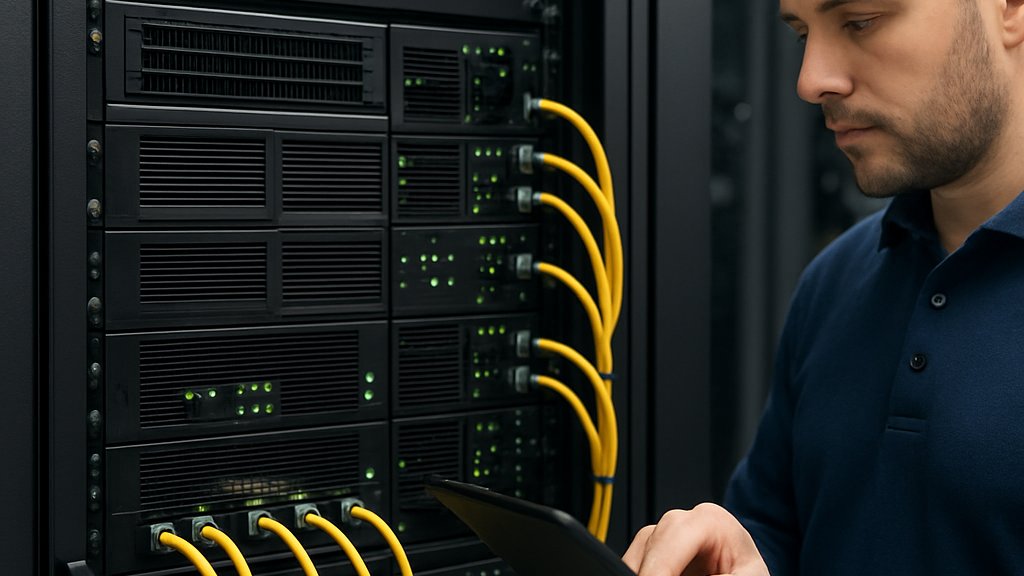
Nvidia’s Blackwell GPUs and AI-RAN software push inference close to the radio edge. Additionally, T-Mobile is testing vision agents on RTX PRO 6000 cards within distributed RAN cabinets. Latency drops below ten milliseconds, enabling physical inspection and safety workloads. Telecom AI Agents rely on this latency budget to function in real time.
Meanwhile, network operators integrate Metropolis VSS v3 for rapid video search. Agents can locate an event in under five seconds and summarize hours of footage rapidly. Consequently, field teams receive concise alerts rather than raw streams.
Always-On Agents Use Cases
Always-on agents monitor towers, substations, and city intersections around the clock. Furthermore, they coordinate tools to isolate outages, dispatch drones, and update dashboards. In warehouse pilots, anomaly detection improved fivefold versus human scanning. Such gains illustrate promising carrier automation prospects.
- Edge latency: <10 ms for vision loops
- Spectrum savings: up to 8% in AI-RAN simulations
- Energy cuts: 15% via intent-driven sleep modes
These metrics show tangible edge value. Subsequently, operators measure enterprise impacts and revenue uplift.
Operational Gains And Metrics
McKinsey data suggest over 80% of enterprises will deploy agentic AI within 18 months. Moreover, 77% of telecom leaders expect AI-native networks before 6G arrives. Such expectations hinge on clear operational improvements.
Nvidia’s 2026 survey reports 90% of respondents linking AI to higher revenue and lower costs. Telecom AI Agents contribute by shortening mean-time-to-repair and automating policy compliance. Network operations metrics improve as agents correlate alarms across domains in minutes.
Carrier automation extends to billing and contract intelligence through integrations with Amdocs and ServiceNow. Additionally, customer tickets route automatically, boosting satisfaction scores.
Quantified benefits strengthen boardroom confidence. However, challenges around data governance still loom.
Challenges Demand Trusted Governance
Data sovereignty, privacy, and upcoming EU AI Act rules rank as top hurdles. Therefore, operators often insist on on-premises or sovereign cloud deployments. Secure runtimes such as OpenShell provide policy enforcement and human-in-the-loop controls.
Nevertheless, Telecom AI Agents carry reliability risks if hallucinations trigger inappropriate actions. Consequently, extensive simulation, rollback plans, and audit logs remain mandatory. Compute economics also challenge budgets because GPUs must stay active continuously.
In contrast, phased deployments can mitigate cost spikes. Operators start with narrow network operations scenarios before scaling broader telco AI functions.
Governance frameworks will decide long-term success. Next, we examine the growing ecosystem addressing such gaps.
Ecosystem Expands Rapidly Now
Nvidia collaborates with Nokia, BubbleRAN, EY, and TCS to accelerate solution maturity. Furthermore, system integrators package reference stacks to simplify adoption for mid-tier carriers. Telco AI marketplaces already list domain agents for energy, security, and inventory optimization. Furthermore, Telecom AI Agents appear in these curated bundles to reduce integration effort.
Always-on agents developed by partners Levatas and Fogsphere deliver industrial safety as a managed service. Moreover, many operators favor external providers for agentic workloads, according to McKinsey. Many executives see Telecom AI Agents as managed offerings rather than internal workloads.
Professionals can enhance credibility with the AI Telecommunications Specialist™ certification. This credential covers agent governance, edge deployment patterns, and carrier automation economics.
A vibrant ecosystem lowers entry barriers. Consequently, attention turns toward strategic roadmaps.
Roadmap Toward AI-Native Networks
Nvidia positions AI-RAN as a stepping-stone to autonomous 6G services. Subsequently, Telecom AI Agents will orchestrate spectrum, energy, and compute resources in near real time.
McKinsey advises starting with high-value network operations pockets and expanding iteratively. Furthermore, enterprise edge services can share infrastructure, improving overall ROI.
Industry analysts recommend measuring MTTR, power savings, and revenue per site to track progress. Therefore, transparent KPIs will attract further capital and regulatory goodwill.
Strategic roadmaps convert Telecom AI Agents hype into milestones. Finally, a succinct recap follows.
Telecom AI Agents have progressed from lab curiosity to multi-operator pilots within one year. Pilots already show faster repairs, leaner energy use, and real-time edge insights. Moreover, executives cite rising revenue as another payoff. Nevertheless, governance, compliance, and cost models require equal attention. Professionals who master agent design and carrier automation will shape this decade’s network reinvention. Therefore, consider earning the AI Telecommunications Specialist™ certification to stay ahead. Explore, experiment, and lead your organization toward autonomous, AI-native networks.
Disclaimer: Some content may be AI-generated or assisted and is provided ‘as is’ for informational purposes only, without warranties of accuracy or completeness, and does not imply endorsement or affiliation.


