

AI CERTS
1 hour ago
Apera Bin Picking Propels Industrial Robotics Automation
Frost & Sullivan even honored the firm with a 2025 innovation award. However, buyers still demand hard evidence of throughput, uptime, and payback. This article dissects the claims, context, and caveats surrounding Apera's push into Industrial Robotics Automation. Moreover, we connect the findings to broader automation trends affecting factory competitiveness.
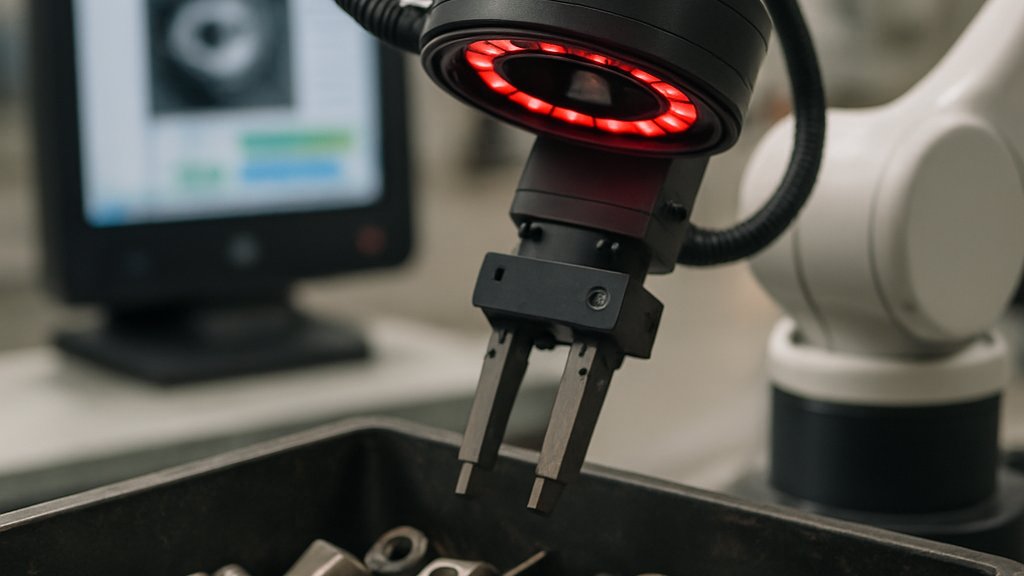
Bin Picking Market Drivers
Analysts estimate the global bin-picking market will pass one billion dollars before decade end. Moreover, strong demand emerges from automotive stamping, electronics assembly, and warehouse automation operations. Industrial Robotics Automation gains momentum when robots conquer such unstructured tasks.
- Fact.MR projects high single-digit CAGR through 2030.
- Control.com reports up to 2,000 picks per hour in optimized cells.
- Apera claims >99.9% recognition reliability after Forge training.
Therefore, stakeholders view bin-picking as a bellwether for broader smart factory adoption. High growth expectations frame strong vendor messaging. Subsequently, technology specifics deserve closer analysis.
Inside Apera Forge Studio
Forge provides a no-code browser workspace for designing each robotic environment. Users drag-and-drop robots, bins, cameras, and grippers to mirror the eventual turnkey cell. Additionally, the July 2025 upgrade introduced advanced cell design, eye-in-hand camera mounting, and de-racking simulation.
Synthetic data generation now loops four times faster, trimming training to as little as six hours. Industrial Robotics Automation practitioners welcome these reductions because offline time carries high opportunity costs. Fast simulation therefore slashes commissioning delays. However, execution speed during production matters equally, which brings us to Vue.
Vue Runtime Feature Updates
Vue 9.52, released January 2026, added Programmable Autopilot for dynamic robot path planning. Furthermore, built-in diagnostics instantly validate calibration and lighting conditions. Apera cites 0.3-second identification and potential 2,000 picks per hour within an optimized turnkey cell.
Meanwhile, Forge speed improvements accelerate vision AI deployments from concept to floor. Industrial Robotics Automation metrics look impressive on slides yet still await wider third-party confirmation. Performance statistics promise major gains. Nevertheless, factory realities may temper headline numbers.
Deployment Metrics Reality Check
Early adopters provide a more nuanced picture. In contrast, cycle time often stretches when greasy, reflective, or lightweight parts increase slip risk. Gripper choice, part nesting, and required machine tending peripherals strongly influence success.
Linamar documented stable operations after iterative tuning, demonstrating attainable reliability close to vendor claims. Reports indicate average project timelines of two to six weeks when a pre-validated turnkey cell is delivered. Deployment data shows progress with caveats. Consequently, ecosystem collaboration becomes vital.
Integration And Ecosystem Forces
Apera partners with ABB, Universal Robots, and Mitsubishi to package complete cells and support. System integrators add conveyors, guarding, and CNC machine tending stations around the vision stack. Moreover, shared libraries allow rapid reuse across warehouse automation lines and assembly islands. Such alignment accelerates Industrial Robotics Automation across greenfield and retrofit projects.
Frost & Sullivan highlighted this cooperative strategy during its 2025 award briefing. Partnership breadth accelerates adoption. Yet, technical hurdles remain for complex parts.
Warehouse automation leaders pilot de-palletizing cells driven by the same 4D engine. Additionally, machine tending projects exploit Vue Autopilot to load high-mix CNC lathes. Consequently, cross-vertical templates cut engineering overhead. Shared tools enable scale. Next, we detail lingering technical challenges.
Persisting Bin Picking Challenges
Academic studies stress the gap between visual estimation and secure grasp execution. Transparent or shiny parts still confound depth cameras despite advanced vision AI models. Nevertheless, tactile sensors remain rare within commercial Industrial Robotics Automation offerings. Competitors like Mujin invest in hybrid tactile and vision AI platforms to address those edge cases. Experts warn that every turnkey cell demands some onsite parameter refinement after part changes.
Persistent edge cases slow universal adoption. Therefore, skills development now receives fresh attention.
Professionals can deepen skills through the AI Quality Assurance™ certification. Additionally, credentialed engineers strengthen Industrial Robotics Automation governance and risk management. Shared standards elevate trust. Subsequently, strategic outlook shapes investment plans.
Strategic Outlook Summary Points
Market momentum favors platforms that integrate simulation, vision AI, and remote diagnostics. Industrial Robotics Automation leaders prioritize higher throughput, quick payback, and modular software stacks. Analysts therefore expect sustained high-single-digit growth for bin-picking over the next five years.
Meanwhile, warehouse automation, machine tending, and assembly converge around unified user interfaces. Government incentives for reshoring further stimulate demand for flexible cells across multiple sectors. Strategy hinges on measurable ROI. Consequently, decision makers must monitor independent benchmarks.
Apera’s latest releases narrow the gap between simulation and profitable production. Forge accelerates model training while Vue guides robots at line speed. Together, they illustrate the direction of Industrial Robotics Automation for unstructured tasks. However, tactile sensing, gripper design, and integration rigor still decide ultimate success.
Nevertheless, collaborative ecosystems and certified talent continue to reduce project risk. Forward-thinking managers should pilot a small cell, collect metrics, and iterate quickly. Therefore, explore certifications, benchmark competing vendors, and stay engaged with the unfolding Industrial Robotics Automation landscape.
Disclaimer: Some content may be AI-generated or assisted and is provided ‘as is’ for informational purposes only, without warranties of accuracy or completeness, and does not imply endorsement or affiliation.


