

AI CERTS
3 hours ago
Navigating AI Robotics Challenges: Humanoid Dexterity Barriers
Throughout, we balance lab optimism with hard economic reality for professional readers.
Therefore, expect actionable insights, verified statistics, and links to enhance your technical credentials.
Humanoid Market Reality Check
Global interest in Humanoid robots has exploded, especially across Asian trade fairs.
However, the Associated Press counted more than 330 distinct models in 2025, many still prototypes.
In contrast, industrial robot installations hit 542,000 units in 2024, reflecting proven reliability and scale.
Gartner explicitly cited dexterity, integration complexity, cost, and energy as core Barriers to scale.
Gartner’s January 2026 forecast underscored the gap.
Analyst Abdil Tunca stated that technology remains immature and expensive for broad supply-chain use.
Consequently, Gartner expects fewer than twenty viable production programs by 2028, a sobering prediction.
Key Statistics Snapshot 2026
- 330 humanoid models displayed in China during 2025 exhibitions
- 542,000 industrial robots installed worldwide in 2024
- <20 companies forecast to scale humanoids by 2028
These numbers reveal a cautious, fragmented market.
Nevertheless, technical progress continues pushing boundaries of AI Robotics Challenges.
Next, we examine how touch unlocks deployable dexterity.
Dexterity Depends On Touch
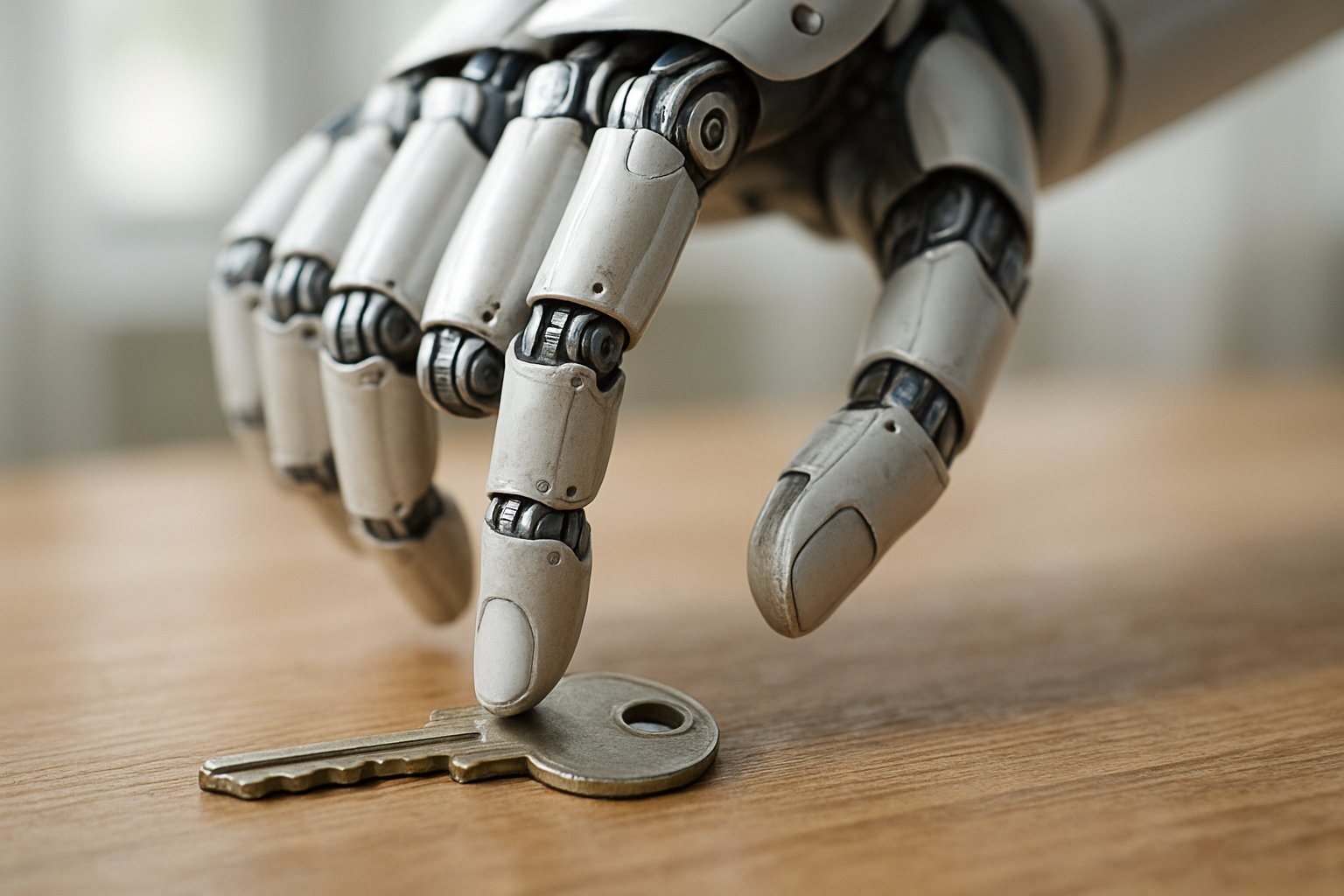
Dexterity defines whether a Humanoid can unscrew lids or fold shirts without breaking them.
Rodney Brooks argued visual data alone neglects human-like sensing, citing 17,000 mechanoreceptors per fingertip.
Moreover, the April 2026 Touch Dreaming paper delivered a 90.9% success boost by integrating tactile prediction.
Robotiq’s TSF-85 fingertips bring lab-grade tactile data into warehouses, detecting micro-slip at high frequency.
Furthermore, over 23,000 adaptive grippers already ship with the module, shortening integration cycles for pilots.
Consequently, researchers cite tactile scarcity as one of the major AI Robotics Challenges limiting generalization.
Touch integration removes some Barriers to fine manipulation.
Reliable touch narrows the sim-to-real gap and elevates grasp success.
However, dexterity alone cannot resolve all AI Robotics Challenges related to uptime, our next focus.
Reliability Remains Prime Barrier
Production engineers demand 99% uptime or better before signing service-level agreements.
Meanwhile, few Humanoid pilots publish mean time between failures, hiding real Reliability concerns.
In contrast, industrial arms boast decades of field data and predictable maintenance schedules.
Falls, sensor drift, and overheating still stop many demos after several hours of continuous work.
Therefore, investors classify these Reliability setbacks among the costliest AI Robotics Challenges today.
Researchers experiment with redundancy, cloud monitoring, and modular actuators to raise mean uptime.
Additionally, Gartner warns that integration complexity multiplies each potential failure mode.
Field evidence confirms AI Robotics Challenges in Reliability remain the toughest barrier.
Nevertheless, simulation advances promise faster debugging, which we evaluate next.
Sim Data Closing Gap
Synthetic data generation accelerates policy training without risking hardware damage.
NVIDIA reported 780,000 simulated trajectories in 11 hours, fueling enormous learning cycles.
However, the notorious sim-to-real gap persists when contact forces diverge from physics models.
Touch Dreaming improved transfer by predicting latent tactile feedback, reducing gap severity.
Consequently, many labs now blend vision, proprioception, and touch to tackle AI Robotics Challenges in manipulation.
- Domain randomization across materials and friction coefficients
- High-density tactile simulation with noise injection
- Real-to-sim data replay for contact calibration
Simulation scale accelerates iteration and debug cycles.
Yet, AI Robotics Challenges around cost still threaten commercial viability, our final section.
Economic Cost Roadblocks Ahead
Hardware cost balloons with every added degree of freedom, actuator, and sensor.
Moreover, whole-body humanoids require custom gearboxes, durable skins, and thermal management, inflating bills further.
Unitree promotes lower-Cost designs, yet long-term maintenance fees remain unclear.
Consequently, analysts fold capital expense, Reliability risk, and energy consumption into payback calculations.
Many pilots target narrow, high-margin tasks, mitigating AI Robotics Challenges relating to Cost.
Economic Barriers persist despite cheaper actuators.
Professionals can enhance decisions through the AI Robotics™ certification, improving ROI assessments.
Cost pressures dictate selective deployment of Humanoids today.
Therefore, holistic progress must balance price with dexterity and reliability gains.
The following conclusion synthesizes these findings into actionable guidance.
Future Outlook And Action
Progress in tactile sensing, simulation, and control is undeniable, yet AI Robotics Challenges remain multifaceted.
Nevertheless, component vendors, academic labs, and integrators are aligning roadmaps toward dependable, affordable Humanoid platforms.
Moreover, simulation scale and retrofit tactile kits should lower Barriers during the next product cycles.
Consequently, Reliability metrics will likely improve as redundancy, cloud diagnostics, and standardized tests mature.
In contrast, Cost will shape deployment scope until economies of scale emerge.
Professionals should track technical benchmarks, pilot economics, and evolving standards.
Additionally, advancing skills through the AI Robotics™ certification builds credibility for leading transformational projects.
Therefore, seize the moment to study, prototype, and collaborate before competitors master the next generation of robotics.
These insights empower informed strategy amid accelerating innovation.
Act now to turn AI Robotics Challenges into competitive advantage.


