

AI CERTS
2 hours ago
Finite Element Agents Drive Automated Solid Mechanics Simulation
Market Drivers Rapidly Emerge
Global FEA revenue reached USD 6.9 billion last year. Meanwhile, demand grows for faster design iterations and cheaper prototypes. Multi-agent systems promise exactly that acceleration. Finite Element Agents appear when compute costs fall and cloud licenses proliferate. Additionally, vendors integrate generative solvers with existing CAD platforms.
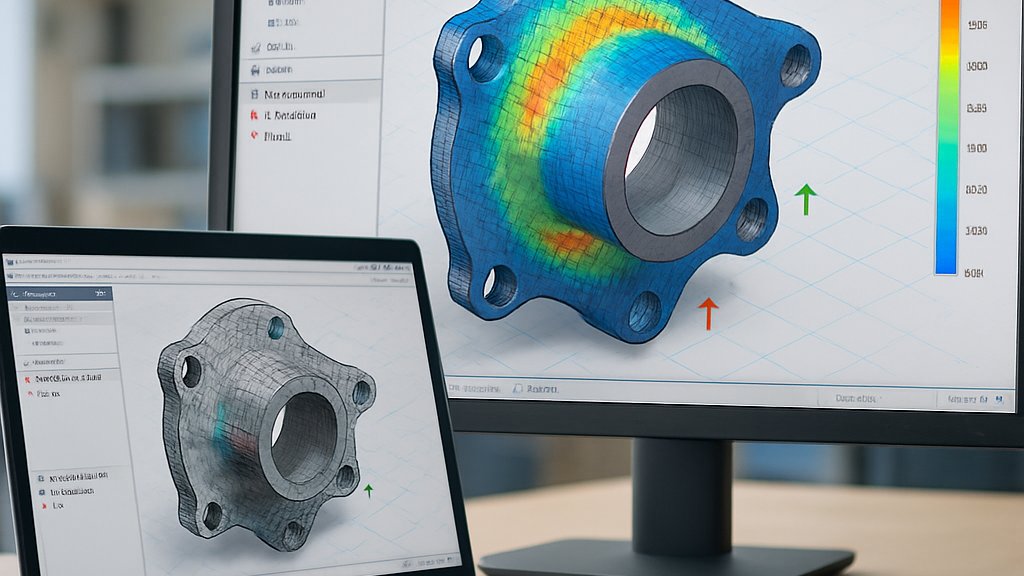
Analysts expect double-digit CAGR across computer-aided engineering. In contrast, legacy scripting cannot match autonomous orchestration speeds. Therefore, investors fund startups building agentic toolchains for simulation automation. Furthermore, universities supply open-source prototypes that inspire commercial forks.
These dynamics reveal a clear momentum shift. Adoption pressure will intensify next quarter. Next, we examine fresh academic results.
Academic Results Impress Stakeholders
Researchers released several headline systems during 2026. AbaqusAgent solved 86 percent of 50 verified solid mechanics cases. VFEAgent combined images with text to outperform single-agent baselines. PDE-Agents recorded 97.8 percent overall success across 1,369 production runs. Such statistics underline important progress for Finite Element Agents.
- 86 % success: AbaqusAgent, 50 problems
- 97.8 % success: PDE-Agents, 1,369 problems
- 57.6 % first-try success: PDE-Agents
Moreover, ablation studies show retrieval layers improve fidelity. Consequently, verification loops now form a standard design element. Meanwhile, MechAgents, MooseAgent, and FEAGPT expand domain coverage to fluids and multiphysics.
Performance numbers continue to rise. However, architecture decisions ultimately determine reliability. That insight drives the next discussion.
Architecture Choices Truly Matter
Agent frameworks split planning, coding, execution, and checking roles. Therefore, specialised bots cooperate while a supervisor coordinates. Experience shows that multi-agent systems reduce hallucinations compared with single monolith LLMs. Retrieval-augmented knowledge graphs further limit errors.
Retrieval Layers Enhance Reliability
GraphRAG fetches past meshes, material tables, and boundary setups. Subsequently, reasoning agents ground their prompts in factual context. In contrast, naive pipelines often misplace units or forget constraints. Additionally, looped verifiers flag unstable eigenvalues before solver launch. Finite Element Agents now embed these guards by default.
Well-chosen orchestration patterns cut runtime costs and boost repeatability. These findings stress the importance of transparent provenance. The following section unpacks benefits alongside remaining drawbacks.
Benefits And Drawbacks Examined
Automated pipelines accelerate early design. Natural language to mesh shortens onboarding for non-experts. Moreover, repetitive preprocessing disappears under simulation automation. Industry leaders also couple agents with optimisation or digital-twin dashboards. Consequently, whole product lines iterate within days, not weeks.
Nevertheless, risks persist. Hallucinated material properties jeopardise safety-critical parts. Furthermore, licence management for commercial solvers complicates deployment. Security researchers warn that multi-agent systems expand attack surfaces. Therefore, human-in-the-loop governance remains essential.
These pros and cons highlight crucial gaps. However, enterprises continue to explore pilot projects. Next, we review adoption roadmaps.
Enterprise Adoption Outlook 2026
Ansys, Dassault Systèmes, and Altair now embed agentic assistants into cloud offerings. Vendor demonstrations generate parameterised meshes from chat prompts. Moreover, Synopsys aligns chip packaging tools with engineering AI simulation engines. Finite Element Agents underpin several beta plugins.
Vendor Roadmaps Add Agents
Altair’s next HyperWorks release bundles a “Mesh Agent” for composite panels. Additionally, NVIDIA markets Omniverse connectors that stream solver outputs into photoreal scenes. Consequently, cross-functional teams gain near-real-time feedback. Professionals can enhance their expertise with the AI Engineer™ certification.
Commercial traction validates academic promise. Two challenges remain prominently: certification of AI-generated results and regulated liability. Therefore, engineers require new skill sets, covered in the final section.
Skills And Next Steps
Teams must blend domain physics, prompt engineering, and cybersecurity. Consequently, curricula now add engineering AI electives. Upskilling programs emphasise solid mechanics theory paired with agent orchestration labs. Finite Element Agents literacy quickly becomes a hiring differentiator.
Additionally, managers demand proofs of reproducibility, traceable seeds, and dataset governance. Therefore, open benchmarks will shape procurement guidelines. Aspirants should practice with public repositories while pursuing recognised credentials. Moreover, simulation automation fluency accelerates promotion opportunities.
Robust training pipelines close the capability gap. Subsequently, enterprises can deploy safe, scalable agent systems.
However, strategic investment alone will not suffice. Continuous verification and human oversight remain mandatory.
Conclusion
Finite Element Agents have progressed from laboratory prototypes to enterprise pilots. Moreover, their integration with multi-agent systems delivers measurable speed and accuracy gains. Academic benchmarks demonstrate high success rates, while vendors rush to productise the technology. Nevertheless, governance, security, and liability require vigilant attention. Consequently, forward-looking professionals should master relevant skills and obtain industry certifications. Explore the linked credential to stay ahead and unlock the next wave of automated engineering innovation.
Disclaimer: Some content may be AI-generated or assisted and is provided ‘as is’ for informational purposes only, without warranties of accuracy or completeness, and does not imply endorsement or affiliation.


