

AI CERTS
1 hour ago
Deskside AI Computing Brings Supercomputers To Your Desk
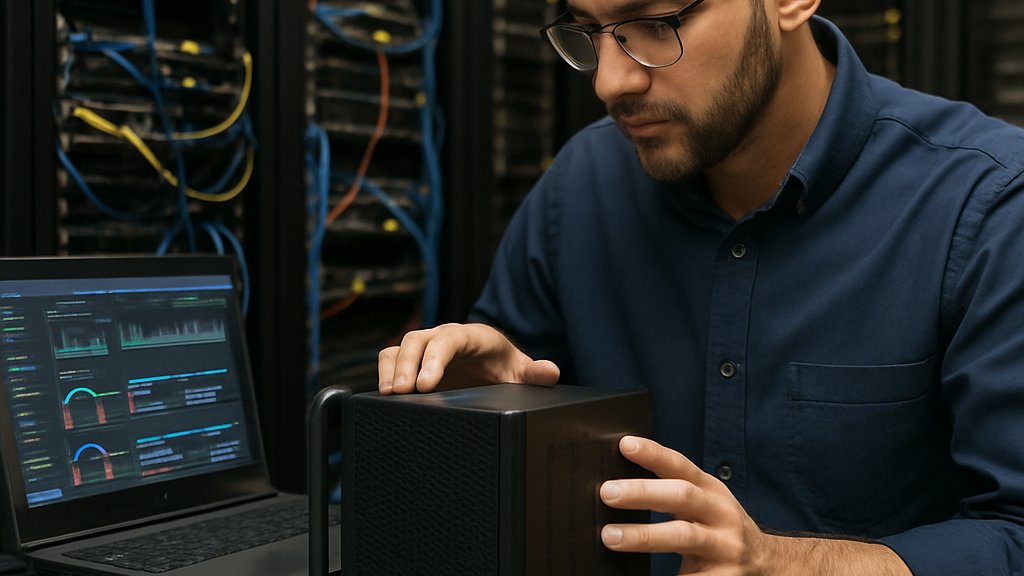
However, the move reshapes procurement, security, and skills planning.
This article explores the market, hardware, workflows, cost factors, and future direction for Deskside AI Computing.
Readers will gain actionable insights and certification pathways to stay competitive.
Deskside AI Market Impact
Industry analysts report double-digit growth as compact Grace Blackwell systems reach procurement lists.
Moreover, ASUS, Dell, HP, and Lenovo all now advertise certified GB10 solutions.
NVIDIA CEO Jensen Huang framed the launch as bringing AI from cloud to desktop edges.
Consequently, many labs that once leased GPUs now consider on-prem Deskside AI Computing for latency-sensitive research.
The Ascent GX10 packs one petaFLOP FP4 performance into a 150 millimeter cube.
Meanwhile, reviewers highlight how that throughput rivals earlier rack DGX A100 nodes.
These shifts redefine the classic enterprise workstation concept, blending local compute with datacenter class silicon.
Therefore, CIOs must evaluate power, cooling, and governance for local compute deployments rolling out across floors.
The market momentum is unmistakable, yet understanding the silicon is essential.
Consequently, the next section dissects the hardware foundation.
Hardware Inside The Box
Understanding the silicon clarifies performance envelopes.
Grace Blackwell GB10 merges an ARM Grace CPU with a Blackwell GPU through NVLink-C2C coherence.
Additionally, this unified memory model lets Deskside AI Computing host 200-billion-parameter models without host copies.
- Up to 1 petaFLOP FP4 throughput, rivaling many rack DGX Station servers.
- 128 GB unified LPDDR5x memory, outperforming typical enterprise workstation GPUs for local compute workloads.
- Footprint of 150×150×51 mm, proving developer hardware can stay unobtrusive on a crowded desk.
Moreover, dual ConnectX ports allow two-node clustering for models exceeding 400 billion parameters.
Consequently, small teams gain scaling headroom without building a full server room.
Overall, Deskside AI Computing makes petaflop power a desk accessory rather than a datacenter privilege.
The following section illustrates how organizations already exploit that power.
Real Enterprise Workflow Cases
Healthcare researchers fine-tune clinical language models locally to avoid sharing sensitive records with external clouds.
Moreover, Deskside AI Computing slashes inference latency for imaging triage, enabling real-time decision support in radiology labs.
A robotics startup uses the ASUS–Hugging Face bundle to run embodied agents on the factory floor.
Consequently, arm trajectories update every few milliseconds, something impossible with distant clouds.
Financial institutions deploy enterprise workstation clusters across trading desks, pairing each node with NVLink fabrics.
Additionally, local compute ensures regulatory compliance by keeping proprietary data on-prem.
Media studios embrace developer hardware for rapid video segmentation and generative design previews.
These cases show how Deskside AI Computing empowers teams to innovate without bandwidth bottlenecks.
However, acquiring such systems still requires careful financial planning.
Procurement And Cost Realities
Sticker prices for the ASUS Ascent GX10 start near $3,000 and stretch beyond $4,200 for larger SSD options.
Meanwhile, rival GB10 minis from Acer and Gigabyte cluster around similar figures.
NVIDIA positions the desktop DGX Station variant above $15,000, reflecting its 784 GB memory and faster networking.
In contrast, some enterprises still compare these sums against monthly cloud invoices exceeding six figures.
- Capital expense locks pricing over hardware life, easing budget forecasting.
- No variable egress fees when local compute handles data pipelines.
- Energy costs rise, yet remain predictable for enterprise workstation fleets.
Consequently, procurement teams often pilot one node before scaling orders across departments.
Deskside AI Computing can pay back quickly when workflows demand sustained GPU usage.
Cost dynamics favor organizations with steady inference loads.
Nevertheless, managers must weigh operational risks before mass deployment.
Risk Limits And Mitigations
Running petascale silicon beside employees introduces fresh security and governance challenges.
Therefore, endpoint patching and model attestation become critical.
Analysts caution that DGX Station and other Grace Blackwell nodes store entire models in coherent memory, magnifying breach impact.
Furthermore, many mini systems limit internal expansion, reducing upgradability compared with a modular enterprise workstation chassis.
Nevertheless, strong disk encryption, role-based access, and physical cable locks reduce threat surfaces for on-prem devices.
Mitigations exist, yet they demand skilled developer hardware administrators and disciplined IT processes.
With risks acknowledged, forward planners turn toward long-term strategy.
Future Outlook And Strategy
Analysts expect GB10 desktop shipments to triple over the next eighteen months.
Moreover, NVIDIA roadmap leaks hint at sub-100-watt variants that bring Deskside AI Computing to even smaller footprints.
Meanwhile, software stacks such as CUDA-X NIM and NemoClaw simplify deployment for developer hardware teams.
Additionally, OEM competition will push prices down while DGX Station branding cements reference standards across vendors.
Professionals can enhance their expertise with the AI Developer™ certification.
Therefore, organizations that pilot early gain compound learning advantages.
Ultimately, Deskside AI Computing will coexist with cloud, giving architects a richer performance toolbox.
Grace Blackwell systems now compress petaflop performance into hardware smaller than a paperback.
Consequently, enterprises can own deterministic latency, predictable cost, and private sovereignty over sensitive datasets.
However, budgets, governance, and cooling still demand rigorous planning.
Analysts advise piloting, measuring, and iterating before rolling units across every department.
Meanwhile, professionals who master orchestration, security, and optimization skills will remain in high demand.
Therefore, consider formal learning paths and the linked certification to validate expertise.
Act now, evaluate your workloads, and position your team for the next generation of on-prem AI.
Disclaimer: Some content may be AI-generated or assisted and is provided ‘as is’ for informational purposes only, without warranties of accuracy or completeness, and does not imply endorsement or affiliation.


