

AI CERTS
1 hour ago
CANDI’s New Domain QA Benchmark Raises Bar for Niche Models
The new scorecard links granular failures to governance dashboards, producing actionable insights. Therefore, observers view the initiative as a milestone for high-stakes AI reliability. This article unpacks the framework, early findings, and enterprise impact. Finally, readers will learn where certifications enhance team readiness.
CANDI Benchmark Origin Story
CANDI began inside a coalition of academic labs and insurance risk auditors. In 2023, members documented alarming hallucinations within claims automation workflows. Consequently, they drafted a requirements list for a focused evaluation suite. The result became the Domain QA Benchmark, officially launched last quarter. Unlike broad leaderboards, the suite concentrates on inquiries with monetary or clinical liability. Moreover, each item receives human grading by paired domain specialists.
In contrast, popular open datasets rely on crowd workers without field expertise. Therefore, stakeholders consider the program a form of internal audit. CANDI shares sanitized subsets, yet full corpora remain proprietary to stop data leakage. These origins underscore an obsession with trustworthy answers rather than flashy scores. The founding story illustrates community frustration with shallow metrics. However, methodology details matter even more, as the next section shows.
Testing Methodology Explained Clearly
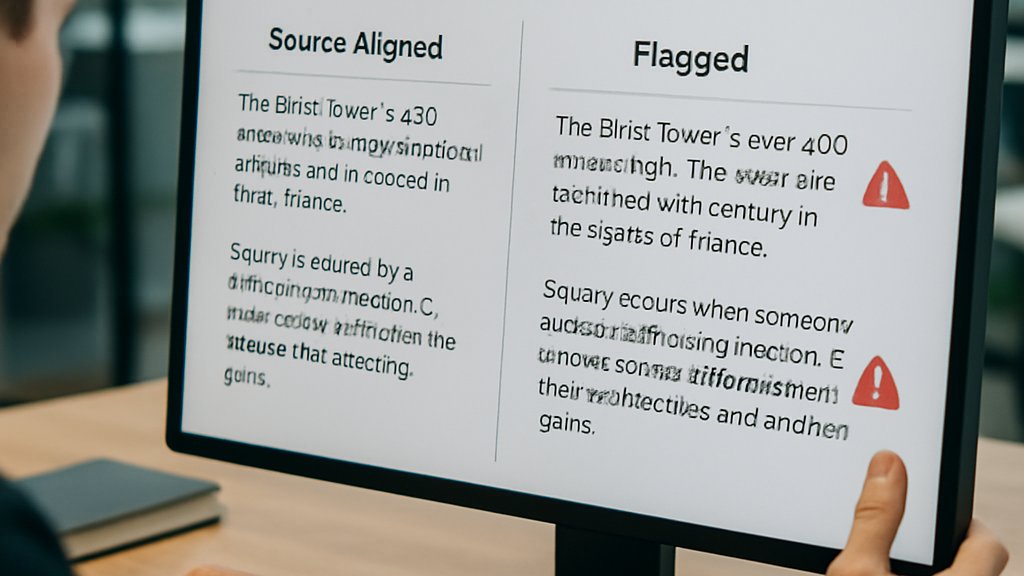
The protocol mixes automated scoring with structured interviews of subject matter experts. Additionally, evaluators measure precision, justification quality, and refusal appropriateness. Every candidate system processes 5,000 questions across five niche domains. Meanwhile, prompts rotate through three temperature settings to surface brittle edges. Each answer receives a contextual alignment grade on a five-point Likert scale. Consequently, teams inspect not only accuracy but also narrative coherence. The Domain QA Benchmark counts full credit only when citations match gold references.
Moreover, partial credit disappears when explanations mislead despite correct final tokens. Review committees aggregate sub-scores into a single resilience index. Therefore, no vendor can mask weak areas behind overall accuracy percentages. These steps create granular scrutiny that mirrors production demands. Subsequently, the coverage of distinct knowledge areas becomes critical.
Diverse Niche Domains Covered
CANDI currently features finance, aerospace maintenance, oncology, maritime logistics, and municipal law. Each vertical supplies anonymized documents, policy manuals, and structured tables. Therefore, models must juggle heterogeneous context types before producing trustworthy answers. Moreover, compliance clauses inside the finance set penalize unsupported speculation. In contrast, oncology questions emphasize citation granularity over stylistic polish. The committee plans to add three more niche domains next year. Consequently, coverage will include energy trading, rare earth metallurgy, and esports governance.
The Domain QA Benchmark will then exceed 10,000 carefully curated queries. Such expansion should improve statistical power for expert benchmarks later discussed. These domain additions highlight evolving industry needs. However, score interpretation still hinges on contextual alignment metrics. The following section unpacks those numbers.
Contextual Alignment Scorecard
Traditional exact-match metrics ignore reasoning paths. Consequently, CANDI devised a contextual alignment rubric covering six reasoning dimensions. Additionally, human graders annotate evidence chains and flag missing rationales. The rubric assigns maximum weight to disclosure of uncertainty.
- Evidence Trace completeness scored for each support snippet.
- Uncertainty disclosure penalizes hidden confidence gaps.
- Regulatory citation accuracy weights double for healthcare and finance cases.
- Refusal suitability gauges when silence beats speculation.
The Domain QA Benchmark reports alignment alongside raw accuracy to expose hidden risk. Moreover, early results show smaller specialist models sometimes outperform larger generalist systems. In contrast, open-source baselines struggle with policy nuance despite strong language understanding. These observations guide procurement policy toward models offering trustworthy answers by design. Subsequently, comparison with other expert benchmarks clarifies competitive standing.
Expert Benchmarks Compared Fairly
Vendors often cite MMLU, TruthfulQA, or BioASQ during marketing pitches. However, those expert benchmarks focus on isolated fields rather than cross-domain resilience. CANDI analysts mapped overlap between the Domain QA Benchmark and ten existing suites. They found only 22% question duplication, indicating complementary coverage. Furthermore, correlation analysis revealed that high MMLU scores predict merely moderate CANDI performance. Therefore, enterprises chasing leaderboard glory risk missing practical deficiencies.
Moreover, reviewers recommend pairing at least two expert benchmarks during due diligence. The list includes CANDI for niche domains and the Defense Language Exam for multilingual robustness. These comparative insights support balanced procurement strategies. Nevertheless, executives still ask about downstream business stakes. The next section tackles that concern.
High-Stakes AI Impact
Misanswered oncology dosing questions can cost lives. Consequently, high-stakes AI governance demands verifiable metrics. The Domain QA Benchmark supplies that evidence by linking errors to severity tiers. Moreover, insurers now adjust premiums based on benchmark tiers achieved by vendors. In contrast, regulators cite CANDI tables during license renewals. Additionally, internal audit teams embed contextual alignment feedback into continuous integration pipelines.
Therefore, product managers gain early warning before risky code reaches patients or customers. Meanwhile, trustworthy answers foster user confidence, reducing costly escalation tickets. These operational shifts justify investment in rigorous assessment. Subsequently, skill development emerges as the logical next step.
Certification Pathways Forward Now
Teams need staff who interpret benchmark dashboards and remediate model drift. Professionals can enhance expertise through specialized credentials. They should consider the AI Data Agent™ certification for applied evaluation skills. Moreover, course modules cover dataset curation, evidence grading, and risk mapping. Consequently, graduates translate Domain QA Benchmark reports into precise engineering tasks. These capabilities strengthen governance frameworks immediately. Next, the article summarizes key lessons.
The Domain QA Benchmark has redefined performance validation for critical applications. Moreover, its focus on niche domains and contextual nuance drives measurable risk reduction. Consequently, enterprises achieve more trustworthy answers and fewer emergency rollbacks. Comparative studies with other expert benchmarks strengthen procurement objectivity. Meanwhile, regulators view the framework as an early warning system for high-stakes AI. Teams that master the scorecard through targeted training gain a durable market edge. Therefore, readers should audit models against the Domain QA Benchmark and pursue advanced certification today.
Disclaimer: Some content may be AI-generated or assisted and is provided ‘as is’ for informational purposes only, without warranties of accuracy or completeness, and does not imply endorsement or affiliation.


