

AI CERTs
3 months ago
AI Entry-Level Careers Face Displacement Storm
Warning bells around junior employment grow louder daily. Consequently, CEOs from Anthropic to Amazon have switched tone. Instead of upbeat promises, executives now caution that generative AI may erase foundational rungs on corporate ladders. Moreover, early statistics already reveal hiring pullbacks. Professionals entering AI Entry-Level Careers must therefore evaluate new risks and strategies. This article dissects executive warnings, examines fresh data, and outlines actionable steps for workers and policymakers.
Executives Signal Sharp Risks
Dario Amodei told Axios that generative AI could wipe out half of entry roles within five years. Meanwhile, Sam Altman compared current agents to interns poised to become tireless engineers. In contrast, Jensen Huang framed the threat as losing to colleagues who leverage automation. Additionally, Amazon’s Andy Jassy warned staff about forthcoming headcount trims driven by AI efficiency.
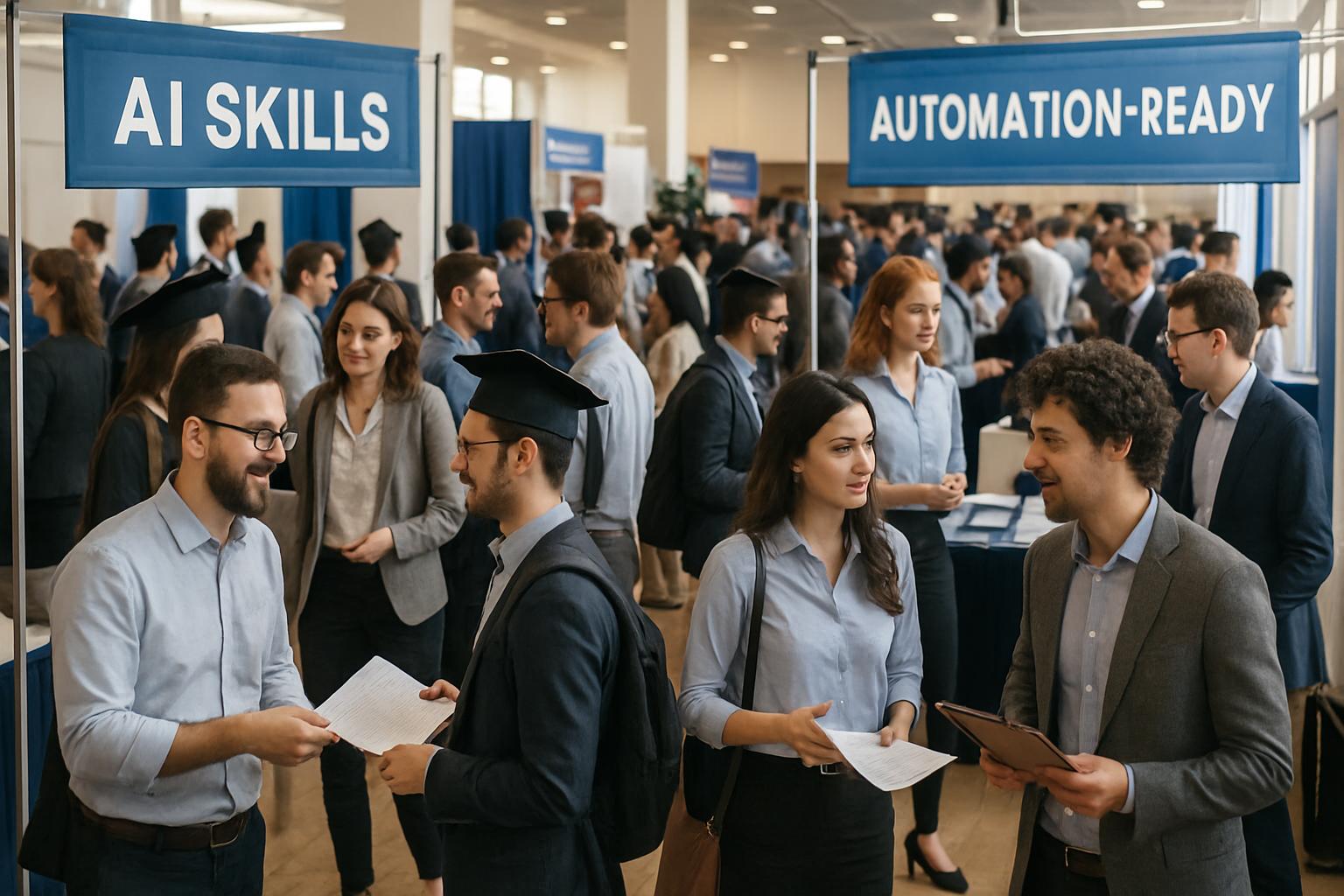
These remarks signal unprecedented disruption. Nevertheless, some leaders still predict long-term job creation. Managers must navigate both narratives carefully.
Executive candor highlights real short-term risks. However, understanding data offers clearer direction for AI Entry-Level Careers.
Data Shows Early Impact
The Stanford Digital Economy Lab found a 13% employment decline among 22–25-year-olds in AI-exposed jobs. Furthermore, Adzuna tracked a 40% drop in graduate postings since late 2022. Financial Times analyses echoed similar contractions across the Junior Job Market. Consequently, early evidence suggests displacement, not wage cuts, drives change.
- 13% relative employment loss for young workers in AI-exposed occupations
- Up to 50% of entry-level white-collar roles at risk, according to Anthropic
- 43% decline in US entry postings requiring degrees since ChatGPT’s release
These numbers underline accelerating Workforce Automation. Therefore, stakeholders need swift responses.
The statistics confirm executives’ concerns. Subsequently, understanding underlying drivers becomes essential.
Drivers Behind Rapid Automation
Generative models complete routine cognitive tasks once handled by new hires. Moreover, AI agents now string tasks together, replacing project assistants. Consequently, managers observe productivity spikes without adding staff. Additionally, shareholder pressure rewards cost control, reinforcing automation incentives.
However, macro forces also matter. Interest-rate hikes dampen overall hiring, and global talent pools remain competitive. Nevertheless, CEOs cite AI as the decisive catalyst shrinking the Junior Job Market.
Automation incentives continue intensifying. Therefore, talent pipelines encounter structural strain.
Implications For Talent Pipelines
Entry roles historically fed future leadership. In contrast, disappearing openings risk hollowing that ladder. Consequently, companies may struggle to groom managers who understand ground-level workflows. Furthermore, diversity goals suffer when early opportunities vanish fastest.
Meanwhile, universities report lower placement rates for graduates pursuing AI Entry-Level Careers. Some firms now favor experienced hires who already master AI tools. Therefore, fresh graduates must present demonstrable competency with automation platforms.
Pipelines cannot thrive without entry points. However, policy and upskilling initiatives can mitigate gaps.
Policy And Upskilling Paths
Policymakers debate taxes on AI usage to fund reskilling programs. Moreover, accelerated apprenticeships could replace traditional entry posts. Additionally, public-private partnerships may expand lifelong learning credits.
Professionals can also act individually. For example, they can enhance expertise with the AI Engineer™ certification. Such credentials validate hands-on skill with model deployment and governance. Consequently, candidates stand out in a Workforce Automation era.
Policy momentum remains uncertain. Nevertheless, targeted upskilling offers immediate relief and opportunity.
Strategic Moves For Graduates
Graduates should audit their task portfolios. Subsequently, they must double down on uniquely human capabilities such as client empathy and domain judgment. Furthermore, mastering prompt engineering and workflow orchestration boosts relevance.
Consider these practical steps:
- Complete at least one industry-recognized AI certification within six months.
- Build a portfolio showcasing agent-based project automation.
- Network with mentors inside firms championing augmentation rather than headcount cuts.
- Track emerging policy incentives supporting upskilling expenses.
Following these steps positions applicants competitively. Consequently, AI Entry-Level Careers remain attainable, though pathways differ.
Proactive planning empowers graduates. Meanwhile, broader outlooks shape future labor architecture.
Future Outlook And Action
Analysts expect continued adoption of large language models across industries. Consequently, entry hiring will likely stay muted through 2027. However, new roles in model evaluation, safety, and compliance are scaling. Moreover, companies recognising pipeline risks may re-introduce rotational programs anchored in AI tooling.
Nevertheless, the Junior Job Market faces turbulence. Therefore, collaborative policy, corporate accountability, and individual upskilling must align. Stakeholders who adapt quickly will harness productivity gains without sacrificing opportunity structures.
The landscape remains fluid. Consequently, vigilance and flexibility define sustainable AI Entry-Level Careers.
Disclaimer: Some content may be AI-generated or assisted and is provided ‘as is’ for informational purposes only, without warranties of accuracy or completeness, and does not imply endorsement or affiliation.


