

AI CERTS
5 months ago
Academic Ethics: Publishers Ban AI-Edited Photos
Moreover, the ban responds to exponential growth in generative models that can fabricate convincing microscopy visuals. Industry data show retractions rising to 14,000 in 2023, many tied to manipulated figures. Meanwhile, policy language from Springer Nature, Elsevier, and others draws a firm line: no undisclosed AI-edited photos. Authors may still apply global brightness tweaks, yet targeted edits that add or erase features are forbidden. Therefore, scholars must adapt workflows, retain raw data, and disclose machine assistance. This article unpacks the policy landscape, enforcement technology, and practical steps researchers must follow to safeguard Image Integrity and Factual Accuracy.
Global Policy Shift Overview
Major publishers moved quickly over the last two years. Springer Nature states, “SN does not allow the inclusion of generative AI images in our publications.” Elsevier echoes the stance, banning AI-Edited Photos unless fully documented within methods. Additionally, Taylor & Francis, Wiley, SAGE, and MDPI released similar rules. In contrast, policy exceptions exist when AI generation forms part of validated experimental design. Nevertheless, undisclosed use remains a potential misconduct trigger across journals. A 2025 cross-sectional study of forty family-medicine titles found 82.5 % referencing AI, yet only half permitted synthetic images.
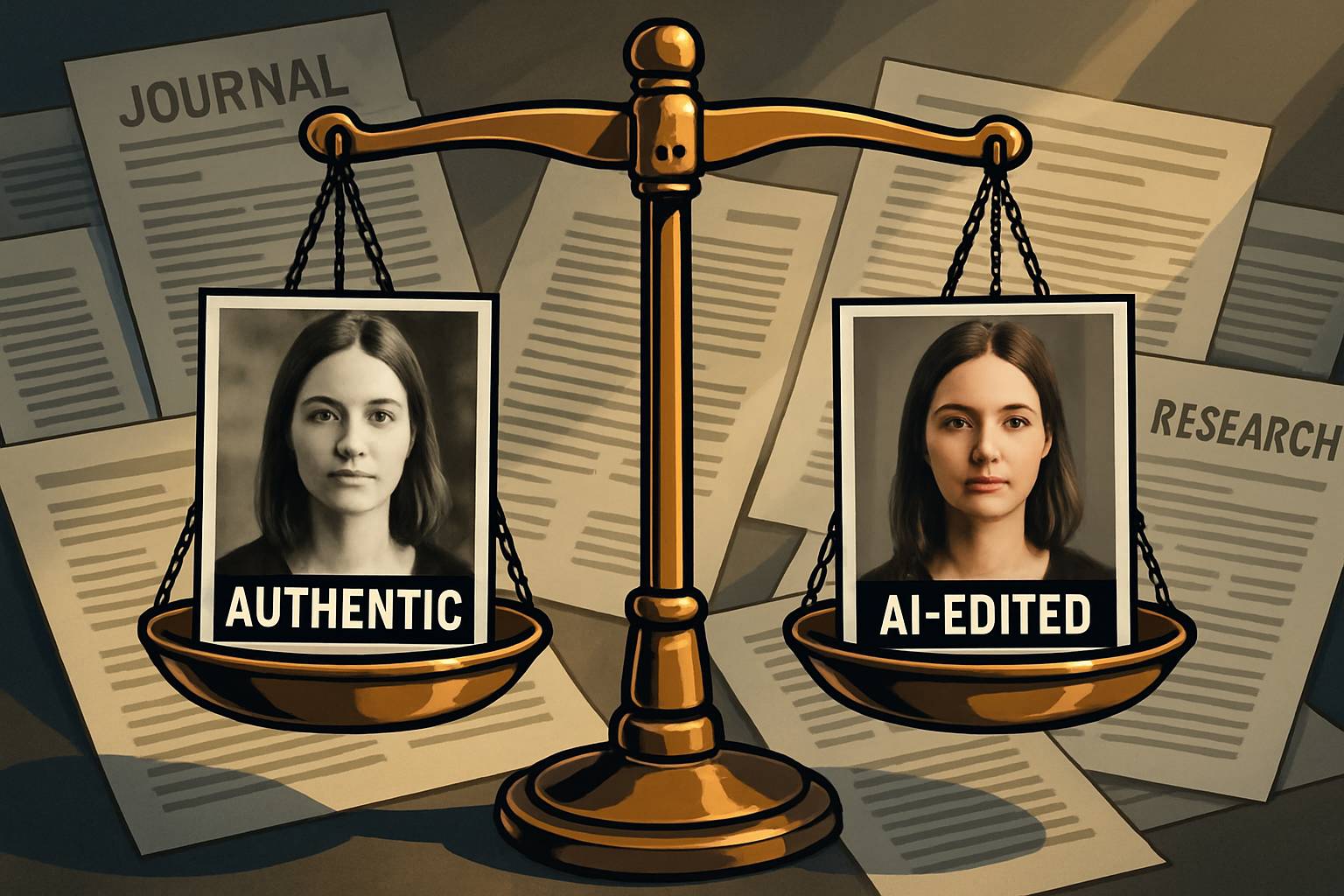
• 82.5 % of surveyed journals mention AI tools.
• 77.5 % prohibit AI authorship entirely.
• 14,000 literature retractions occurred during 2023, many for image issues.
Publishers cite legal risks and reader trust when justifying bans. Consequently, Academic Ethics now prioritizes transparent image provenance.
These numbers show rapid, coordinated change. However, understanding the motivations behind the ban offers deeper insight.
Drivers Behind the Ban
Protecting primary data sits at the center. Photographs and microscopy plates often serve as evidence supporting experimental claims. Generative tools can add nonexistent bands or remove unwanted artifacts, undermining Factual Accuracy. Moreover, copyright for AI outputs remains unsettled, exposing journals to legal disputes. Consequently, prohibitions safeguard both Image Integrity and publisher liability.
Community watchdogs, including Jennifer Byrne and Guillaume Cabanac, amplified concerns on social media. Their investigations revealed cloned Western blots and reused cell images spanning multiple papers. Subsequently, editors faced public pressure to respond decisively. Therefore, stringent policies became an Academic Ethics imperative.
Yet legitimate scientific applications exist. Computational imaging groups employ diffusion models to reconstruct low-light scans, boosting signal without distorting meaning. Publishers accommodate such cases when authors share raw data, code, and model descriptors. Transparency reconciles innovation with Factual Accuracy.
Safeguarding data and public trust drives the clampdown. Meanwhile, enforcement technology evolves to meet the challenge.
Detection Tools Evolve Rapidly
Journals now deploy automated forensics during peer review. Proofig, used by the Science family, scans submissions for duplications, splices, and AI signatures. Furthermore, Elsevier and Springer Nature request original image files, enabling auditors to trace every processing step. Consequently, deceptive AI-Edited Photos face higher discovery risk.
Detection remains an arms race. Generative models learn to mask digital fingerprints, while classifiers adapt to new artifacts. Nevertheless, even sophisticated tools yield false positives. Editors therefore combine automation with human expertise to confirm Image Integrity findings.
Researchers must log workflows meticulously. Version histories, prompt texts, and parameter files provide evidence of honest practice. Professionals can enhance their expertise with the AI Cloud Architect™ certification, which covers secure data handling for computational pipelines.
Screening tools increase enforcement consistency. However, navigating divergent journal requirements still challenges authors.
Practical Guidance For Authors
Preparation begins before image acquisition. Capture redundant frames, archive raw files, and document every transformation. Additionally, consult the target journal’s most recent policy; wording changes frequently. Create a disclosure section detailing any algorithmic denoising or segmentation. Include software name, version, and training data if applicable.
When AI generation constitutes a research method, place the full description inside Methods. Provide code repositories and seed values to bolster Factual Accuracy. Meanwhile, avoid uploading unpublished figures to public generative platforms, as some services retain user inputs.
Authors should expect extra documentation requests. Reviewers may demand original TIFF stacks or microscope metadata. Therefore, maintaining organized data hierarchies reduces administrative burden. Moreover, early compliance signals commitment to Academic Ethics and improves reviewer confidence.
Clear preparation minimizes submission friction. Yet unresolved debates persist within the community.
Ongoing Debates And Gaps
Policy heterogeneity complicates cross-disciplinary work. A study found image rules varied even inside the same publisher portfolio. Additionally, smaller journals lack resources for robust detection, relying on volunteer reviewers. Consequently, enforcement unevenness threatens overall Image Integrity.
Critics argue that blanket bans may stifle methodological innovation. In contrast, proponents counter that reproducibility must remain paramount. Moreover, the cost of retractions—including damaged reputations and wasted funding—outweighs short-term convenience.
False positives from forensic AI raise further concerns. Innocent contrast adjustments sometimes resemble manipulations. Therefore, editors must apply due process before sanctioning authors, maintaining Academic Ethics fairness.
Debate underscores the evolving nature of standards. Subsequently, stakeholders look ahead to harmonized guidelines.
Future Outlook And Actions
Publishers plan to refine language with input from COPE, ICMJE, and WAME. Moreover, cross-industry working groups discuss shared disclosure templates, which would streamline compliance. Integration of blockchain provenance solutions also gains traction, promising immutable audit trails that enhance Factual Accuracy.
Funding agencies now emphasize responsible AI use in grant calls. Consequently, laboratories must budget for data stewards and secure storage. Meanwhile, certification programs expand. The previously mentioned AI Cloud Architect™ curriculum, for instance, trains scientists to embed security and transparency within image pipelines.
Ultimately, community vigilance remains crucial. Post-publication peer review, supported by forensic tools, will continue exposing misconduct. Therefore, authors, reviewers, and editors must collaborate to uphold Image Integrity and Academic Ethics.
Standards will keep tightening as technology advances. However, proactive compliance offers researchers a clear path forward.
Key Takeaways Summary
• Global publishers now forbid undisclosed AI-Edited Photos, prioritizing data trust.
• Automated detectors like Proofig strengthen enforcement yet require human oversight.
• Detailed disclosure and raw data archiving demonstrate Academic Ethics commitment.
These insights highlight immediate action points. Consequently, informed researchers can navigate future submission landscapes confidently.
Action Steps Ahead
1. Audit current imaging workflows for undocumented AI tools.
2. Review each journal’s latest policy before submission.
3. Pursue targeted training, such as the linked certification, to deepen compliance knowledge.
Such measures protect Image Integrity while supporting innovative science. Therefore, the research community can advance responsibly.
Academic publishing sits at a crossroads. Nevertheless, collective effort ensures reliable visuals underpin tomorrow’s discoveries.
Disclaimer: Some content may be AI-generated or assisted and is provided ‘as is’ for informational purposes only, without warranties of accuracy or completeness, and does not imply endorsement or affiliation.


