

AI CERTS
2 hours ago
AI Accessibility Research: LLMs Fail Korean Braille Translation
This article unpacks the metrics, causes, and business implications. It also outlines practical next steps for inclusive AI projects. Additionally, we highlight certification pathways that reinforce responsible development skills. Read on to understand why accessibility cannot be an afterthought. In contrast, organisations that act early can capture an underserved market. Ultimately, every stakeholder benefits when products meet diverse sensory needs by design. Leading AI Accessibility Research groups attended the LTEDI presentation and confirmed the urgency.
Study Reveals Translation Gaps
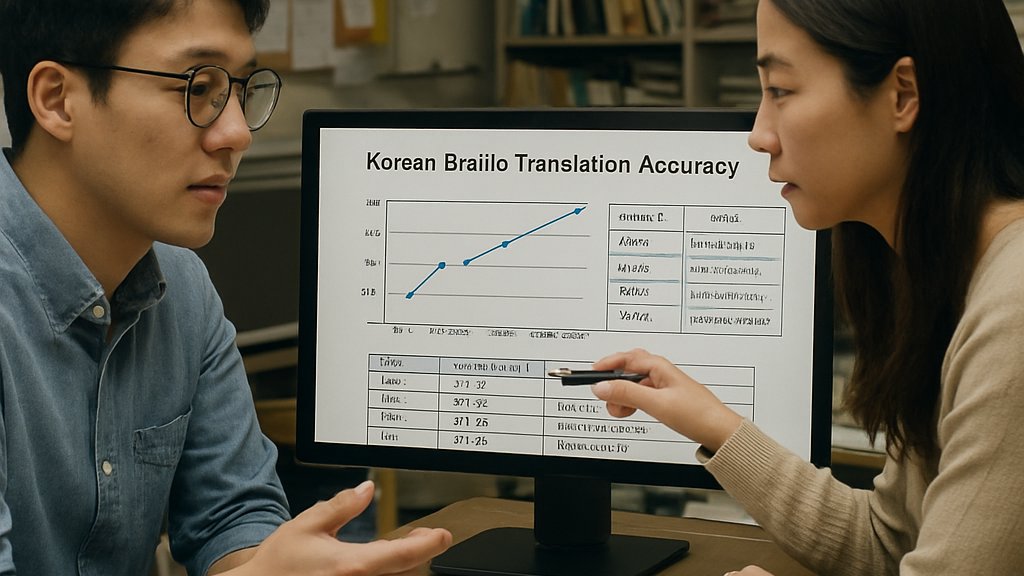
Firstly, the authors evaluated seven top proprietary models and one open-source baseline. GPT-5 variants, Gemini-3-pro, Claude Opus 4.5, GPT-4, and HCX-3 all faltered. Five controlled prompts produced consistent refusals or nonsensical Braille strings. In contrast, the rule-based Liblouis system delivered usable though imperfect output. However, the fine-tuned BT5 system outperformed every competitor by wide margins. The researchers used the NIKL Korean Braille Parallel Corpus, spanning 126,693 sentence pairs. Consequently, BT5 reached a SacreBLEU score of 95.79 for Braille translation. These numbers dwarf the Liblouis 71.94 baseline and the near-zero LLM averages.
Meanwhile, back-translation metrics showed similar dominance, with BT5 achieving ROUGE-L 0.9859. Such evidence establishes a reproducible benchmark for future AI Accessibility Research. Human evaluators confirmed that every refusal directly blocked study reading assignments for blind participants. Such user-level effects translate research metrics into lived accessibility barriers. Overall, the dataset exposes stark capability gaps. Yet the statistics alone never explain why the gaps exist, so root causes demand inspection.
Metrics Underscore Model Failures
Quantitative results illuminate critical model limitations that threaten production accessibility workflows. Furthermore, refusal rates reached 100% on several tasks, blocking automated pipelines entirely. Hallucination episodes also surfaced, where plausible-looking Braille contained silent contraction errors. Therefore, blind readers would encounter unreadable or misleading passages without warning. Authors argue that such silent faults represent higher safety risk than explicit refusals. Moreover, token-level Character Error Rates showed orders-of-magnitude differences: 0.0043 for BT5 versus 0.0568 for Liblouis. Consequently, small numeric deltas compound into thousands of corrupted Braille cells across textbooks.
These metrics remind teams that scale amplifies error impact. Robust monitoring and sampling must back any accessible deployment. Thus, success hinges on more than flashy demo accuracy claims. Academic AI Accessibility Research consistently links such failure modes with training data bias. Researchers visualised error heat maps showing dense clusters around contracted particles. These visualisations help developers localise failure hotspots within generated Braille strings. In summary, numbers reveal systemic weaknesses, not isolated glitches. The next section examines why popular architectures stumble so badly.
Root Causes Behind Failures
At the architecture level, two factors dominate performance. Firstly, mainstream tokenizers never include Unicode Braille patterns. Consequently, models treat each Braille cell as an unknown symbol, degrading context windows instantly. Secondly, pretraining corpora rarely show any Braille, leaving the networks semantically clueless. Therefore, even instruction-tuned chat models resort to blanket refusals when confronted with unfamiliar glyphs. In contrast, BT5 saw thousands of parallel examples during supervised fine-tuning, aligning tokens and semantics. Moreover, contracted Grade-2 rules are deterministic, so exposure quickly drives accurate mappings.
Authors also cite prompt rejection policies that guard proprietary assets against perceived copyright risk. These guardrails accidentally silence accessible content generation. Recent AI Accessibility Research echoes similar tokenizer problems in chemistry and programming domains. Hardware considerations also matter because embossers require perfectly ordered Unicode code points. Even minuscule alignment drift forces expensive reprints or manual corrections.
Tokenization Gaps Explained Clearly
Tokenization gaps create cascading issues well beyond unknown symbol penalties. Additionally, they break alignment during beam search, worsening hallucinations. Therefore, surface-level prompt tweaks rarely fix the underlying mismatch. Researchers recommend Braille-aware tokenizers or rule-assisted preprocessing to stabilise sequence mapping. Nevertheless, commercial vendors have not yet prioritised these ergonomic improvements. Root cause insights clarify why naive scaling fails. With problems mapped, we can assess promising remediation techniques.
Fine-Tuning Shows Clear Promise
Supervised fine-tuning transformed a lightweight T5-small into the top performer. BT5 required only 101,354 training pairs and standard hyperparameters. Furthermore, training ran on a single consumer GPU in two hours. Cost profiles therefore fit many enterprise research budgets. Subsequently, the model generalised across unseen validation sentences with minimal degradation. Moreover, authors propose hybrid pipelines that combine rule-based preprocessing with Braille-aware language models. Industry-led AI Accessibility Research validates these gains across multiple low-resource scripts.
Pilot deployments already rely on the improved Braille translation accuracy to update digital libraries. BT5’s training consumed less than three kilowatt-hours, lowering carbon footprints. Energy efficiency resonates strongly with sustainability mandates across public procurement.
Hybrid Pipeline Approach Benefits
Hybrid designs allow deterministic conversions for simple patterns and neural decoding for edge cases. Consequently, error distributions shift from catastrophic to correctable. Business teams gain both scalability and auditability within assistive technology stacks. Moreover, human Braille experts can focus reviews on low-confidence spans flagged by confidence scores. Fine-tuning and hybridisation clearly outperform brute-force scaling. The discussion now turns to commercial and policy ramifications.
Business And Policy Impacts
Missed accessibility targets carry legal, reputational, and revenue consequences. Regulators increasingly mandate equal information access under laws like Korea’s Disability Act. Therefore, defective Braille translation may trigger compliance investigations and penalties. Ongoing AI Accessibility Research warns that regulators will soon demand machine-readable conformance reports. In enterprise contexts, broken conversions also sink employee productivity and brand trust. Conversely, inclusive AI investments unlock new customer segments and public funding opportunities. Moreover, research leadership strengthens corporate ESG reporting, pleasing investors.
Professionals can deepen domain skills through industry certifications. For example, the AI+ Everyone™ certification covers ethics, testing, and accessible design principles. Consequently, graduates can steer roadmap discussions with authoritative knowledge. Investors now include digital inclusion metrics within environmental, social, and governance scorecards. Consequently, proactive disclosure can improve capital access and insurance terms. In short, accessibility pays tangible dividends. Next, we explore practical guidelines for engineering teams.
Next Steps For Teams
Start with a baseline audit against representative Braille datasets. Additionally, include both automatic metrics and manual Braille reader reviews. Researchers suggest tracking SacreBLEU, ChrF++, CER, and human comprehension scores. Subsequently, fine-tune or retrain models using domain-specific corpora, mirroring the BT5 recipe. Moreover, integrate rule-based engines like Liblouis as preprocessing or fallback modules. Implement confidence thresholds that route low-certainty spans to human editors.
In contrast, high-confidence segments can flow directly into production deployments. Finally, document accessibility KPIs within governance dashboards and quarterly disclosures. Inclusive AI roadmaps must reserve capacity for periodic Braille regression tests. Internal AI Accessibility Research teams should document experiments and publish reproducible notebooks. Teams should also simulate worst-case degradations during outage rehearsals. Regulated sectors must preserve logs for at least five years to support audits. The following quick checklist supports disciplined rollouts:
- Gather a balanced Korean Braille corpus for internal benchmarking.
- Automate SacreBLEU and CER scoring in continuous integration pipelines.
- Set refusal and hallucination alert thresholds before launch.
- Schedule quarterly reviews with certified blind consultants.
- Update documentation whenever models or Braille translation rules change.
- Publish quarterly AI Accessibility Research findings to executive leadership.
These practices institutionalise accessibility rather than treating it as a heroic fix. Consequently, teams stay ahead of evolving policy and market expectations. Consistent process converts research insight into everyday operational quality. The conclusion now synthesises all major insights.
This investigation shows that scale alone cannot guarantee accessibility. However, targeted fine-tuning and hybrid pipelines deliver dramatic performance lifts. Moreover, quantitative metrics and human audits must co-exist for safety-critical content. Enterprises that embrace these principles will avoid legal pitfalls and capture new audiences through inclusive AI. Therefore, the lessons from Korean Braille generalise to many languages and modalities. Ultimately, AI Accessibility Research remains essential for trustworthy assistive technology.
We encourage readers to pursue the AI+ Everyone™ certification and champion accessible innovation internally. Meanwhile, community feedback loops ensure continuous improvement without relying solely on vendor updates. Act today and lead tomorrow’s equitable digital landscape.
Disclaimer: Some content may be AI-generated or assisted and is provided ‘as is’ for informational purposes only, without warranties of accuracy or completeness, and does not imply endorsement or affiliation.


