

AI CERTS
3 hours ago
Elder Care Robots Gain Trust Through Gentle Humanoid Touch
However, adoption still depends on evidence, ethics, and clinician trust. This article distills the findings, market context, and practical takeaways. Additionally, readers will learn certification routes to strengthen interdisciplinary skills. Every section meets strict technical and journalistic standards for clarity. In contrast to hype, we anchor discussion in peer-reviewed data. Therefore, stakeholders can plan deployments with confidence and accountability.
Global Market Drivers Surge
Global longevity trends are relentless. WHO projects 2.1 billion people aged over 60 by 2050. Consequently, caregiver shortages are widening across continents. Assistive robotics promises capacity relief without replacing human compassion.
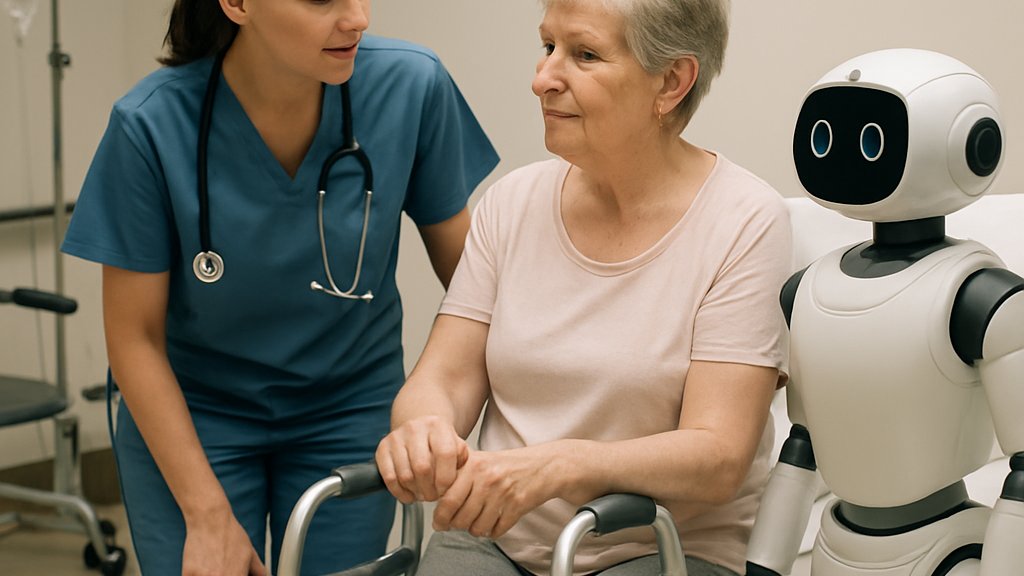
Market researchers value social and elder-focused robots at roughly USD 3-4 billion today. Moreover, compounded annual growth rates exceed 15 percent in several forecasts. Definitions vary; nevertheless, directional momentum appears strong.
Drivers include healthcare cost pressure, fall prevention programs, and smart-home integration policies. In contrast, reimbursement uncertainty and regulatory gaps temper immediate purchasing. Growing evidence around walking guidance performance may shift that balance.
Elder Care Robots therefore attract investment from startups and incumbents alike. PAL Robotics, Intuition Robotics, and SoftBank continue enhancing platforms for humanoid assistance. Additionally, hospital networks run pilot trials to quantify mobility outcomes.
Demand signals suggest sustained funding for research and deployment. However, technical validation remains essential before mass scaling, leading into the next section.
Latest Study Reveals Touch
July 2026 delivered a pivotal experiment on humanoid assistance. KIT and Heidelberg scientists recruited 24 older adults between 68 and 88. The team evaluated four walking guidance conditions using a TIAGo Pro robot.
Participants tested no contact, hand-holding, arm linking, and forearm rest modes. Median forces ranged from 1.2 N without contact to 14.3 N for forearm support. Moreover, gentle, stable touch boosted perceived safety and trust.
Key Statistics Snapshot Data
- Sample: 24 participants, ages 68-88.
- Trajectories: four ten-meter walks per condition.
- Highest median force: 14.3 N forearm contact.
- Heart rate change: 0.7 bpm average increase.
Physiological metrics painted a nuanced picture. Heart rate rose marginally, while heart-rate variability dipped during physical interaction. ScrAmplitudeMean increased significantly for some contact scenarios, indicating mild arousal.
Nevertheless, subjective comfort outweighed the small stress markers. Older adults accepted hand-holding and forearm support more than arm linking. Therefore, design guidance now favors those two modalities for Elder Care Robots.
The study confirms that contact quality matters more than contact presence alone. Subsequently, we examine how these insights influence practical design decisions.
Critical Design Lessons Learned
Engineers must translate laboratory numbers into everyday safeguards. Moreover, force limits should respect the 6-14 N envelope observed during trials. Tunable actuators can maintain gentle pressure under dynamic walking guidance.
- Profile users by sensory capacity, cognition, and attitude toward physical interaction.
- Offer contactless fallback modes to accommodate diverse older adults.
- Blend haptic, visual, and auditory cues for richer humanoid assistance.
- Log force, distance, and physiological data for continuous safety validation.
Furthermore, designers should include emergency release mechanisms and human override buttons. In contrast, purely autonomous decisions may erode clinician confidence.
Ethical framing also influences acceptance. Referring to robots as teammates rather than replacements reduces stigma among older adults.
These guidelines convert research into concrete product requirements. Consequently, attention now shifts to obstacles delaying scale adoption.
Implementation Hurdles Still Persist
Real-world care settings differ greatly from clean laboratories. Flooring irregularities, clutter, and unpredictable resident behavior complicate walking guidance. Moreover, long-term durability remains unproven for many assistive robotics platforms.
Data governance surfaces another barrier. Collecting physiology and location streams raises privacy, consent, and compliance concerns. Nevertheless, transparent policies can mitigate resistance from families and staff.
Reimbursement pathways for Elder Care Robots are still emerging. Consequently, providers hesitate to budget capital for humanoid assistance hardware. Pilot-based evidence of fall reduction could unlock insurance support.
Primary Benefits And Risks
- Benefit: Increased mobility confidence during physical interaction sessions.
- Benefit: Continuous monitoring of gait deviations.
- Risk: Small yet measurable stress signals in some users.
- Risk: Over-reliance may reduce human social contact.
The mixed picture urges cautious, evidence-led rollouts. Meanwhile, strategic roadmaps can steer institutions through uncertainty.
Strategic Roadmap For Deployment
Successful programs follow phased pilots before enterprise rollout. Initially, select residents receptive to assistive robotics and train staff. Additionally, involve occupational therapists to tailor walking guidance protocols.
Quantitative endpoints should include fall frequency, step symmetry, and user satisfaction. Weekly data reviews enable rapid parameter optimisation for physical interaction forces.
Legal teams must draft consent forms covering data collection, autonomy boundaries, and maintenance duties. Moreover, third-party certification can validate safety and cybersecurity claims. Professionals may upskill via the AI Nurse certification.
Elder Care Robots should integrate with electronic health records for seamless progress notes. Consequently, clinicians gain holistic views of mobility trends alongside vitals.
A structured roadmap reduces operational surprises during scale. Subsequently, attention turns to workforce competencies supporting daily robot care.
Essential Skills And Certifications
Care teams require interdisciplinary abilities spanning gerontology, robotics, and data ethics. Moreover, training must cover safe physical interaction and troubleshooting humanoid assistance. Simulation labs can reinforce confidence before real deployments with older adults.
Certification programs now address these gaps. The earlier mentioned AI Nurse credential teaches sensor basics, walking guidance configuration, and incident response.
Providers selecting Elder Care Robots should budget dedicated refresher hours annually. In contrast, ad-hoc learning risks inconsistent practice and elevated liability.
Skills investment protects users and assets alike. Therefore, capacity building remains as crucial as hardware acquisition.
The evidence base for Elder Care Robots keeps expanding across continents. Moreover, gentle touch strategies improve perceived safety and trust scores. Market analysts consequently anticipate wider procurement of Elder Care Robots once reimbursement crystallises. Designers must pair compact forces with adaptable walking guidance to sustain acceptance. Care teams equipped with certifications will operate Elder Care Robots confidently and ethically. Nevertheless, longitudinal trials remain vital to benchmark Elder Care Robots against human standards. Therefore, stakeholders should pilot, measure, and iterate before scaling nationally. Explore the referenced certification today and lead the next wave of compassionate innovation.
Disclaimer: Some content may be AI-generated or assisted and is provided ‘as is’ for informational purposes only, without warranties of accuracy or completeness, and does not imply endorsement or affiliation.


