

AI CERTS
3 hours ago
Aerial Robotics Control Drives Airflow-Aware Manipulator Redesign
Moreover, we detail market pressures, emerging hardware, compact models, and adaptive controllers driving rapid progress. The analysis draws on peer-reviewed papers published between 2025 and 2026 and on market data.
Readers will gain actionable insight for design, research, and procurement decisions. Meanwhile, professionals can benchmark innovations against regulatory and endurance constraints that still demand attention. In contrast, legacy platforms often ignored airflow interactions, risking unstable contact and damaged payloads. Therefore, an evidence-based perspective is essential before scaling prototypes to field operations.
Market Forces Driving Innovation
Global drone spending neared USD 83.8 billion in 2025, according to Grand View Research. Furthermore, projections suggest USD 96.4 billion in 2026, despite regulatory headwinds. Service providers now chase high-margin inspection and maintenance contracts that require precise physical interaction.
Therefore, aerial platforms must carry tools, sensors, or sample collectors without compromising flight time. Downwash, however, remains the dominant blocker for delicate contact with infrastructure. Researchers answered that challenge with airflow-focused Aerial Robotics Control prototypes during the last 12 months.
Investors also notice the trend. Moreover, venture rounds for robotic engineering startups increasingly highlight manipulation capacity as a differentiator. OEMs anticipate modular manipulators that clip onto existing frames, unlocking recurring revenue via accessory ecosystems.
- 30 May 2026: CFD-driven long-reach arm keeps end-effector flow below 1 m/s.
- 24 Sep 2025: Nature paper demonstrates sub-centimetre vertical docking between stacked drones.
- 10 Jul 2026: Cone-sphere model enables task-adaptive optimization accepted to IROS.
Consequently, procurement teams demand specifications that quantify airflow constraints rather than vague stability claims. Sustained investment signals confidence in Aerial Robotics Control as a growth driver. These market pressures underscore the need for transparent benchmarks and repeatable field metrics.
Market momentum rewards platforms that tame downwash while preserving endurance. However, turning that promise into hardware requires disciplined design strategies. The following section outlines those emerging strategies.
Core Airflow Design Strategies
Researchers converge on three complementary strategies for airflow mitigation. First, geometry alterations extend or tilt the manipulator away from the rotor core. Second, compact flow models integrate into optimization loops to guide early-stage drone design. Third, controllers adapt to changing payload inertia and residual turbulent forces.
Moreover, each strategy benefits from advances in sensors and onboard computing. Consequently, Aerial Robotics Control research now blends aerodynamics, software, and materials science. That integration paves the way for cooperative autonomous systems performing complex assemblies. The next subsections examine representative implementations.
Long Reach Arm Insights
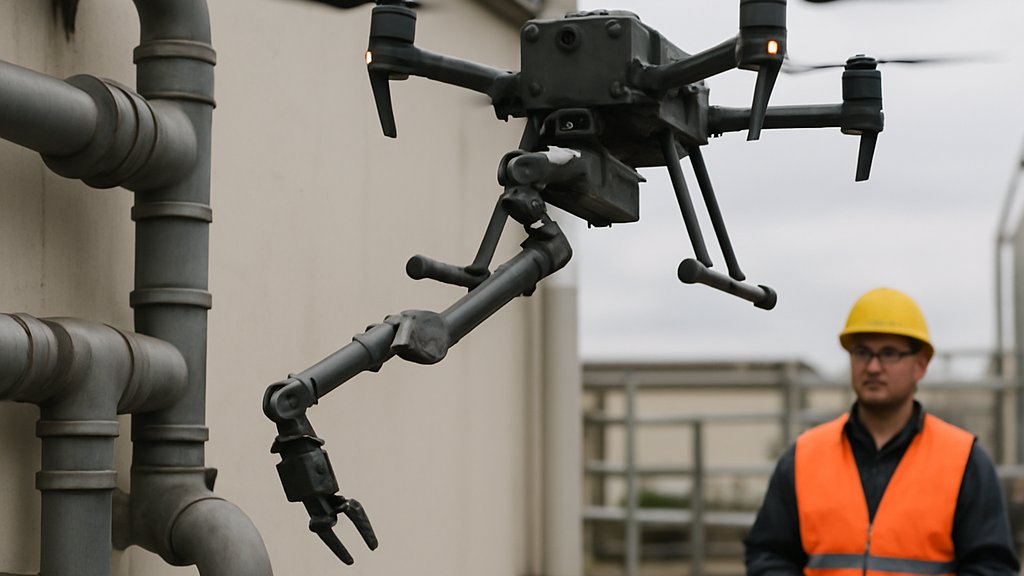
Jiang et al. designed a three-degree arm with interchangeable 0.40 m and 0.80 m links. CFD simulations ensured the end-effector avoided the high-momentum core. Flight tests measured sub-1 m/s airflow at the gripper, validating the model-based approach. Aerial Robotics Control principles guided kinematic choices and stabilizer placement.
Furthermore, the extended arm increased task envelope without large energy penalties. Nevertheless, added mass required refined motor sizing to maintain stable hover. This case illustrates how airflow constraints influence structural and propulsion choices.
Long reach geometry lowers flow disturbance at the cost of weight. Therefore, designers must balance length, mass, and mission profile. Optimization models address that balance, as the next subsection reveals.
Cone Sphere Model Optimization
Li and Koeppl introduced a cone-sphere envelope to approximate rotor downwash inside mixed-integer optimization. The model converts CFD into algebraic constraints solvable within minutes on a laptop. Consequently, the framework iterates through modular manipulators placements and multirotor geometry simultaneously. The study reinforces scalable Aerial Robotics Control by unifying design and constraint handling. Additionally, their work bridges aerodynamics and robotic engineering through formal optimization.
Experiments enforced user-defined 1 m/s exposure limits at the target surface. In contrast, naive layouts violated limits in more than fifty percent of sampled poses. Moreover, the optimizer proposed non-intuitive asymmetric arm positions that balanced thrust and airflow constraints.
Compact models accelerate early design decisions without heavy simulation costs. However, they trade fidelity for speed and require experimental calibration. Adaptive control approaches mitigate residual model error, as the next subsection details.
Adaptive Inertia Control Advances
Ye et al. tackled inertia variation that arises once a drone grasps tools or samples. Their FlyAware controller combines onboard vision with real-time parameter estimation. Consequently, thrust commands adjust within milliseconds, maintaining attitude even under shifting loads. Such responsiveness marks a milestone for closed-loop Aerial Robotics Control under dynamic payloads.
While the study focused on inertia, improved stability indirectly mitigates downwash-induced oscillations. Furthermore, coupling adaptive control with airflow constraints promises robust contact in turbulent environments. This synergy exemplifies the multidisciplinary nature of modern robotic engineering research.
Adaptive controllers compensate for uncertainties that geometry alone cannot eliminate. Therefore, holistic co-design is emerging as the default methodology. The next section examines remaining challenges before widespread deployment.
Remaining Key Technical Challenges
Despite progress, several hurdles persist. Accurate CFD remains computationally expensive for real-time planning. Moreover, long arms reduce battery endurance and strain joints during aggressive manoeuvres. Safety certification also lags because regulators lack standards for aerial contact actions.
Wider Aerial Robotics Control adoption also depends on harmonized safety standards and operator training. Inter-robot interactions add complexity when autonomous systems operate in close proximity. Meanwhile, data scarcity hampers benchmarking across labs and industries. Consequently, public datasets linking flow fields to task success are urgent.
- Sparse experimental flow maps for varied thrust settings
- Limited endurance with heavy modular manipulators payloads
- Fragmented safety regulations across jurisdictions
Nevertheless, collaboration among academia, industry, and standards bodies could accelerate solutions. Professionals can track evolving guidelines while investing in flexible drone design architectures.
Current challenges are surmountable with coordinated research and informed investment. Subsequently, commercial roadmaps are sharpening focus on modular, certifiable products. The conclusion now outlines those trajectories and actionable next steps.
Conclusion And Future Outlook
Airflow-aware manipulators moved from concept to flight-tested prototypes within one research cycle. Furthermore, market demand aligns with the technical maturity achieved so far. Aerial Robotics Control now integrates geometry, models, and adaptive software into cohesive platforms.
Key advances include long reach arms, cone-sphere optimization, and inertia-aware control. Moreover, each advance leverages modular manipulators that respect tight airflow constraints without sacrificing agility.
Nevertheless, endurance, regulation, and data access still challenge widespread industrial roll-out. Therefore, stakeholders should pilot systems in controlled environments while refining drone design for production.
Professionals can expand skills via the AI Engineer™ certification, supporting co-design of autonomous systems. Consequently, they remain competitive as airflow-aware drones transition from labs to infrastructure sites.
Continued interdisciplinary research will transform conceptual breakthroughs into reliable aerial workhorses. Stay informed, experiment responsibly, and help shape the next chapter of Aerial Robotics Control.
Disclaimer: Some content may be AI-generated or assisted and is provided ‘as is’ for informational purposes only, without warranties of accuracy or completeness, and does not imply endorsement or affiliation.


