

AI CERTS
2 hours ago
B-Spline Breakthroughs Propel Robot Manipulation AI Forward
Meanwhile, sceptics note open challenges around controller bandwidth and safety. Nevertheless, momentum is building across labs and start-ups worldwide. Therefore, understanding spline-based action representations becomes vital for technical leaders. The following sections deliver a concise, data-driven briefing. In contrast to marketing hype, all claims here cite peer-reviewed or archived sources. Consequently, you can separate signal from noise when planning deployment roadmaps. For investors, Robot Manipulation AI offers measurable gains.
Why Splines Matter Now
Traditional controllers sample joint commands at fixed timesteps. That design simplifies training but ignores the continuity of physical motion. Moreover, discrete waypoints create jerks that waste energy and risk wear.
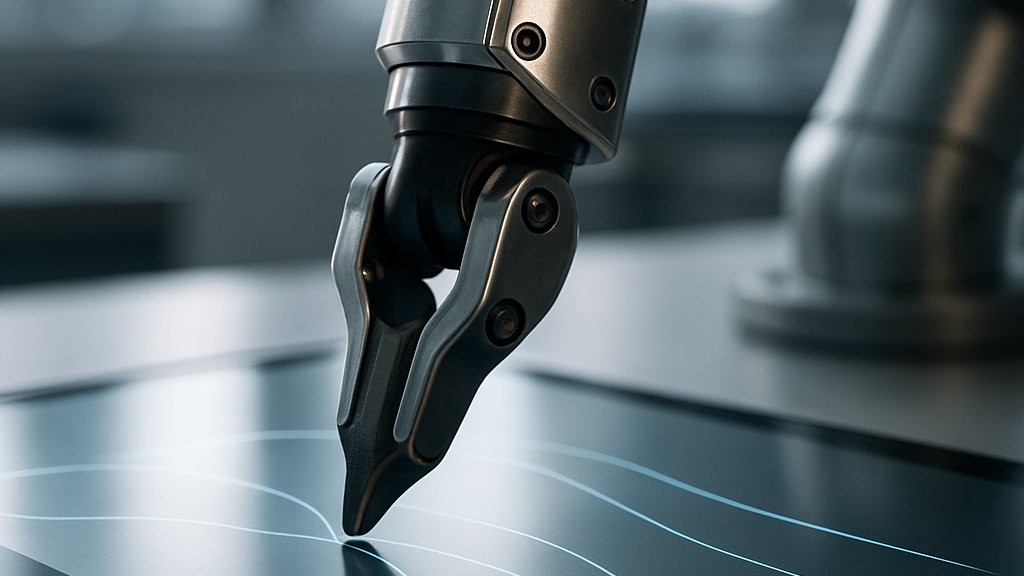
B-spline curves upgrade action representations from points to smooth polynomials. Consequently, robotic policies can exploit continuous derivatives for precise feedforward control. Researchers in embodied AI view this switch as a natural extension of motor primitives.
Additionally, temporal rescaling allows control acceleration without retraining the high-level network. A single spline segment can be sampled faster to finish a pick task sooner. Therefore, system architects gain a new throughput dial at inference time.
Splines thus merge mathematical elegance with pragmatic speedups for Robot Manipulation AI. The next section details which technical advances unlocked this leap.
Core Technical Advances Explained
Three 2026 papers define the emerging stack. B-spline Policy predicts fixed-length spline segments every camera frame. In contrast, ABPolicy fits bidirectional splines asynchronously for real-time updates.
BEAST tokenizes continuous control into compact spline codes for transformer decoders. Moreover, Spline Policy analyses uncertainty propagation and controller compatibility. These designs push Robot Manipulation AI closer to human dexterity.
Collectively, these works show that polynomial order, knot spacing, and refitting latency shape performance. Researchers also report that GPU cost rises modestly, often below 5%.
Consequently, manipulation learning pipelines can import splines with minimal retraining. Meanwhile, control acceleration emerges because fewer network steps are required per second. However, extreme scaling still challenges low-level torque controllers.
Splines tokens also compress action representations for transformers. Technical breakthroughs reduce integration friction while boosting responsiveness. Next, we inspect quantitative benchmarks to ground the discussion.
Benchmark Results Highlight Speed
For evaluators of Robot Manipulation AI, numbers matter. Real-robot demos offer concrete evidence. BSP cut cube-picking time from 6.48 seconds to 3.43 seconds. Similarly, microwave closing success jumped from 77% to 89% in simulation.
- Cube picking: 47% faster, equal success.
- Microwave closing: 12% higher success, quicker finish.
- Door closing: 70% relative success gain.
- Stacking: 25% smoother motions recorded.
Additionally, ABPolicy lowered velocity zero-crossing by 29.2%, signalling smoother control acceleration. Success in a static stacking task rose from 60% to 85% after bidirectional refitting. Nevertheless, aggressive 4× speedups occasionally breached actuator limits, dropping reliability.
Across tasks, spline policies maintain or exceed baseline success while halving execution time. These numbers motivate deeper analysis of business benefits.
Benefits For Industry Teams
Factory managers adopting Robot Manipulation AI care about ROI. Manufacturers chase throughput, uptime, and maintenance savings. Spline-based robotic policies tick every box by reducing cycle duration and actuator stress. Moreover, smoother motion lowers noise, pleasing nearby human operators in embodied AI settings.
- Lower jerk extends joint lifespan.
- Shorter cycles raise hourly throughput.
- Smoother motion improves human trust.
- Unified splines simplify code maintenance.
Adopting spline action representations also simplifies cross-task transfer. Consequently, manipulation learning engineers can reuse a single network for stacking, wiping, and opening. Therefore, data efficiency improves, shrinking annotation budgets.
Teams can upskill with the AI Robotics Professional™ certification. Overall, spline adoption aligns technical gains with hard cost savings. Yet, leaders must weigh residual risks, discussed next.
Ongoing Limits And Risks
Safety remains paramount in Robot Manipulation AI deployments. Not every robot tolerates abrupt control acceleration. Low-level torque loops may saturate when splines are sampled four times faster. Moreover, segment misalignment can produce unexpected end-effector spikes.
Debugging becomes harder because spline action representations hide individual waypoints. Consequently, robotic policies require extra logging for post-mortem analysis. In contrast, traditional chunk outputs are simpler to visualize.
Researchers still lack peer-reviewed studies on long-term wear under spline schedules. Additionally, safety under adversarial contacts remains underexplored. Nevertheless, public repos provide fertile ground for community validation.
Current drawbacks center on hardware constraints and debugging complexity. Subsequently, we explore the future roadmap and talent implications.
Roadmap And Career Impact
Career trajectories in Robot Manipulation AI will mirror the technology's curve. Next conferences will likely crown splines as default for manipulation learning. NeurIPS and ICRA workshops already schedule dedicated spline tutorials for embodied AI researchers. Meanwhile, vendors prepare firmware updates to expose higher-rate control channels.
Standardization bodies may define safe limits for online control acceleration. Moreover, robotic policies may soon advertise compliance labels, easing procurement. Therefore, early adopters can influence those guidelines by sharing field data.
Professionals with spline expertise will command premium salaries. Consequently, pursuing accredited training now delivers strategic advantage.
The roadmap shows clear momentum toward mainstream adoption. Finally, we summarise key lessons and actions.
Key Takeaways And Outlook
B-spline curves redefine Robot Manipulation AI by merging speed and smoothness. Recent papers prove that spline action representations halve cycle time without hurting success. Benchmarks across eight household and industrial tasks confirm the pattern. However, aggressive control acceleration can overload actuators and complicate debugging. Nevertheless, public code, thriving forums, and new certifications lower adoption friction. Therefore, leaders should pilot spline robotic policies on restricted workcells, measure latency, then scale. Explore the linked certification today to future-proof your career. Stay tuned as Robot Manipulation AI evolves at spline speed.
Disclaimer: Some content may be AI-generated or assisted and is provided ‘as is’ for informational purposes only, without warranties of accuracy or completeness, and does not imply endorsement or affiliation.


