

AI CERTS
2 hours ago
DexRobot’s Robot Teleoperation Platform Reshapes Manipulation
Meanwhile, the company positions the stack as a bridge toward robust embodied AI across industries. This article unpacks the announcement, product details, competitive context, and remaining questions.
Market Demands Intensify Rapidly
Global automation spend keeps rising as labor shortages strain fulfillment centers. However, delicate picking tasks still challenge rigid grippers. Enter dexterous hands, which promise human-level versatility. Yet training them requires realistic contact data and fast iteration.
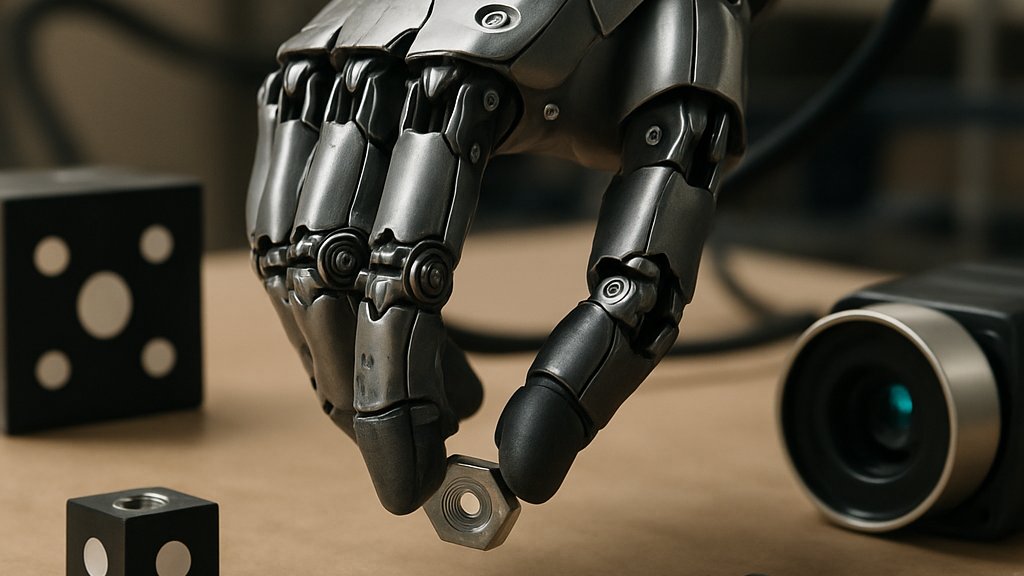
Researchers agree teleoperation remains the most reliable path for gathering high-quality demonstrations. Furthermore, synchronized sensors reduce annotation overhead during data acquisition workflows. But teams often juggle mismatched cameras, driver code, and calibration scripts.
Therefore, an integrated Robot Teleoperation Platform can compress timelines and lower project risk. These market pressures set the stage. In contrast, fragmented tools have slowed innovation until now.
Demand is clear and immediate. Consequently, DexRobot designed a turnkey response that merits close inspection.
DexRobot Launch Key Details
DexTele premiered on the Chicago show floor during Automate 2026, drawing dense booth traffic. Attendees steered mounted DexHand021 Pro fingers through complex puzzles in real time. Latency appeared sub-100 milliseconds on the demo video wall. Nevertheless, independent labs have not yet verified those numbers. The on-site demonstration showcased the Robot Teleoperation Platform running across two network segments.
DexRobot markets three dexterous hands covering research and industrial price points. The flagship Pro variant offers 22 degrees of freedom and lifts 50 newtons. Moreover, durability testing claims exceed 300,000 cycles.
DexCap, a wearable exoskeleton, tracks 65 joint angles with millimeter accuracy. Additionally, its battery runs up to twelve hours, ensuring continuous data acquisition shifts. Wireless streaming reaches 200 hertz, while tethered mode yields 1000 hertz.
These specifications illustrate robust engineering. Now, the wider strategy connects each component into a cohesive pipeline leading to embodied AI gains.
Hardware Plus Data Strategy
Instead of selling parts, DexRobot bundles hardware, dataset, and tooling. Consequently, the offering resembles a full-stack cloud paradigm, but for robots. Teams secure dexterous hands, a teleoperation rig, and a managed repository through one vendor.
Crucially, the Robot Teleoperation Platform logs multimodal streams in an aligned schema. Subsequently, engineers can export trajectories directly into simulation for domain randomization. Therefore, less time is wasted on format wrangling.
DexRobot also promotes the AI Robotics certification to accelerate adoption. Professionals can enhance their expertise with the AI Robotics™ certification.
An integrated stack simplifies deployment. However, dataset quality ultimately determines real performance, as the next section explains.
Dataset Impacts Global Research
DexCanvas currently ships a 1% preview containing 30 million frames. Moreover, the hybrid real-to-sim pipeline provides physics-validated force annotations. Researchers label this design a milestone for embodied AI replication.
Key advantages include broad skill coverage and consistent contact signals. Nevertheless, v0.1 spans only 0.7 recorded hours, leaving scale questions. Full release promises 7,000 hours seeded from 70 real hours. Researchers will soon test the Robot Teleoperation Platform against these larger corpora.
SmartLoadingHub analysts predict benchmarks will quickly adopt the corpus. In contrast, competing labs still train on smaller simulated sets.
The dataset could catalyze cross-institution collaboration. Subsequently, competitive pressures already intensify across the teleoperation market.
Competitive Landscape Overview Today
Operant, Proxy Robotics, and Viam each advertise low-latency streaming stacks. However, none ship proprietary dexterous hands yet. Consequently, DexRobot holds a vertical integration edge. Automate 2026 exhibitors exchanged specification sheets on the floor.
Proxy Robotics claims sub-80 millisecond remote control across oceans. Meanwhile, Operant specializes in custom data acquisition services. Viam focuses on open source tooling. Customers compare each Robot Teleoperation Platform on latency, format support, and service levels.
- Operant: Service model, flexible hardware, pay-per-hour teleoperators.
- Proxy Robotics: Cloud forge, global relays, enterprise SLA.
- Viam: Modular SDK, community drivers, self-hosted options.
- DexRobot: Integrated Robot Teleoperation Platform with dataset bundling.
Each player tackles latency, tooling, and scale differently. Therefore, buyers must match offerings to workload needs before signing contracts.
Challenges And Open Questions
Large-scale human teleoperation remains expensive and tiring. Nevertheless, wearable ergonomics continue improving. Action space mismatch between operators and robots still jeopardizes policy transfer.
Researchers also worry about cross-robot generalization within embodied AI models. Moreover, independent verification of DexTele latency has not surfaced. Pricing details remain confidential. Independent labs plan to profile the Robot Teleoperation Platform under load.
Consequently, early adopters should demand service level agreements and transparent benchmarks. Professionals can document results to inform the broader community.
Answering these concerns will influence adoption curves. Future outlook suggests rapid iteration after field feedback.
Future Outlook And Actions
Industry momentum favors tightly integrated solutions. Meanwhile, Automate 2026 demonstrated surging interest from logistics, medical, and food companies. DexRobot plans additional software updates, according to statements.
Stakeholders should monitor final DexCanvas release timing and audit toolchain documentation. Additionally, cross-vendor benchmarking events could clarify performance deltas.
Consequently, teams evaluating a Robot Teleoperation Platform must balance innovation goals against current uncertainties. Proper evaluation frameworks will de-risk deployments.
The coming year will reveal whether integrated stacks dominate. Nevertheless, proactive planning positions teams for swift progress.
DexRobot's integrated stack unites hardware, software, and dataset management in one coherent Robot Teleoperation Platform. Consequently, teams gain faster prototyping, rigorous force data, and streamlined deployment. Nevertheless, independent latency benchmarks, pricing transparency, and cross-robot transfer studies remain urgent. Automate 2026 excitement suggests market appetite, yet real proof will emerge from pilot programs. Therefore, professionals should monitor DexCanvas expansion and request public dashboards before committing budgets. Meanwhile, enhancing skills through the AI Robotics™ certification can prepare engineers for upcoming teleoperation demand. Act now, explore certifications, and position your team at the forefront of embodied AI adoption.
Disclaimer: Some content may be AI-generated or assisted and is provided ‘as is’ for informational purposes only, without warranties of accuracy or completeness, and does not imply endorsement or affiliation.


