

AI CERTS
3 hours ago
Los Alamos bets on Agentic Science Computing
However, the announcement also marks a shift in how scientific simulation and supercomputing infrastructure intertwine. Consequently, policy makers and architects need clear insight into the hardware, benchmarks, and governance implications. This report unpacks the technical details, early performance numbers, and strategic considerations. Moreover, it offers guidance for leaders tracking emerging national lab procurement trends. Finally, professionals can upskill through the AI+ Quantum Research™ certification to engage with these advances.
LANL Bets On Vera
Los Alamos selected Vera CPUs after a competitive evaluation spanning twelve months. Additionally, the lab cited close coupling between CPU and GPU memory as decisive. Consequently, 2,300 standalone Vera CPUs will anchor the Mission system, while Veritas deploys roughly 1,150. Vision mixes CPU and GPU nodes to stress integrated AI and scientific simulation workflows.
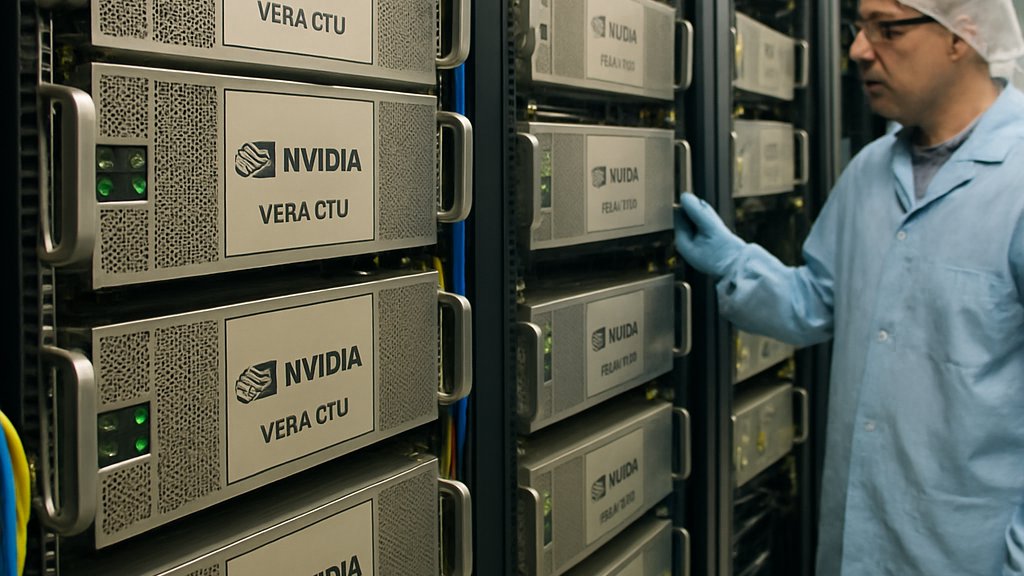
In contrast, previous procurements relied on general-purpose x86 silicon with external interconnects. Therefore, engineers viewed Vera Rubin as purpose built for Agentic Science Computing. The design minimizes latency for dynamic tool calls generated by URSA agents. Meanwhile, NVIDIA markets each rack at seven exaflops of AI throughput and five petaflops FP64.
LANL’s gamble centers on specialized silicon married to agent frameworks. However, deeper understanding of agentic workflows clarifies this choice.
Agentic Workflows In Depth
Agentic workflows pair large language models with domain tools to close the loop on discovery. Moreover, planners generate hypotheses, select solvers, launch runs, and ingest results autonomously. URSA, developed at Los Alamos, exemplifies this pattern. It decomposes tasks into isolated sandboxes, guarding sensitive codes.
Agent loops demand rapid context switching and thousands of concurrent processes. Consequently, high thread counts and massive memory footprint prove vital. For that reason, the Vera CPU integrates 88 Olympus cores and up to 1.5 terabytes of memory. Furthermore, NVLink-C2C sustains 1.8 terabytes per second of coherent bandwidth.
Agentic Science Computing thrives when orchestration overhead stays low. Therefore, co-design across CPU, GPU, and network removes traditional bottlenecks.
These workflow traits illuminate hardware priorities. Subsequently, we review the platform specifications that meet them.
Hardware That Enables Breakthroughs
The Vera CPU forms the orchestration tier for agentic tasks. Meanwhile, Rubin GPUs handle heavy tensor and scientific simulation calculations. Each NVL72 tray couples 18 Vera CPUs with 72 Rubin GPUs through NVLink-6. Moreover, one rack promises seven exaflops of mixed-precision AI.
In contrast, the Vera CPU rack focuses on control flow density. Up to 256 liquid-cooled CPUs deliver more than 22,500 concurrent environments. Consequently, labs can spawn massive agent swarms driving autonomous research campaigns. Power efficiency remains unverified, yet NVIDIA claims favorable metrics against prior supercomputing nodes.
Agentic Science Computing benefits when simulation and reasoning share memory space. Therefore, unified LPDDR5X pools cut copy overhead between domains.
These figures sound impressive on paper. However, benchmark evidence determines real impact.
Benchmark Claims And Caveats
Early LANL micro-benchmarks highlight performance gains. For URSA agent workloads, Vera reportedly delivers seven times throughput versus Crossroads’ x86 CPUs. Additionally, a Monte Carlo heat-transfer code sees over threefold improvement. Nevertheless, these numbers originate from vendor-guided tests.
Reproducibility across full scientific simulation suites remains uncertain. Moreover, workload diversity inside supercomputing centers complicates validation. Independent labs must measure energy, cost, and wall-clock time under production conditions. Consequently, transparent benchmark suites are essential.
Verified results will dictate Agentic Science Computing adoption pace.
- URSA agent throughput: 7× vs. Crossroads CPUs
- Branson Monte Carlo: 3× speedup
- Per rack AI compute: ~7 exaflops NVFP4
- Per rack FP64: ~5 petaflops
- Concurrent CPU environments: >22,500
In contrast, site-specific codes may expose scaling limits.
Benchmark scrutiny will shape procurement confidence. Subsequently, governance and policy aspects deserve equal attention.
Governance And Procurement Questions
Large scale autonomous research introduces fresh oversight challenges. Identity management, sandboxing, and audit trails must evolve. Furthermore, national security projects at Los Alamos carry heightened compliance demands.
Vendor concentration also troubles procurement officers. Moreover, Agentic Science Computing currently ties tightly to a single supplier stack. In contrast, open standards could reduce lock-in risk across supercomputing communities.
Policy teams therefore seek diversification strategies, including CPU heterogeneity and cloud bursting options. Additionally, they weigh intellectual property restrictions on firmware and interconnects.
Governance conversations will grow alongside deployment scale. Consequently, strategic takeaways guide executive actions next.
Strategic Takeaways For Leaders
Decision makers need a balanced scorecard covering performance, cost, and sovereignty. Agentic Science Computing promises faster discovery cycles and tighter AI-HPC integration. However, buyers must validate claims on representative scientific simulation workloads. Simultaneously, they must address autonomous research governance before production deployment.
Consider these immediate action items. First, request independent benchmark access within your supercomputing environment. Second, engage legal teams on agent permissioning and data lineage. Third, develop staff skills through specialized credentials.
- Benchmark on URSA or equivalent agents
- Model total cost over system life
- Draft vendor exit strategies
- Pursue the AI+ Quantum Research™ certification for talent growth
Moreover, partnerships with Los Alamos and HPE provide insight into real-world tuning. Therefore, early adopters will shape the emerging Agentic Science Computing ecosystem.
These steps create informed procurement paths. Subsequently, we conclude with final reflections.
The Vera Rubin launch signals a broader pivot in research infrastructure. Consequently, laboratories worldwide evaluate purpose-built racks that unify AI reasoning and physics modeling. Agentic Science Computing will reduce experiment iteration time and deepen cross-disciplinary collaboration. However, stakeholders must insist on transparent benchmarks and robust safety guardrails. Furthermore, vendor diversification strategies will protect long-term budget flexibility. Professionals eager to contribute should acquire advanced skills. They can start by earning the AI+ Quantum Research™ certification. Ultimately, careful execution will transform Agentic Science Computing into a dependable engine for discovery.
Disclaimer: Some content may be AI-generated or assisted and is provided ‘as is’ for informational purposes only, without warranties of accuracy or completeness, and does not imply endorsement or affiliation.


