

AI CERTS
24 minutes ago
XPONENTIAL 2026 signals industrial autonomy shift
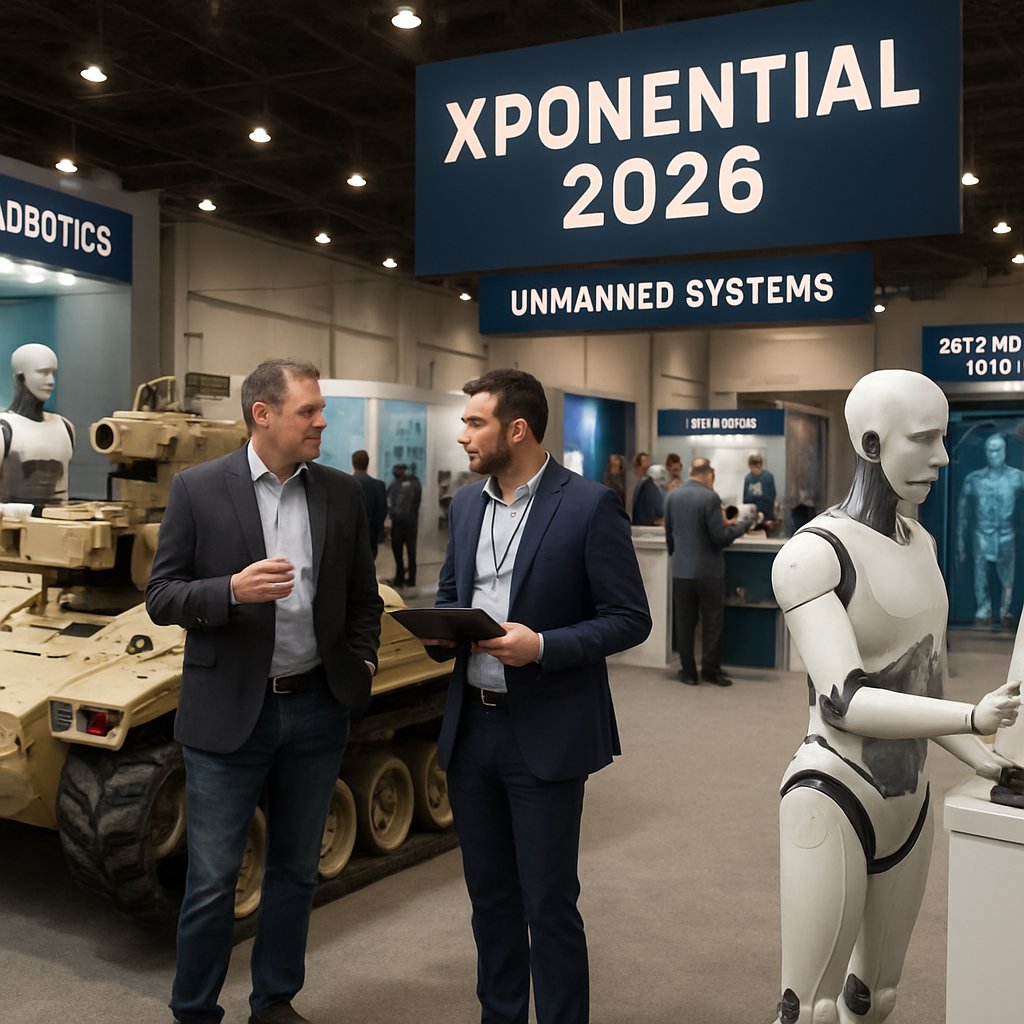
Detroit Robotics Showcase Highlights
Organizers projected more than 10,000 attendees and 550 exhibitors. In contrast, the prospectus cited 7,500 professionals and 100,000 square feet of booths. Nevertheless, both sources agreed on more than 100 technical sessions.
Keynotes featured author Dr. Chris Miller on semiconductor supply resilience and MIT’s Dr. Kate Darling on human-robot interaction. Furthermore, Arthur Herman interviewed Assistant Secretary Michael Cadenazzi regarding industrial base policy.
- 10,000+ attendees (AUVSI estimate)
- 550+ exhibitors across air, ground, maritime domains
- 150+ educational sessions in total
- 3,000 additional defense stakeholders via MDEX
These figures underscored soaring interest. Therefore, XPONENTIAL 2026 captured unprecedented scale for robotics events. The numbers also set expectations for sharp competition among unmanned innovators.
Such momentum demands proof of operational readiness. Hence, the next section examines how demonstrations turned into deployment commitments.
From Demo To Deployment
Exhibitors shifted messaging from concept videos to deliverable timelines. For example, HP displayed Multi Jet Fusion parts enabling lightweight drone airframes. François Minec said the process “transforms drone manufacturing.”
Similarly, Honeywell, u-blox, and Amprius revealed production contracts supporting beyond-visual-line-of-sight logistics. Moreover, supply-chain sessions highlighted additive manufacturing and advanced materials hubs near Detroit.
Consequently, buyers arrived with procurement checklists instead of curiosity tours. Several primes scheduled closed-door evaluations during XPONENTIAL 2026 to accelerate vendor selection.
These deployment moves marked a cultural shift. However, defense integration amplified that urgency, as explored next.
Defense Convergence Spotlighting Tech
The co-located Michigan Defense Expo added more than 3,000 uniformed and civilian officials. Additionally, the Defense Innovation Unit’s Travis Metz led a forum on rapid acquisition pathways.
Live demonstrations included a U.S. Army unmanned marketplace and a GNSS jamming scenario showcasing resilient navigation. Meanwhile, counter-UAS vendors displayed layered detection grids suitable for contested bases.
Interoperability remained a constant theme. Therefore, XPONENTIAL 2026 became a testbed where robotics suppliers aligned with defense open-architecture mandates.
These sessions clarified procurement criteria. Subsequently, regulatory conversations took center stage.
Regulation Shapes Future Skies
FAA officials briefed progress on BVLOS rulemaking and UTM pilots. Moreover, panelists debated data-sharing models that balance safety and operator privacy.
Energy companies argued that consistent BVLOS approvals could unlock nationwide inspection networks. In contrast, public-safety chiefs requested clearer airspace priority rules for emergency drones.
Unmanned cargo operators felt optimistic after hearing timelines for remote-ID harmonization. Consequently, several start-ups updated investors during XPONENTIAL 2026 about anticipated certification milestones.
Policy clarity drives investment confidence. Next, attention turned to factories able to meet scaled demand.
Manufacturing Supply Chain Scale
Detroit offered immediate access to automotive grade suppliers. Furthermore, sessions on secure sourcing addressed recent semiconductor shortages and geopolitical risks.
Volvo, John Deere, and GE Aerospace outlined joint ventures leveraging local skilled labor for robotics assembly. Additionally, additive manufacturing pavilions showed on-demand part replacement lowering downtime.
Professionals can enhance their expertise with the AI + Robotics™ certification. Consequently, project leads gain standardized methods for scaling autonomous fleets.
Manufacturing insights solved part of the equation. However, human factors demanded equal focus.
Human Robot Collaboration Ethics
Dr. Kate Darling emphasized empathy driven design in mixed teams. Meanwhile, workforce panels discussed reskilling programs for legacy line workers.
Vision systems that communicate intent through lights and sound received strong interest. Moreover, ethicists warned that unclear cues could erode public trust in robotics.
Nevertheless, structured training reduces adoption friction. Therefore, attendee feedback suggested that XPONENTIAL 2026 advanced both technical and social readiness.
Those multidisciplinary lessons feed the final outlook.
Key Takeaways Outlook Ahead
XPONENTIAL 2026 proved that scale, not novelty, now defines market leadership. Defense participation injected urgency and funding. Regulatory updates provided clearer roadmaps for unmanned expansion. Detroit’s industrial base offered practical manufacturing blueprints. Human-centric design kept vision aligned with public acceptance.
The industry must sustain collaboration to meet production targets. Subsequently, organizers promised deeper vertical tracks for next year.
These insights summarize the event’s strategic impact. Consequently, readers should position teams for emerging procurement cycles.
Industry momentum will not slow. Therefore, explore advanced learning paths and secure an AI + Robotics™ certification to lead the deployments sparked by XPONENTIAL 2026.
Disclaimer: Some content may be AI-generated or assisted and is provided ‘as is’ for informational purposes only, without warranties of accuracy or completeness, and does not imply endorsement or affiliation.


