

AI CERTS
9 minutes ago
Chinese Humanoids Smash Half-Marathon Records in Beijing
This article unpacks the race, the technology, and the commercial stakes. Furthermore, we examine expert doubts and future milestones. Stay with us to learn how Chinese Humanoids may redefine high-speed running robots. Historically, humanoid marathons emerged in 2025 as research showcases rather than spectator sports. Consequently, year-on-year progress is easy to quantify against fixed distance benchmarks. Analysts now treat the event as a proxy for China’s embodied AI ambitions. Therefore, understanding the stakes matters for engineers, investors, and policymakers alike.
Fast Beijing Race Overview
Beijing Economic-Technological Development Area hosted parallel human and robot fields on a closed 21.0975-kilometre loop. However, spectators focused on the dedicated Humanoid category featuring 102 entries from universities and companies. Weather conditions were mild, with 14-degree temperatures and negligible wind. Organisers deployed ground markers every 100 metres for optical navigation calibration. Meanwhile, volunteer crews cleared debris to prevent tripping hazards for delicate actuators.
Organisers split competitors into autonomous and remote-controlled classes. Moreover, they applied different scoring coefficients to reward full autonomy. Finishing times were then adjusted before official medals were assigned. The structure set the stage for historic speed milestones. Consequently, our next section examines the fastest machine on course.
Lightning's Historic Net Time
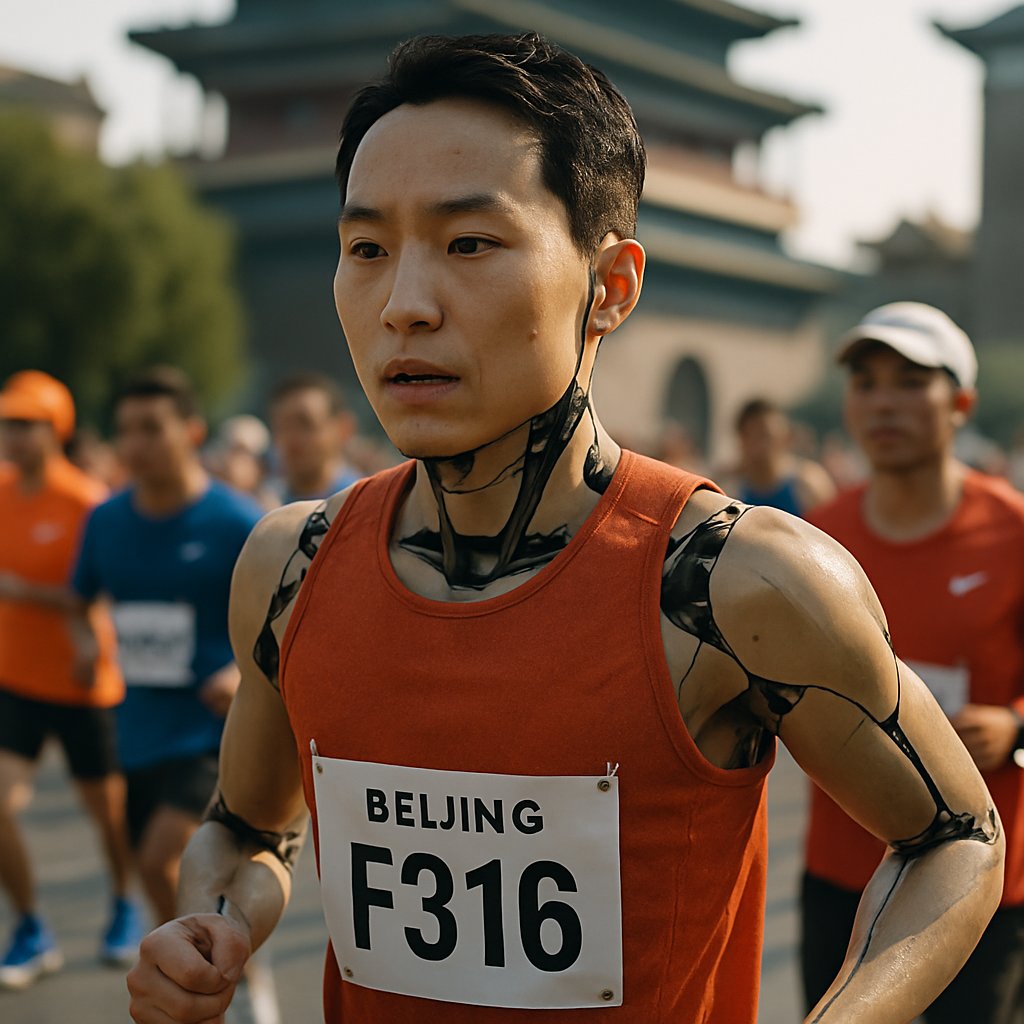
Honor’s flagship prototype, nicknamed Lightning, ran the half-marathon in 50 minutes 26 seconds. Therefore, the robot beat Jacob Kiplimo’s human world record by nearly seven minutes. Lightning operated without joystick input, qualifying for the lower 1.0 weighting coefficient. Meanwhile, a remote-controlled sister unit crossed first in 48:19 but received a 1.2 multiplier. Consequently, Lightning secured the gold despite physically arriving later. Chip timing sensors mounted on each ankle logged split intervals every kilometre.
Data showed Lightning accelerated during the final five kilometres instead of fading. Engineers attribute that negative split to active motor cooling adjustments. Consequently, peak internal temperatures stayed ten degrees below last year’s levels. Official timing sheets list kilometre splits between 2:15 and 2:30 throughout the course. Such pace equates to nearly 25 kilometres per hour average speed. By comparison, Kipchoge’s human marathon world record averages 20.9 kilometres per hour.
Consequently, Lightning delivered not just incremental but exponential mechanical efficiency gains. Only 47 of 102 teams finished, producing a 46 percent completion rate. In contrast, last year’s winner needed 2 hours 40 minutes, revealing dramatic performance growth. Lightning’s pace reframes expectations for Chinese Humanoids and competitive robotics. However, questions about control modes demand deeper comparison.
Autonomy Versus Remote Control
Event rules rewarded autonomy to push research beyond tele-operation. Consequently, remote pilots accepted a 20 percent time penalty. Organisers published the weighting table two weeks before race day. GPS was disabled to force reliance on onboard perception stacks. Additionally, teams running autonomous modes had to pre-register fallback halt procedures. The rule aimed to protect marshals in case of unexpected control loss. Nevertheless, three autonomous entries still crashed into signage, incurring replacement penalties.
Furthermore, penalty minutes applied whenever teams swapped damaged robots mid-course. Only 18 finishers ran fully autonomously, underscoring technical difficulty. Nevertheless, those autonomous units collectively averaged 62 minutes, still under elite human standards. These contrasts clarify why autonomy remains a core benchmark. For Chinese Humanoids, winning autonomously carries extra prestige and funding visibility. Subsequently, we explore the hardware breakthroughs that enabled such speed.
Hardware Advances Enable Speed
Longer composite legs, roughly 95 centimetres, improved stride length without excess mass. Moreover, liquid cooling loops drawn from smartphone design kept joint motors below 60 degrees Celsius. Yanran Ding credits cooling as this year’s decisive engineering jump. Battery density also rose, enabling sustained 25 kilometres-per-hour running bursts. Additionally, reinforcement-learning controllers trained in simulation delivered smoother gait transitions on pavement.
Motor magnets used high-temperature neodymium alloys for sustained torque density. In contrast, last year’s models relied on ferrite magnets that demagnetised earlier. Moreover, carbon-fiber torsos lowered inertia, reducing energy cost per stride. Key performance enablers included:
- High-torque, low-weight actuators rated at 150 newton-metres
- Liquid-cooled carbon-fiber shanks reducing thermal throttling
- Lidar and stereo vision fused for centimetre-level lane keeping
- Swappable 2 kWh battery packs for quick servicing
Chinese Humanoids now exploit these components at scale. Together, these components allowed Chinese Humanoids to sustain record pace without overheating. Consequently, hardware maturity now matches software sophistication. Hardware gains explain raw speed. However, experts warn that context matters. Therefore, we next survey those expert views.
Expert Opinions And Caveats
Rodney Brooks labeled the spectacle a measured stunt rather than a general capability breakthrough. In contrast, Jonathan Hurst called the results an inflection point for commercial interest. Alan Fern emphasized cumulative engineering, not sudden algorithmic magic. Meanwhile, Chinese state media framed the run as proof of national innovation leadership. Nevertheless, all commentators noted limited autonomy on unpredictable terrain. Falls and handler interventions occurred throughout the marathon track, underscoring reliability gaps. Consequently, safety certification remains unfinished business.
These insights contextualize the headline numbers. Experts agree Chinese Humanoids still lack general adaptability. Brooks further argued that the closed course concealed environmental complexity. Fern countered that controlled benchmarks are necessary before wider deployment. Hurst predicted widespread field pilots within three years if funding continues. Subsequently, we consider industry impacts beyond sport.
Broader Industry Implications Emerging
Rapid performance gains could translate to warehouse and factory tasks requiring swift locomotion. Moreover, investors are tracking Chinese Humanoids as bellwethers for embodied AI maturity. Honor executives hinted at logistics pilots launching next year. Consequently, suppliers of actuators, batteries, and sensors see new volume opportunities. Meanwhile, policy analysts view the event as soft-power signaling within global tech rivalry. Professionals can enhance robotics credentials through the AI Robotics certification.
Additionally, Chinese Humanoids could accelerate standards work on bipedal running safety. Therefore, companies that prepare early may capture first-mover advantage. China’s Ministry of Industry listed humanoids as a strategic sector in its latest five-year plan. Consequently, subsidies for actuator suppliers have expanded. Western firms including Agility Robotics are monitoring patent filings from Beijing teams. Meanwhile, venture capital flows into legged robotics surpassed $1.2 billion last quarter.
The industrial dominoes are lining up quickly. However, sustainable adoption depends on closing reliability gaps discussed earlier. Next, we summarise essential insights and outline recommended actions.
Conclusion And Next Steps
Chinese Humanoids have now outrun world-class athletes and captured global headlines. Lightning’s 50:26 finish showcases coordinated advances in cooling, motors, batteries, and control software. However, only 18 machines completed autonomously, highlighting persistent field robustness issues. Consequently, near-term applications will remain confined to structured environments with safety buffers. Furthermore, policy and standards bodies must align on human-robot interaction norms.
Meanwhile, engineers and managers can build relevant skills through the linked AI Robotics credential. Therefore, readers should monitor upcoming marathons, technical papers, and pilot deployments. Act early, certify, and stay ahead as the next generation of running robots emerges.
Disclaimer: Some content may be AI-generated or assisted and is provided ‘as is’ for informational purposes only, without warranties of accuracy or completeness, and does not imply endorsement or affiliation.


