

AI CERTS
2 hours ago
B2Broker Unveils Fintech AI Solutions Assistant for B2Trader
Moreover, the launch underscores the firm’s wider campaign to deliver Fintech AI Solutions across its stack. Industry forecasts peg AI trading software at roughly USD 33-35 billion by 2030, underscoring demand. Therefore, timing appears calculated, giving brokers fresh tools before market saturation sets in. Analysts, however, caution that regulatory scrutiny is rising alongside adoption. In contrast, early press coverage mainly echoed vendor claims without deep technical validation. This report examines features, business impact, competitive context, and risks surrounding B2Broker’s new assistant.
Trading Market Timing Perfect
Grand View Research projects AI trading platforms will hit USD 33.45 billion by 2030. Consequently, vendors integrating intelligence today can capture outsized share before consolidation accelerates. B2Broker cites this trajectory while emphasizing its 3,000-requests-per-second throughput benchmark. Additionally, the firm operates across eleven countries, which eases regional onboarding for partner brokers. These data points suggest calculated timing rather than opportunistic marketing.
Fintech analysts note that latency budgets under 50 milliseconds increasingly differentiate execution venues. Therefore, embedding analytics locally removes extra hops between data feed and decision surface. Fintech AI Solutions embedded natively also reduce vendor sprawl for resource-constrained brokerages. Nevertheless, the absence of published accuracy metrics still clouds real value. Subsequently, early adopters must demand live testing before rolling features to retail clients. The numbers reveal a sizable, fast-growing opportunity. However, seizing it demands verifiable performance, leading to the next focus on features.
B2Trader Assistant Feature Set
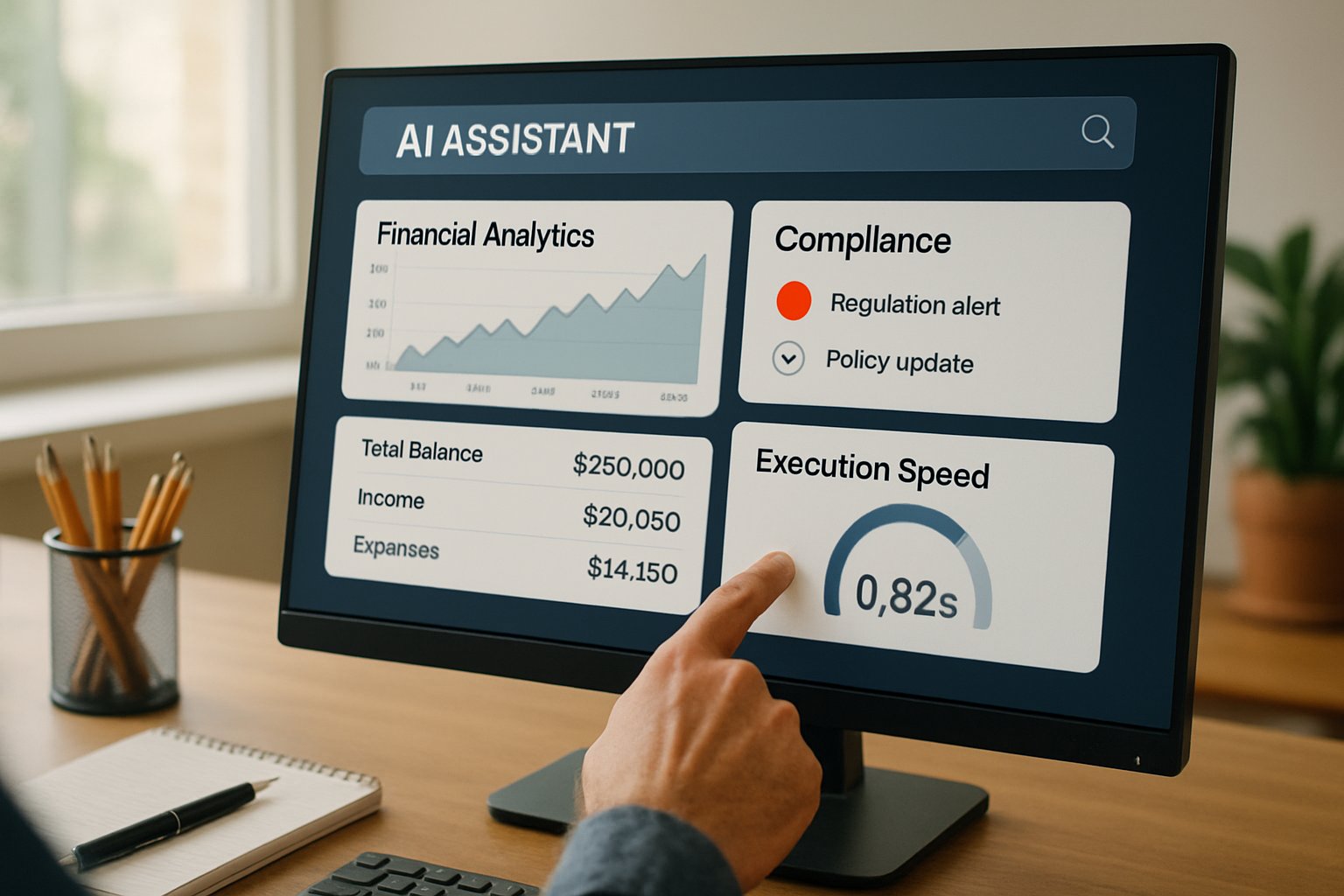
Inside the B2Trader terminal, the assistant surfaces forecasts, sentiment scores, signal drivers, and actionable prompts. Moreover, outputs appear alongside order books, allowing immediate contextual response. Sentiment analysis ingests news and social chatter, then quantifies bullishness or fear using NLP pipelines. Consequently, retail users gain institutional-style dashboards without external subscriptions. B2Broker states that explanations accompany every prediction, outlining drivers such as volatility spikes or macro headlines. In contrast, many rival bots remain opaque, obscuring model logic behind black boxes.
Fintech AI Solutions built directly at API level enable deeper access to user positions for tailored insights. However, the company has not disclosed model architecture or training corpus details. Therefore, questions linger around potential bias, drift, and resilience during stressed markets. Trading professionals should request a model card before integrating the assistant into live books. Feature breadth certainly impresses on paper. Next, we investigate business outcomes promised to brokers.
Broker Yield Impact Explained
Higher user engagement often translates into stronger Broker Yield through increased transaction volume and retention. Additionally, faster onboarding in new geographies, powered by B2Translate, expands addressable revenue per broker. Flexible pricing tiers further lower entry barriers for smaller firms chasing scale. B2Broker argues that baked-in analytics shorten learning curves, consequently cutting support costs. Fintech AI Solutions can also surface cross-sell opportunities such as margin products or copy portfolios. Meanwhile, brokers retain branding control because the assistant inherits platform theming.
That configuration aligns with white-label expectations across competitive ecosystems. Nevertheless, Broker Yield gains remain theoretical until longitudinal data emerges. Therefore, early adopters should benchmark churn, lifetime value, and ticket size before and after deployment. Publishing these metrics would strengthen B2Broker’s credibility during subsequent sales cycles. Potential upside seems clear on spreadsheets. However, competitive dynamics will influence real monetization, explored in the following section.
Competitive Field Shifts Emerging
Bybit’s TradeGPT, Binance Sensei, and several startups already tout AI-guided experiences. Consequently, B2Broker must differentiate on transparency, speed, and broker-centric tooling. Fintech observers note that B2Trader targets intermediaries, whereas exchanges like Binance sell directly to traders. Moreover, third-party white-label vendors promise similar analytics at lower price points. Fintech AI Solutions inside B2Trader claim seamless integration, a value angle peers cannot match easily.
In contrast, deploying external widgets can create security and latency headaches. Therefore, embedded architecture could provide a durable moat if performance proves reliable. Nevertheless, open models are commoditizing fast, pressuring proprietary assistants to evolve continually. Subsequently, competitive advantages may rest on dataset exclusivity and governance frameworks. Vendors lacking these layers risk feature parity within months. Market rivalry is intensifying quickly. Regulatory forces will further shape differentiation, as detailed next.
Regulatory Risk Factors Mount
Dutch regulator AFM warns that correlated AI signals can amplify feedback loops during stress events. Similarly, the IMF urges safeguards like circuit breakers suited for algorithmic surges. Therefore, brokers must maintain human-in-the-loop oversight and clear audit trails. B2Broker claims kill-switch capabilities but has not disclosed governance schematics publicly. Fintech AI Solutions raise liability questions when recommendations blur into regulated advice. Moreover, differing jurisdictions interpret the advisory boundary inconsistently.
Consequently, legal teams should classify outputs as information, not directives, until clarity emerges. Model explainability also matters because hidden biases invite enforcement action. In contrast, transparent driver summaries aid compliance reviews. Subsequently, obtaining independent audits could reassure regulators and institutional partners. Risk management cannot be an afterthought. Next, we outline practical adoption steps for brokers evaluating the assistant.
Adoption Considerations Checklist Guide
Implementing new technology requires structured due diligence. Therefore, brokers should pursue a phased rollout using sandbox environments first.
- Request technical whitepaper detailing model architecture, data sources, and assistant latency targets.
- Review security penetration tests covering B2Trader middleware and cloud endpoints.
- Simulate peak load to confirm 3,000-requests-per-second throughput during high-volume market windows.
- Benchmark pre-and post-deployment metrics for churn, Broker Yield, and average daily revenue.
- Document human override procedures aligned with regional regulatory frameworks.
Additionally, capture baseline metrics on volume, Broker Yield, and support tickets before toggling features live. Monitor variance between control and experimental cohorts to identify unintended position convergence. Moreover, schedule periodic bias reviews against evolving market regimes. Fintech AI Solutions performance should correlate with, not dictate, portfolio strategy.
Nevertheless, user education remains essential; traders may misinterpret probabilistic outputs as guarantees. Consequently, in-app tooltips and disclaimers protect both firm and client. Finally, align deployment timelines with regulatory guidance updates in target regions. Structured adoption minimizes surprises. A skills upgrade can further strengthen rollout readiness, covered in the next section.
Certification Next Steps Forward
Human capital ultimately dictates technology success. Therefore, revenue teams should deepen AI fluency alongside platform integration. Professionals can enhance their expertise with the AI Sales Strategist™ certification. Moreover, the course aligns directly with Fintech AI Solutions selling motions and compliance dialogues. Graduates gain practical frameworks for positioning value, handling objections, and navigating oversight rules.
Additionally, credential recognition signals commitment to responsible innovation among prospective clients. Fintech AI Solutions adoption thus pairs well with formal upskilling pathways. Consequently, firms embedding certificates into enablement programs often accelerate sales cycles. Education closes the readiness gap. The final section synthesizes key insights and recommends immediate actions.
B2Broker’s AI Assistant signals a decisive shift toward data-driven brokerage tooling. Embedded forecasts, sentiment analysis, and signal explanations promise richer user experiences. However, performance validation, regulatory alignment, and education remain prerequisites for durable value. Consequently, brokers should pilot the assistant, demand transparent metrics, and document governance workflows.
Competitive pressure will intensify as other vendors iterate at pace. Fintech AI Solutions that prioritize transparency and speed will likely capture sustainable mindshare. Therefore, firms that act early, yet cautiously, can convert innovation into measurable Broker Yield. Begin exploring demos, auditing code paths, and upskilling teams today to secure tomorrow’s edge.
Disclaimer: Some content may be AI-generated or assisted and is provided ‘as is’ for informational purposes only, without warranties of accuracy or completeness, and does not imply endorsement or affiliation.


