

AI CERTS
5 hours ago
AI Hardware Engineering Faces 3D Stacking Thermal Bottleneck
Therefore, AI Hardware Engineering now treats cooling, materials, and power delivery as first-class design axes. This article examines the volumetric crisis, recent data, emerging solutions, and business impact. Moreover, professionals can strengthen cross-disciplinary fluency with the AI Supply Chain™ certification. Meanwhile, market forecasts suggest advanced Packaging revenue could top ten billion dollars within two years. Read on for insights tested by data.
Volumetric Heat Crisis Unpacked
Heat moves upward through silicon, metal, and interface pastes before reaching external sinks. In 3D Stacking, each extra die adds power sources yet also lengthens that path. Consequently, local Thermal density can triple relative to 2.5D interposers measured by Imec. Temperatures above 120 °C accelerate electromigration and delamination, slashing yield and lifetime. For AI Hardware Engineering managers, rising die temperatures now dominate weekly risk reviews. Nevertheless, workload throttling sacrifices promised throughput, eroding the economic case. Therefore, engineers describe the situation as a volumetric Bottleneck that demands holistic action.
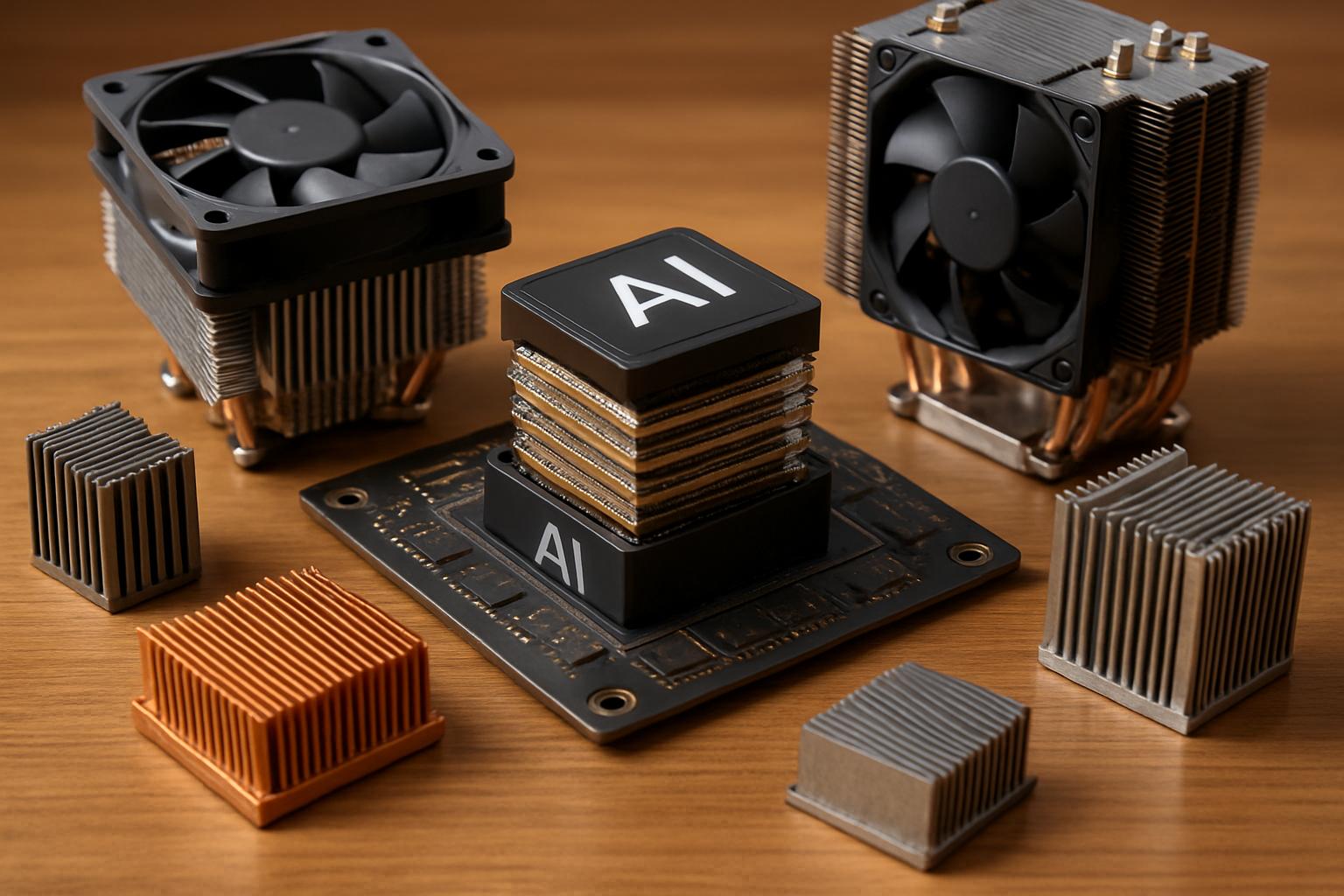
Hot tiers degrade performance, reliability, and cost. However, quantifying the crisis helps direct solutions, leading to design breakthroughs discussed next.
Simulation Data Speaks Volumes
Imec applied system-technology co-optimization to a GPU overlapped by four 12-die HBM stacks. Without mitigations, peak silicon reached 141.7 °C under standard liquid cold-plate conditions. AI Hardware Engineering practitioners value such numbers because they justify tooling budgets. Moreover, frequency halving trimmed peaks yet cost 28 % throughput. Conversely, combined mitigations—including backside power, microchannels, and diamond TIMs—cut peaks to 70.8 °C. Therefore, 3D Stacking maintained twice the bandwidth density of the 2.5D baseline at safe temperatures. EPFL’s 3D-ICE 4.0 tool now emulates such scenarios six times faster than earlier versions. Consequently, architects can iterate many floorplans overnight, refining Thermal maps early.
Data proves co-design works if modeled precisely. Next, we examine cooling paths that make those numbers possible.
Cooling Paths Inside Silicon
Engineers pursue passive and active techniques. Passive improvements include diamond heat spreaders and segmenting interface layers to lower resistance. However, passive steps alone cannot sustain kilowatt-class accelerators. Embedded microfluidic channels circulate dielectric liquid within interposers or even between dies. Moreover, two-phase evaporation absorbs latent Heat, offering superior removal per unit area. Nevertheless, leaks or contamination could threaten yield, so reliability testing stays intense. AI Hardware Engineering groups test microchannels on internal vehicles before scaling production.
- Passive TIM upgrade: ~15 % peak drop, minimal tool cost
- Single-phase microchannels: ~40 % drop, medium fabrication complexity
- Two-phase microchannels: >60 % drop, highest complexity, reliability TBD
Cooling must start inside silicon to unlock stacking height. Therefore, material and power strategies matter equally, explored below.
Materials And Power Delivery
Backside power delivery reroutes high currents away from congested bumps. Consequently, resistive Heating drops, complementing Thermal controls. Copper-plated diamond substrates spread Heat rapidly, outperforming conventional aluminum nitride. Additionally, liquid metal TIMs cut interface resistance yet demand strict void control. Material swaps usually require new Packaging tools and metrology, increasing CAPEX. AI Hardware Engineering roadmaps already list backside power as a 2027 milestone. Nevertheless, lower temperatures reduce electromigration, offsetting yield risk.
Materials and power co-design shrinks Thermal gradients. Next, we consider market forces driving deployment.
Market Forces And Investment
Demand for AI clusters pushes advanced Packaging capacity to record levels. IMARC and Mordor estimate 2.5D and 3D revenues at roughly eleven to thirteen billion dollars by 2026. Consequently, foundries expand CoWoS, SoIC, and Foveros lines while OSATs pilot panel formats. Moreover, cooling equipment vendors see orders from hyperscalers targeting kilowatt accelerators. Skeptics warn that the Thermal Bottleneck could shift supply-chain risk to cooling modules and materials. Analysts note that AI Hardware Engineering spend drives most advanced-packaging revenue growth.
- Advanced Packaging CAGR: 8-12 % across 2024-2028 reports
- 2.5D/3D revenue 2026: $11-13 B consensus
- AI Hardware Engineering share: ~70 % of capacity bookings
Capital flows show the crisis is actionable, not hypothetical. However, design tools must keep pace, as the next section reveals.
Design Tools Advance Fast
Toolchains now integrate physics with architecture exploration. EPFL’s 3D-ICE 4.0 adds adaptive meshing and parallel solvers, yielding up to six-fold speed gains. Meanwhile, commercial EDA vendors embed Thermal models into floorplanning stages. Moreover, cloud clusters can sweep thousands of power maps overnight, guiding AI Hardware Engineering teams. Consequently, mitigation choices become quantitative, not anecdotal.
Faster iteration compresses time to reliable tape-out. Finally, we outline a practical roadmap for stakeholders.
Practical Roadmap For Practitioners
Adopt cross-disciplinary review gates that track Thermal, power, and mechanical metrics together. Include AI Hardware Engineering, package, and data-center teams in early charters. Secondly, require STCO simulations using tools like 3D-ICE before committing masks. Thirdly, pilot microfluidic cooling on small dielets to gather reliability statistics. Moreover, negotiate supply-chain commitments for diamond substrates and backside power tools. Consequently, mitigate schedule surprises tied to specialty Packaging equipment. Professionals deepen insight via the linked AI Supply Chain™ certification.
Structured processes and skills turn thermal risk into competitive advantage. Therefore, companies can scale stacked accelerators with confidence.
Conclusion
3D Stacking unlocks bandwidth yet introduces a fierce Thermal Bottleneck threatening yield and performance. Recent Imec and EPFL data demonstrate that co-design across cooling, materials, and power can tame Heat. Moreover, growing market investment confirms urgent demand for reliable solutions. Design tools now provide rapid feedback, empowering AI Hardware Engineering teams to iterate daily. Nevertheless, success demands disciplined roadmaps and new skills. Consequently, consider earning the AI Supply Chain™ certification to sharpen multidisciplinary coordination. Commit to integrated strategies today, and your next stacked accelerator will deliver its promised throughput tomorrow.


