

AI CERTS
2 months ago
Taiwan’s AI Cognitive Warfare Frontline Exposed
Meanwhile, state-aligned actors reportedly exploit the confusion to push coordinated narratives. Taiwan’s National Security Bureau (NSB) documented 2.3 million disinformation items during 2025 alone. Moreover, leaked GoLaxy documents reveal corporate vendors running cross-border influence for clients in China. These findings place Taiwan at the epicenter of a global contest over attention.
Therefore, understanding tactics, scale, and countermeasures has become urgent for security professionals. This article dissects the controversy and recommends practical next steps. It also shows how professionals can upskill against future waves of AI Cognitive Warfare.
Taiwan Frontline Testing Ground
Observers call Taiwan a live laboratory for AI Cognitive Warfare experiments. However, geography is only part of the story. The island sits beside China’s massive Propaganda apparatus and hosts vibrant democratic debate.
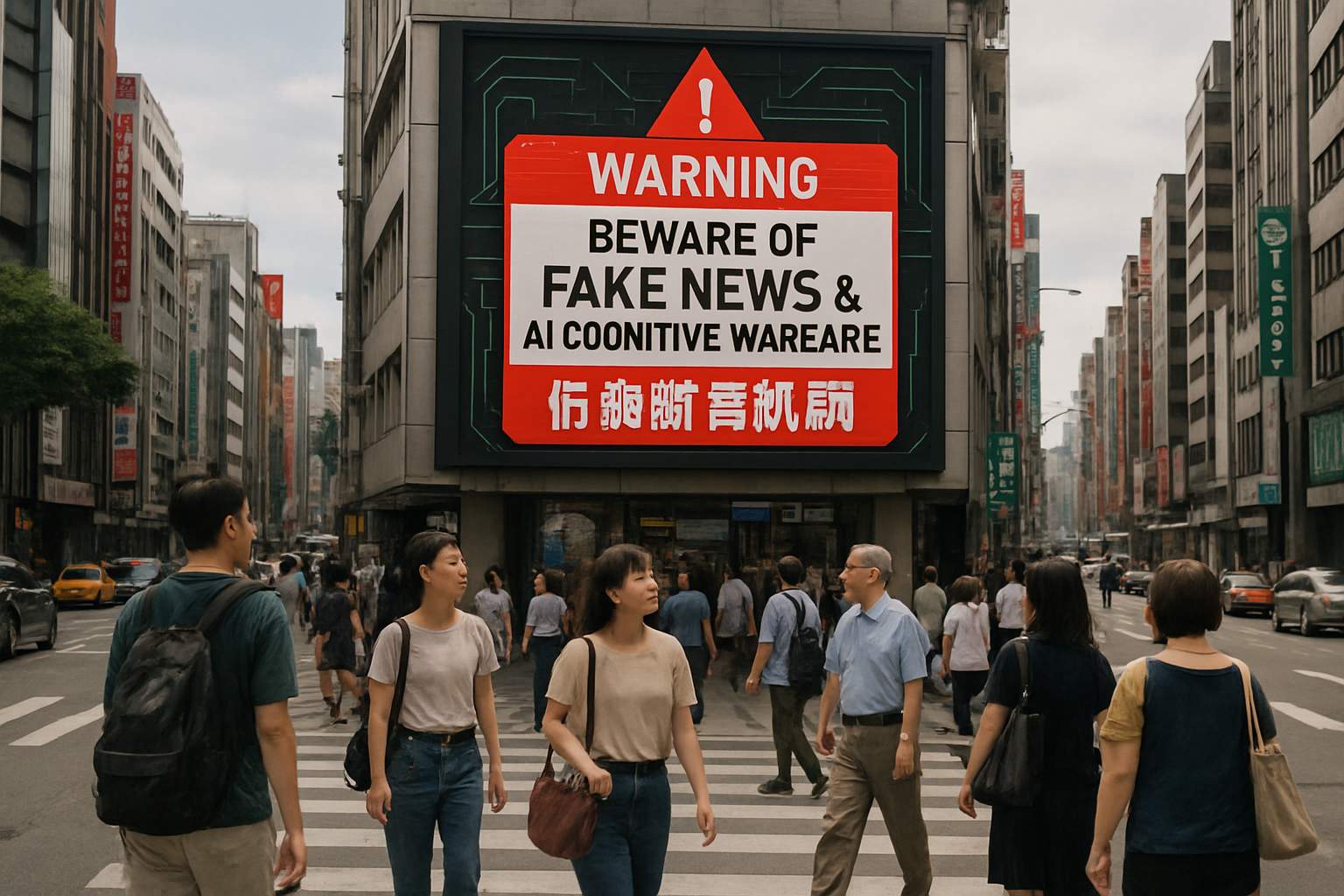
Consequently, malicious actors can test narratives against an engaged public before exporting them elsewhere. Graphika’s Tyler Williams notes imperfect deepfakes still capture Social Media attention on small screens. He stresses that viral velocity outweighs cinematic quality in crowded feeds.
Meanwhile, retired General Paul Nakasone highlights unprecedented operational speed enabled by generative tools. His warning underscores the frontline reality facing Taiwanese fact-checkers each election season.
Taiwan therefore offers early evidence of evolving offensive techniques and public resilience. These lessons set the context for deeper analysis of specific deepfake tactics.
Deepfake Tactics Fully Unwrapped
Attackers increasingly prefer short, subtitled videos featuring fabricated officials or celebrity endorsers. Additionally, AI news anchors deliver scripted segments that mimic trusted broadcasters. In contrast, long form television spoofs appear less common because detection risk grows.
GoLaxy documentation shows automated account clusters releasing synchronized clips across Social Media platforms. Subsequently, bots amplify engagement metrics within the first crucial hour. The surge tricks recommendation algorithms into spotlighting fresh misinformation.
NSB analysts classify these maneuvers under the umbrella of AI Cognitive Warfare. Nevertheless, they note that quality varies; many productions still contain lighting or lip-sync artifacts.
Deepfake campaigns rely on speed, scale, and algorithmic favoritism more than photorealistic perfection. Consequently, defenders must prioritize early detection and rapid takedowns before virality peaks.
Digital Garbage Floods Feeds
Taiwanese journalists increasingly describe low-effort spam as digital garbage rather than sophisticated Propaganda. Furthermore, content farms pump out thousands of AI generated memes, recipes, and gossip. These innocuous posts warm algorithms ahead of sudden political pivots. Analysts classify this flood as low-grade AI Cognitive Warfare aimed at attention capture.
In contrast, disinformation bursts bury reputable coverage under layers of clickable distraction. NSB reported 45,000 fake accounts driving 2.314 million items during 2025. Moreover, only 3,200 items reached official remedial channels, highlighting scale mismatches.
Social Media companies have removed many networks, yet volume rebounds within weeks. Therefore, civic groups promote media literacy workshops across schools and community centers.
The garbage metaphor captures how quantity alone can undermine democratic discourse without cinematic deepfakes. This scale challenge becomes clearer when examining hard numbers from recent reports.
Recent Numbers Reveal Escalation
Hard metrics anchor the debate and avoid anecdotal drift. Consequently, the following figures illustrate 2025 escalation:
- NSB logged 45,000 inauthentic accounts, up 17,000 year over year.
- Investigators counted 2.314 million disinformation items targeting voters.
- GoLaxy files expose China-linked profiling of 117 U.S. lawmakers and 2,000 other figures.
- Police recorded daily fraud losses averaging NT$275 million in July 2025.
Moreover, Vanderbilt researchers argue these totals undercount cross-platform reposts and screenshot resharing. Brett Goldstein predicts that next generation language models will double output without additional staffing.
Such projections alarm regulators in Taiwan and abroad. However, raw numbers alone do not tell the defensive story.
These statistics confirm rising volume and sophistication. Subsequently, attention shifts toward how Taiwan has organized its countermeasure ecosystem.
Taiwan's Evolving Countermeasure Ecosystem
Taiwan founded a Cognitive Warfare Research Center within the Ministry of Justice in 2024. Furthermore, NSB now partners with civil fact-checking groups and foreign security agencies. International dialogues numbered more than 80 during 2025, according to the latest NSB review.
Platforms cooperate by labeling synthetic media and throttling coordinated raids. Nevertheless, critics fear mission creep and domestic political targeting. Opposition lawmakers demand transparent oversight mechanisms before new takedown powers expand.
Professionals can upskill through the AI Security Level-1 certification. Such programs teach threat modeling, detection workflows, and responsible deployment fundamentals.
Effective defense blends institutional coordination, private research, and workforce development. However, policy questions still linger far beyond Taipei.
Wider Global Policy Implications
Other democracies study Taiwan’s experience for early warning signals. Moreover, regional blocs fear similar playbooks during their own elections. ENISA and ASPI now cite China’s campaigns as case studies in strategic Propaganda. Multiple NATO states now fund AI Cognitive Warfare research consortia.
Consequently, proposals include watermark mandates, algorithmic transparency, and joint attribution frameworks. In contrast, platform executives caution against one-size regulatory models that might stifle innovation. Brett Goldstein therefore advocates sustained R&D funding over heavy handed content bans.
Social Media firms also push privacy-preserving provenance standards to rebuild trust. Nevertheless, enforcement gaps persist across borders and legal regimes.
Global coordination appears essential yet politically delicate. The closing section summarizes takeaways and recommended actions for professionals tracking AI Cognitive Warfare.
Taiwan’s experience shows how deepfakes, spam, and traditional Propaganda now blend into a single threat. Moreover, statistics confirm that volume and speed are rising despite ongoing takedowns. Security teams must therefore monitor content flows, source metadata, and network behavior in real time. Upskilling remains vital as AI Cognitive Warfare tools evolve monthly. Professionals should join international information-sharing groups and demand transparent platform reporting. Additionally, consider earning technical certifications to validate detection and response expertise. Explore the linked AI Security Level-1 course and stay ahead of the next influence storm.
Disclaimer: Some content may be AI-generated or assisted and is provided ‘as is’ for informational purposes only, without warranties of accuracy or completeness, and does not imply endorsement or affiliation.


