

AI CERTS
1 hour ago
Edge AI Hardware Funding Surges With HrdWyr’s $13M Round
Meanwhile, policymakers tout local design incentives under the India Semiconductor Mission. HrdWyr aims to ship an advanced AISoC family that slashes power while boosting on-device inference. Such chips promise faster response, tighter privacy, and lower bandwidth bills. Moreover, the fresh funding highlights global interest in Bengaluru engineering talent. This article examines the financing, strategy, policy context, and challenges ahead. It also outlines skills and certifications that help professionals ride the hardware wave. Readers will gain a concise, data-driven view of India’s edge silicon moment.
Funding Boosts Edge Hardware
Series A rounds often define a startup’s trajectory. However, HrdWyr’s $13 million raise arrives during tightened capital markets. Ideaspring Capital led, with Singularity AMC, Avatar Growth Capital, and Persistent Systems joining. Consequently, total disclosed funding now stands near $16 million since incorporation in 2023. Investors cite differentiated Edge AI Hardware pipelines and early customer signals as key.
Naganand Doraswamy, Ideaspring’s managing partner, praised power efficiency across mobility, industrial, and consumer lines. Furthermore, he framed the bet as an “India-for-world” silicon thesis. Persistent Systems signaled software integration support, an important moat in embedded AI.
Such cross-disciplinary backing adds credibility during supply chain negotiations with foundries. In contrast, many early chip startups struggle to secure both capital and design partners. These commitments anchor the roadmap. Therefore, the raise marks a pivotal milestone before tape-out and sample distribution.
The financing validates technical ambition and commercial urgency. Subsequently, strategic vision becomes critical as silicon moves from slides to wafers.
Vision Behind HrdWyr AISoC
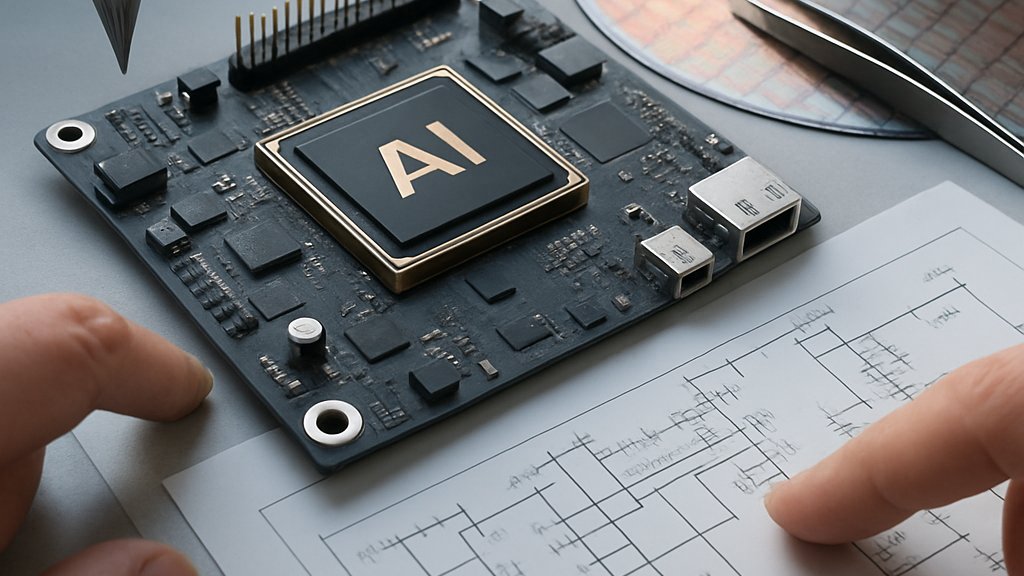
Founder Ramamurthy Sivakumar speaks frequently about “Physical AI”. He argues that robots, appliances, and vehicles must sense, decide, and act in realtime. Therefore, compute must live adjacent to sensors, not in distant clouds. Edge AI Hardware satisfies that latency constraint yet often drains batteries. Consequently, HrdWyr designed an AISoC architecture with integrated NPU, memory islands, and power governors.
The firm claims orders-of-magnitude better energy per inference for domain tasks. Moreover, its roadmap shows vertical versions for data-center power management, EV subsystems, and white goods. Such specialization reduces bill of materials and simplifies firmware development. In contrast, generic CPUs or GPUs waste silicon on unused blocks.
Analysts view the approach as a hedge against tightening export controls on advanced nodes. Additionally, the company’s Bengaluru R&D hub provides proximity to local appliance brands. These factors strengthen early adopter confidence.
HrdWyr positions AISoC as the engine for embodied intelligence. However, execution speed will decide whether the concept becomes mainstream.
India Policy Momentum Grows
Policy support shapes semiconductor success in every region. India Semiconductor Mission offers design-linked incentives, tax breaks, and infrastructure grants. Consequently, Bengaluru startups receive subsidised EDA licences and shared lab access. Furthermore, state governments run talent skilling programs for VLSI engineers. The national government targets a $155 billion domestic chip market by 2031.
Company executives praise these measures for shortening prototype cycles. Meanwhile, global OEMs search for alternative supply chains outside geopolitically sensitive hubs. Therefore, government backing can convert interest into contracts.
Analysts also note growing capital inflows into design services and verification outfits. Moreover, talent returning from overseas fabs brings know-how that accelerates ecosystem maturity.
India Semiconductor Mission creates soft landing zones for ambitious designers. Subsequently, global customers may perceive Indian silicon as lower risk.
Competitive Field Intensifies Globally
The edge silicon arena remains crowded. Qualcomm, Apple, and MediaTek integrate NPUs into flagship SoCs. Meanwhile, startups like Hailo, Syntiant, and SiMa.ai court automotive and industrial clients. Edge AI Hardware differentiation therefore hinges on software stacks, tooling, and community support. Additionally, foundry access and pricing affect production timelines.
The Bengaluru newcomer competes by focusing on narrow, high-volume verticals, not broad smartphone portfolios. Consequently, smaller die sizes and relaxed process requirements may keep costs manageable. In contrast, large incumbents chase premium nodes, increasing per-wafer expenses. Moreover, strategic partner boAt offers a consumer scale testbed for first silicon.
- Incumbent SoC suppliers: Qualcomm, Apple, MediaTek
- Specialist startups: Hailo, Syntiant, SiMa.ai
- Cloud players entering silicon: Google, Amazon, Microsoft
- Emerging fabless entrants from India and Israel
Analysts expect aggressive price pressure as demand spreads from phones to kiosks. Therefore, continuous feature updates will be vital for retention.
Competition rewards agility and robust developer ecosystems. However, focused execution can carve durable niches within larger value chains.
Engineering Barriers And Risks
Designing custom silicon involves intricate trade-offs. Power, latency, and cost targets often pull in different directions. Moreover, Edge AI Hardware must support evolving model architectures without silicon respins. Consequently, designers embed configurable tensor cores and scalable memory fabrics. Security also matters because compromised firmware endangers safety-critical deployments.
Test chips require expensive mask sets and long foundry queues. Therefore, missed deadlines can evaporate first-mover advantages. In contrast, software teams must compress models to fit tight footprints. Additionally, development boards need reliable update channels for field fixes.
Supply chain shocks remain another hazard. Components such as power management ICs often face multi-quarter backlogs. Meanwhile, geopolitical tensions threaten advanced node export licenses.
Engineering risk spans design, manufacturing, and deployment layers. Subsequently, disciplined program management will separate winners from aspirants.
Roadmap And Upcoming Milestones
Executives outline a three-phase rollout through 2028. Phase one targets tape-out of a 22-nanometer AISoC sample within 12 months. Furthermore, evaluation kits will ship to anchor customers in consumer audio and EV subsystems. Edge AI Hardware will then enter mass production after reliability testing completes.
Phase two migrates selected IP blocks to a 12-nanometer process for industrial control markets. Consequently, thermal envelopes drop while compute density rises. Phase three extends the platform with multi-die packaging for heavier robotics workloads. Meanwhile, software teams refine SDKs and reference models to lock in developers.
The Bengaluru engineering center plans to double headcount during these stages. Moreover, management will leverage India Semiconductor Mission grants for lab expansions. Success hinges on meeting every milestone without silicon rework.
Clear milestones provide investors with objective progress signals. Therefore, transparent updates can sustain confidence through capital-intensive phases.
Upskilling Through Key Certifications
Rapid hardware cycles create a persistent skills gap. Professionals versed in system architecture, ML compression, and verification are highly demanded. Additionally, domain experts must understand Edge AI Hardware constraints when selecting models. Consequently, training programs now pair embedded design with data science fundamentals.
Engineers can deepen knowledge through industry recognised certifications. For example, learners can boost credentials via the AI+ Quantum™ certification. Moreover, such programs blend quantum concepts with pragmatic embedded inference techniques.
Hiring managers report salary premiums for candidates who bridge firmware and model workflows. Therefore, continuous learning remains essential as Edge AI Hardware evolves rapidly.
Targeted certification accelerates individual contribution on complex AISoC projects. Subsequently, organizations achieve shorter prototyping cycles and lower rework costs.
Conclusion And Next Steps
The $13 million raise highlights India’s sharpened focus on device-side AI performance. Edge AI Hardware now sits at the intersection of policy ambition, market demand, and technical innovation. However, fierce competition and fabrication risks could still derail schedules. Therefore, disciplined engineering and ecosystem partnerships remain decisive.
Professionals who master AISoC concepts and secure relevant certifications will shape the next wave. Ultimately, Edge AI Hardware promises to transform everyday objects into responsive, efficient collaborators. Industry leaders should act now, pursue continuous learning, and engage with emerging chip programs. Such steps will convert potential into profitable, sustainable innovation.
Disclaimer: Some content may be AI-generated or assisted and is provided ‘as is’ for informational purposes only, without warranties of accuracy or completeness, and does not imply endorsement or affiliation.


