

AI CERTs
4 months ago
Multimodal Content Generation Pipelines Transform Workflows
Creators face a rapid shift as Multimodal Content Generation Pipelines move from novelty to necessity. Moreover, rising model quality lets one prompt yield text, imagery, audio, and finished video. Consequently, tooling vendors embed these pipelines inside mainstream creative suites. Meanwhile, production teams save hours yet confront legal and provenance questions. This article dissects the trend, explains the technology, and highlights market, policy, and workflow impacts. Finally, readers will see where Multimodal Content Generation Pipelines fit within daily creator tasks.
Market Shift Overview 2025
Grand View Research valued generative AI at USD 22.2 billion for 2025 and projects steep growth. Additionally, Gartner expects global GenAI spending to reach USD 644 billion this year. In contrast, analysts warn of high proof-of-concept failure rates. Nevertheless, vendors continue heavy investment because creator demand accelerates. Over 50 million people identify as creators, and only a small slice work full time. Therefore, scalable automation promises significant economic upside.
Adobe reports Firefly users generated more than 18 billion assets by late 2025. Furthermore, Google’s Gemini platform rapidly on-boards enterprises seeking streamlined video-text synthesis workloads. OpenAI and Runway also cite surging adoption across social and studio segments. These data points prove the market shift is real.
The landscape clearly favors integrated Multimodal Content Generation Pipelines. However, competition around openness, pricing, and provenance will shape winners. These dynamics underline rapid commercialization. Consequently, the next section explores how pipelines actually work.
Core Multimodal Pipeline Stages
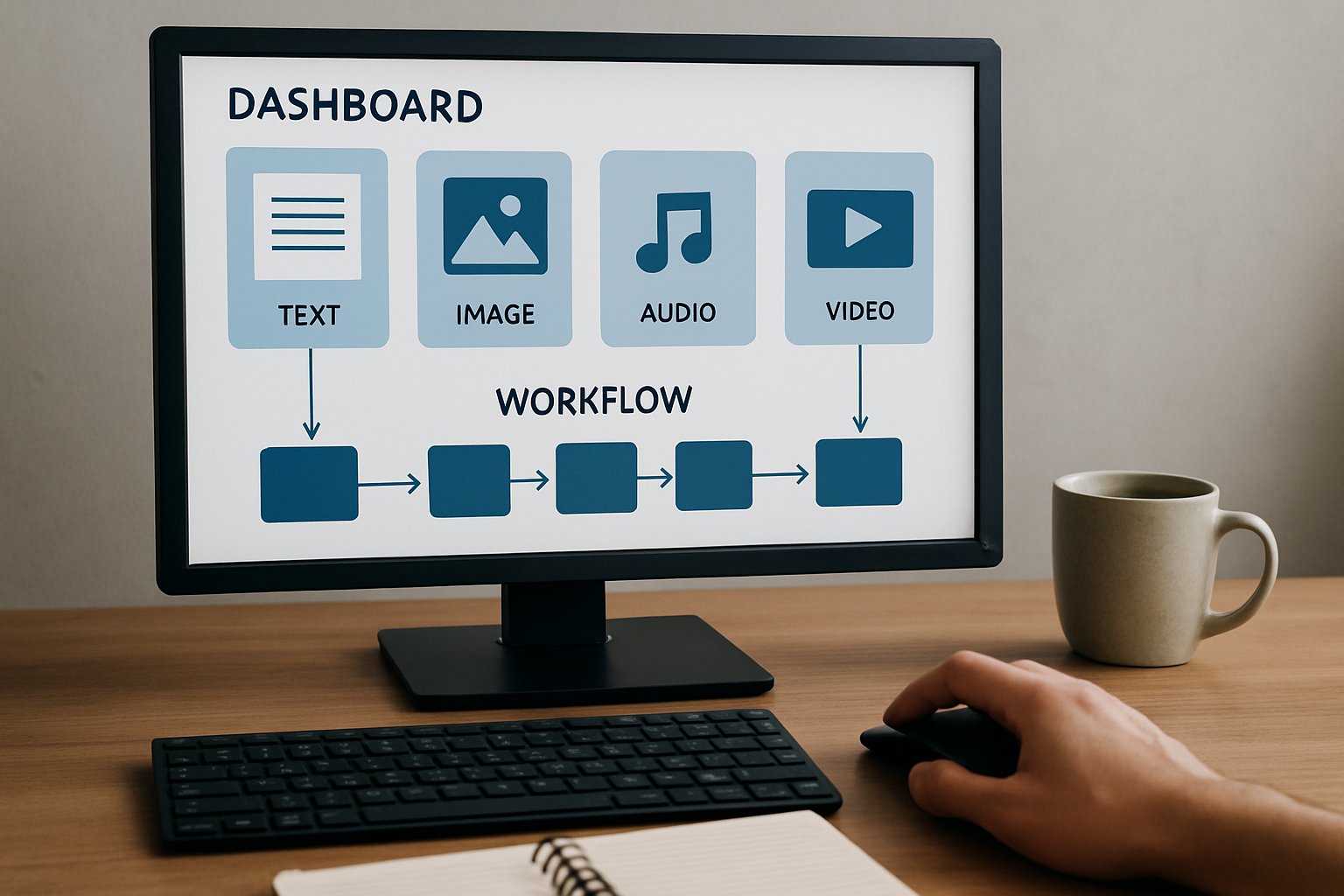
Typical pipelines begin with ideation prompts, reference boards, or scripts. Subsequently, preprocessing normalizes inputs and runs safety checks against brand or copyright policies. An orchestration layer then routes tasks to specialized models. For example, a language model drafts narration, an image model creates keyframes, followed by a video-text synthesis engine generating motion.
Meanwhile, audio models craft voiceovers and background scores. Postprocessing adds color grading, frame interpolation, and continuity fixes. Content Credentials or SynthID watermarks embed provenance metadata before export. Consequently, teams gain repeatable, auditable workflows.
Agentic orchestration frameworks such as LangChain v1 and LangGraph manage branching logic and caching. Moreover, Retrieval-Augmented Generation pulls brand guides to maintain style consistency. These blocks combine into Multimodal Content Generation Pipelines that scale from indie projects to studio productions.
Pipelines follow clear stages from prompt to delivery. Yet platform advances determine speed and quality. Therefore, the following section reviews leading vendor innovations.
Leading Platform Advances 2025
Adobe united text, vector, image, and commercially safe video inside its Firefly web app during early 2025. Moreover, partner integrations with OpenAI and Google offer wider model choice. Content Credentials, based on the C2PA standard, ship by default to assert asset origin.
Google made Veo production ready and exposed it through Gemini Advanced and Vertex AI. Furthermore, SynthID watermarks allow downstream verification. Runway’s Gen-4 improves character consistency across shots, easing storyboarding for creator AI tools.
Meanwhile, open-source efforts like LTX-2 and platforms such as Hugging Face provide modular alternatives. Consequently, creators can mix-and-match engines within custom Multimodal Content Generation Pipelines.
Each platform races to reduce latency and raise fidelity. However, productivity impact matters most to practitioners, as shown next.
Productivity Impact Data Points
Vendors tout striking efficiency gains, and early data supports many claims:
- Wolf Games cut iteration cycles by over 60 percent using Google Veo.
- Studios integrating Runway Gen-4 report 2–3× faster pre-production loops.
- Creators inside Adobe Firefly stay within one interface from concept to export.
Additionally, OpenAI notes that hundreds of millions now access multimodal features, raising the overall content supply. Consequently, competition for attention intensifies, pushing professionals toward automation.
These outcomes stem from optimized Multimodal Content Generation Pipelines that minimize tool-switching. Nevertheless, legal uncertainty may blunt benefits, as the next section discusses.
Emerging Legal Concerns Today
The U.S. Copyright Office issued detailed guidance on AI training fair use on 9 May 2025. Consequently, model builders face heightened scrutiny over copyrighted data. Concurrent litigation from musicians and studios underscores unresolved risk.
Moreover, realistic outputs raise deepfake fears, challenging audience trust. Provenance systems like Content Credentials and SynthID mitigate, yet not eliminate, deception. In contrast, revenue-sharing proposals from OpenAI aim to align incentives, but concrete frameworks remain absent.
Legal clarity will influence adoption of Multimodal Content Generation Pipelines across regulated industries. Therefore, creators should stay informed and pursue relevant upskilling, such as the AI Security Level-1 certification.
Regulation creates both guardrails and innovation pressure. Subsequently, we explore practical deployment advice.
Implementation Best Practices Now
Teams should start small with pilot workflows targeting high-volume pain points. Additionally, maintain a human-in-the-loop step for critical approvals. Adopt agent orchestration frameworks to track state and enable rollback.
Furthermore, integrate RAG with style libraries to ensure brand alignment. Meanwhile, cache intermediate outputs to control costs and latency. Secure provenance metadata at every stage to support audit needs.
Vendor lock-in remains a concern. Therefore, favor open standards for model interchange and asset storage. Multimodal Content Generation Pipelines thrive when components stay interoperable.
Following these practices reduces risk and maximizes return. Consequently, attention shifts to future signals shaping strategy.
Future Outlook Signals Ahead
Model roadmaps point toward longer, higher-fidelity video with synced audio. Moreover, broader adoption of watermark detection will strengthen trust across distribution channels. Commercial frameworks for creator compensation may emerge as policy debates continue.
Meanwhile, orchestration runtimes such as LangSmith advance observability, enabling enterprise-grade monitoring for creator AI stacks. In contrast, independent benchmarks comparing end-to-end pipelines remain scarce, signaling a research opportunity.
Prospects indicate expanding capability and regulation. Therefore, constant learning and certification will keep professionals competitive.
Future advances promise richer media and clearer rules. However, sustained vigilance ensures ethical, profitable deployment.
Conclusion And Call-To-Action
Multimodal Content Generation Pipelines now anchor modern creative workflows. They merge text, images, audio, and video into one automated stream. Consequently, creators gain speed, scale, and new revenue paths. Nevertheless, legal, provenance, and lock-in challenges demand informed oversight. Continuous skills growth remains vital. Therefore, enhance your expertise with the AI Security Level-1 course and stay ahead in the evolving creator AI landscape.
Disclaimer: Some content may be AI-generated or assisted and is provided ‘as is’ for informational purposes only, without warranties of accuracy or completeness, and does not imply endorsement or affiliation.


