

AI CERTS
6 hours ago
Why Long Context LLMs Are Self-Tuning
In this article, we unpack the mechanics, benefits, and risks behind self-tuning Long Context LLMs at test time. Moreover, we present deployment tips, cost metrics, and certification pathways for technical leaders. Read on to decide whether adaptive inference can unlock faster, cheaper, and safer long-document reasoning in production. Meanwhile, policy teams must weigh privacy and security implications when weights shift on sensitive user text. Ultimately, understanding these tradeoffs now will position your organization for the next memory-intensive AI wave. Consequently, the following sections deliver data-driven guidance for prudent adoption.
Why Long Context LLMs Matter
Enterprises increasingly process legal briefs, genomic logs, and call transcripts exceeding 500 pages. Consequently, retrieval alone struggles to maintain narrative coherence across such sprawling discourse. While vendors now advertise million-token context windows, compute still scales quadratically with standard attention. Therefore, compressing relevant information into internal fast weights offers an attractive alternative.
Long Context LLMs using rapid weight updates can simulate far larger memory without exploding latency. Moreover, empirical studies show modest weight tweaks lower test loss even against full-attention baselines. These findings highlight why memory efficiency now ranks among the top architecture priorities. Next, we dissect the self-tuning procedure that enables such gains.
Inside Test-Time Training Mechanics
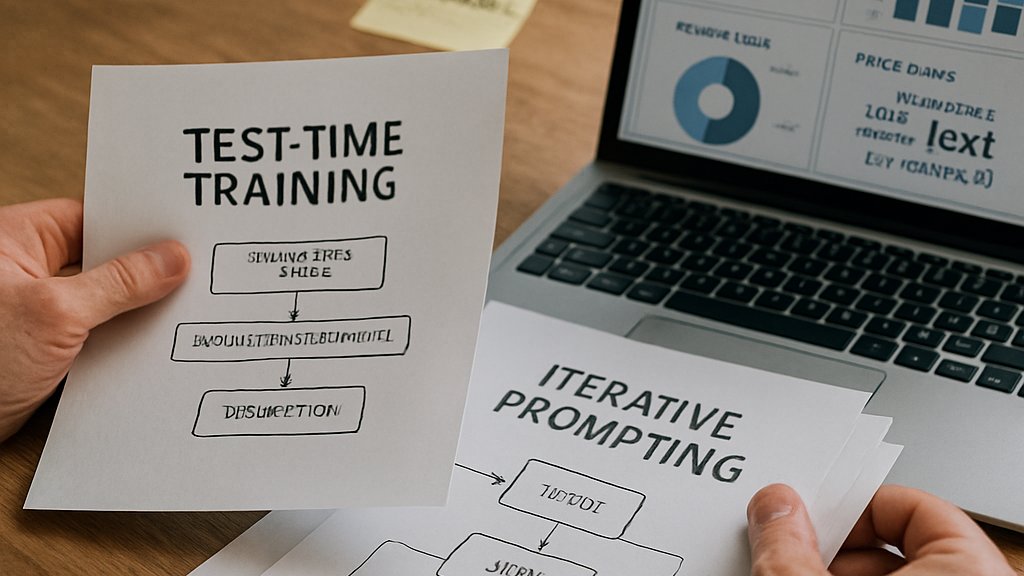
At its core, test-time training performs gradient updates on a small parameter subset during inference. Typically, researchers freeze slow weights and adapt fast projections like MLP outputs or query matrices for prompt optimization. Consequently, Long Context LLMs internalize recent tokens without revisiting the entire context window each step. Most published systems meta-train models so they can learn quickly from self-supervised losses at test time. However, in-place variants retrofit existing checkpoints by updating only the MLP output layer. Moreover, query-only methods restrict updates further, allowing cache reuse in production servers. This design keeps per-token compute near constant across long sequences.
Theoretically, recent ICML proofs show gradient-based adaptation reduces expected loss for any convex subtask derived from the prompt. In contrast, plain in-context learning cannot guarantee such monotonic improvement. Moreover, the proofs hold under bounded noise, giving practitioners confidence in worst-case performance. Subsequently, open-source repos reproduced these findings on language, math, and vision benchmarks. Together, formal guarantees and empirical breadth justify continued investment in online weight adaptation. Together, these strategies define the practical toolbox for modern self-tuning. Next, we examine how adaptive inference manifests in benchmark results.
Adaptive Inference In Practice
Benchmark suites like LongBench and ZeroScrolls quantify how adaptive inference improves long-document tasks. For Qwen3-4B, test-time training raised factual accuracy by over fourteen percentage points. Meanwhile, language-modeling loss dropped by roughly 0.018 when using end-to-end updates on 128K tokens. Consequently, models delivered 2.7× speedups on NVIDIA H100 GPUs compared with full attention at that length.
Furthermore, Long Context LLMs saw the gap widen to 35× at two million tokens in lab tests. Importantly, these gains persisted across varied context windows without adding new parameters. However, meta-training increased pretraining compute by about 3.4× in current implementations. These tradeoffs illustrate why careful model tuning remains essential. Next, we detail quantitative speed benefits in clearer form.
Speed And Latency Gains
Latency dominates user experience when context stretches into hundreds of thousands of tokens. Therefore, researchers track speedups relative to full attention baselines.
- 128K tokens: 2.7× faster inference with TTT-E2E on H100 GPUs.
- 2M tokens: 35× speedup versus full attention in controlled benchmarks.
- Constant cost: Per-token compute stays flat when sliding windows pair with test-time training.
- Smaller models: 125M parameter checkpoints meet long-document targets after selective model tuning and prompt optimization.
Moreover, Long Context LLMs with fast weight updates avoid quadratic memory growth, easing deployment on commodity accelerators. Overall, this approach converts extra latency budget into sharper predictions. However, benefits come with new security and reliability risks. Engineers emphasize that constant-time attention works because the model already distilled distant facts into fast weights. Consequently, token throughput remains stable even when contexts climb into the multimillion range.
Hardware utilisation also improves because smaller activation maps fit fully inside on-chip SRAM. Furthermore, early benchmarks suggest energy per generated token falls by nearly 40 percent. These resource efficiencies matter for sustainability goals and batch serving economics. Therefore, operations teams may redirect saved compute toward creative generation or retrieval augmentation.
Risks And Open Challenges
Updating weights at inference opens fresh attack surfaces for poisoning or jailbreak attempts. In contrast, static models never expose gradient hooks to adversaries. Nevertheless, several papers document membership leakage when sensitive data guides on-the-fly learning. Consequently, differential privacy adaptations and outlier detectors are active research topics. Furthermore, negative transfer can harm quality if the incoming context is noisy or misleading. Therefore, practitioners must monitor loss signals and optionally rollback updates during suspicious sessions. Meanwhile, auditors require traceable logs that capture gradient norms and learning rates for each request.
In addition, multi-tenant clusters must isolate fast weights so secrets from one client never reach another. Failure to sandbox updates may violate emerging AI accreditation standards. Consequently, several open-source libraries now include per-request checkpoint cloning and automatic rollback. These concerns mandate governance policies alongside engineering safeguards. Next, we discuss practical cost considerations.
Deployment And Cost Tradeoffs
Enterprises weigh pretraining overhead against inference savings when planning adoption. Meta-training can triple compute time, yet may pay back when serving million-token conversations daily. Meanwhile, in-place methods lower capital barriers because they retrofit existing checkpoints without lengthy retraining. Cost modeling should estimate GPU hours, memory footprint, and added latency from per-request updates. Consequently, some teams blend retrieval with adaptive inference to balance budget and quality. Moreover, selective model tuning lets Long Context LLMs update only a quarter of layers, further reducing cost. Analysts recommend creating scenario tables that compare break-even points across model sizes and query volumes.
For example, a 3B parameter checkpoint with updates may cost less than a 10B static model. However, the meta-training surcharge must amortize over months of production traffic. Therefore, finance departments should track electricity costs because energy dominates operational expenditure at scale. In practice, dashboards that combine token throughput, dollar spend, and carbon usage support transparent decisions. Professionals can enhance their expertise with the AI Prompt Engineer™ certification focused on prompt optimization best practices. Overall, budget projections must accompany rigorous benchmark tests. Next, we outline an adoption roadmap.
Roadmap For Enterprise Adoption
Start with small pilot projects focused on summarization or log analysis. Gather latency, accuracy, and cost metrics under controlled loads. Subsequently, decide whether test-time training should remain optional or default for each endpoint. Incorporate adaptive inference only after validating safety filters against poisoning cases. Additionally, schedule periodic offline model tuning to refresh slow weights with accumulated fast updates.
Finally, track regulatory guidance on privacy to inform logging and retention policies. Moreover, publishing an internal style guide for prompt optimization will standardize update objectives across teams. These steps ensure measured progress toward scalable Long Context LLMs capability. We now close with key conclusions.
Conclusion And Next Steps
Long Context LLMs are rapidly moving from lab demos to potential production staples. Meanwhile, test-time training has proven that small, well-placed updates unlock significant accuracy and speed. However, new attack surfaces and compute budgets require disciplined governance and clear ROI analysis. Therefore, adaptive inference must launch alongside monitoring, rollback, and privacy safeguards.
When combined with retrieval, selective model tuning offers balanced accuracy and efficiency. Consequently, early adopters gain a head start on the next wave of AI workloads. Further mastery awaits those who invest in continuous learning and prompt optimization expertise. Consider enrolling in the linked AI Prompt Engineer certification to deepen practical skills.
Disclaimer: Some content may be AI-generated or assisted and is provided ‘as is’ for informational purposes only, without warranties of accuracy or completeness, and does not imply endorsement or affiliation.


