

AI CERTS
6 hours ago
Edge AI Inference Gets Leaner With AMD XDNA Attention Advances
This article unpacks the numbers, methods, and business impact behind these advances. Moreover, it outlines practical steps for engineering teams seeking sustainable on-device scaling. Readers will learn why attention dominates energy, how AMD XDNA addresses the issue, and what remains unsolved. Finally, we highlight certification paths that deepen professional credibility in this dynamic field.
Why Long Sequences Matter
Transformers excel because self-attention tracks relationships across any context length. However, computation grows quadratically, so extended documents explode compute, memory, and energy. For Edge AI Inference scenarios, such inefficiency quickly drains batteries and thermal budgets. Consequently, long-sequence inference faces stricter constraints than cloud workloads that offload heat to datacenter chillers.
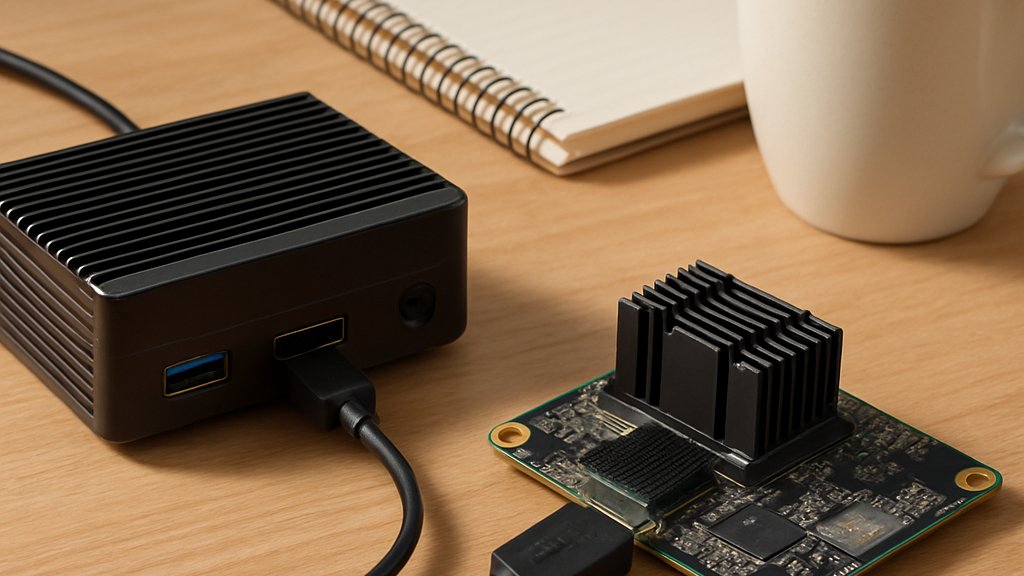
These limits spotlight why architecture matters in mobile settings. Therefore, AMD XDNA energy figures deserve close inspection.
AMD XDNA Energy Wins
AMD XDNA combines tightly coupled matrix engines with on-chip SRAM to slash external memory traffic. Furthermore, the open-source STEEL kernel fuses FlashAttention steps and exploits structured sparsity for Edge AI Inference. Researchers measured impressive advantages during long-sequence inference on Ryzen AI 9 HX 370 hardware.
- Energy: 9.17× lower than CPU, 1.75× lower than GPU, average across tasks.
- Latency: 9.6× faster versus previous NPU baseline, 22.8× faster than naive attention.
- Peak prefill throughput: nearly 50 TOPS using mixed BF16 precision on AMD XDNA2 silicon.
Consequently, AMD XDNA appears primed for Edge AI Inference at enterprise scale. Independent labs confirm similar patterns, albeit with slightly lower absolute speedups for convolution-heavy mixes. Nevertheless, latency reductions above 5× still appear across diverse tasks such as summarisation and code completion.
These statistics prove hardware acceleration delivers concrete gains. However, software techniques amplify those benefits further.
Algorithmic Attention Advances Today
FlashAttention inspired many derivatives that tile compute to preserve on-chip locality. STEEL integrates that idea with sparsity placement, trimming redundant token pairs. Meanwhile, HALL-OPT prunes low-entropy tokens and gates hallucination risk during long-sequence inference. Grouped Query Attention shares keys and values, so KV cache shrinks markedly. Additionally, BF16 storage halves memory yet keeps accuracy within tight tolerances. Collectively, these algorithmic tricks embody efficient attention strategies demanded by battery-powered devices.
Edge AI Inference workloads often carry chat memory exceeding 32k tokens. Researchers now explore combining token pruning with grouped heads to preserve accuracy while halving energy again. Early results suggest less than 0.2 BLEU drop on translation tasks when 30% tokens are skipped.
Algorithmic progress complements silicon innovation. Consequently, teams must coordinate both layers for optimal return. Next, we examine concrete NPU optimization patterns.
Practical NPU Optimization Guide
Engineering teams rarely deploy research code unchanged. Therefore, AMD shares a pipeline mixing NPU and integrated GPU stages. Prefill runs on the NPU, while memory-bound decode migrates to the GPU. Furthermore, designers chunk prefill into 256-token blocks to stabilize SRAM residency. They also apply BF16 KV caches, operator fusion, and deferred weight initialisation.
Case studies show a 15% battery life gain on ultra-thin laptops running nightly chat sessions. Developers instrumented power rails directly rather than relying on software estimators to verify improvements.
- Profile varying sequence lengths and batch sizes; record both average and worst-case energy.
- Combine efficient attention kernels with runtime token pruning for maximum savings.
- Adopt INT8 or INT4 weights after accuracy verification.
- Automate on-chip / off-chip split to avoid manual graphs.
Professionals can enhance their expertise with the AI Architect™ certification. Such training accelerates Edge AI Inference project delivery across product lines.
These steps convert research novelty into deployable pipelines. Nevertheless, unresolved challenges still exist. Let’s review them next.
Remaining Gaps And Risks
Quadratic attention complexity never disappears entirely. In contrast, pruning and grouping trade accuracy for savings and can mis-handle rare tokens. Moreover, mapping kernels to diverse NPUs demands intimate knowledge of microarchitectural details. Portability suffers when each vendor exposes unique toolchains and scheduling APIs. Energy figures also shift with workload patterns, complicating headline comparisons. Consequently, independent benchmarks across AMD XDNA, Apple, and Arm NPUs remain essential.
Open benchmarks also need unified logging of silicon temperature, because throttling skews energy readings. Meanwhile, licensing terms for vendor SDKs can impede academic reproduction of optimisation pipelines.
These uncertainties caution decision makers. However, structured evaluation frameworks can mitigate confusion. Industry lessons emerge from the data.
Strategic Takeaways For Teams
Decision makers care about return on watt more than raw tops. Therefore, pair hardware acceleration with efficient attention design to secure durable gains. Edge AI Inference benefits when developers adopt iterative profiling and automated tuning loops. Furthermore, invest in skills that translate across vendor toolchains and model families. Consequently, organisations should evaluate open kernels like STEEL and standardise energy measurement rigs. Teams embracing AMD XDNA early report faster product cycles and reduced cloud bills.
- Adopt NPU optimization playbooks and document assumptions.
- Track hardware acceleration metrics at each release.
- Validate accuracy under extreme long-sequence inference conditions.
These priorities convert technology hype into measurable business value. In contrast, ignoring them leads to wasted silicon capacity.
Strategic Takeaways For Teams
Boards should track both kilojoules per answer and monthly inference cost when approving budgets. Consequently, procurement teams may prioritise SoCs with integrated NPUs over discrete GPUs for enterprise fleets.
These priorities convert technology hype into measurable business value. In contrast, ignoring them leads to wasted silicon capacity.
Moreover, consistent benchmarking will clarify vendor claims and steer stronger open standards. Your team can lead that effort through shared test harnesses and transparent reporting.
Edge AI Inference now stands at a pivotal moment thanks to AMD’s recent breakthroughs. However, sustained success requires disciplined NPU optimization and continuous algorithm research. Moreover, efficient attention and hardware acceleration must advance together to suppress quadratic costs. Organisations adopting Edge AI Inference today gain privacy, latency, and cost advantages over cloud-only rivals. Consequently, forward-looking teams should test STEEL, HALL-OPT, and grouped query models on AMD XDNA devices. Finally, strengthen career prospects by securing the AI Architect™ credential and leading future Edge AI Inference deployments.
Disclaimer: Some content may be AI-generated or assisted and is provided ‘as is’ for informational purposes only, without warranties of accuracy or completeness, and does not imply endorsement or affiliation.


