

AI CERTS
2 hours ago
VR Validation Advances Human Robot Navigation
This article explains why the latest validation study matters, where the approach excels, and what gaps remain before wide deployment.
VR Mirrors Real Interactions
July 2026 experiments placed 21 volunteers inside a motion-capture arena and an identical virtual scene. Consequently, scientists compared trajectories, head turns, and avoidance timing across both settings. The team found no significant differences in robot path legibility. In contrast, humans walked slightly slower in the virtual scenario, preserving collision margins. Still, the relative movement trends matched.
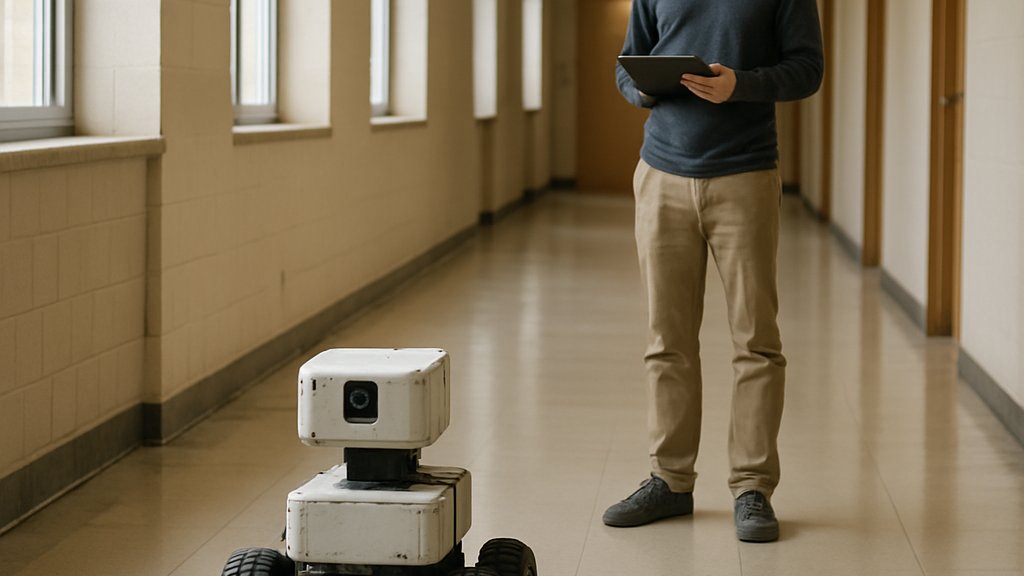
These findings strengthen confidence that Human Robot Navigation insights transferred from the headset will survive hallway rollout. Additionally, the study confirms earlier SEAN-VR demos suggesting that avatars convey subtle social cues such as proxemic intent and gaze direction.
The evidence establishes VR as an authentic sandbox. Therefore, design teams can prototype social navigation rules without risking dents or discomfort.
These parallels validate core assumptions. Accordingly, the next section quantifies the effect sizes.
Key Quantitative Study Findings
Numbers clarify credibility. Average participant velocity during orthogonal crossings reached 0.87 m/s in the arena yet 0.65 m/s in the headset. Meanwhile, minimum human-robot distance remained within 30 cm across settings. Human Robot Navigation planners that relied on distance thresholds therefore need limited retuning after VR data collection.
Correlation analysis offered further assurance. Volunteers deviated farther when robots approached closely, and this negative relationship appeared in both domains. Moreover, robot path deviation barely changed, indicating consistent planner behavior.
Core Metrics At Glance
- Closest approach distance: 1.61 m real vs 1.90 m virtual
- Pass-by velocity: 1.03 m/s real vs 0.60 m/s virtual
- Path deviation correlation: r ≈ –0.45 across conditions
Consequently, engineers can trust VR for early parameter sweeps. Yet they should account for slower human pace when calibrating timing-sensitive cues.
The statistics reveal tangible alignment. Nevertheless, practical benefits motivate adoption, as discussed next.
Benefits For Early Testing
Immersive headsets deliver three major payoffs. Firstly, safety improves because unproven policies cannot smash into ankles. Secondly, reproducibility rises; scenes reset instantly, letting teams run hundreds of trials daily. Thirdly, data richness increases because built-in eye or head trackers capture attention shifts, a prized signal for multimodal HRI modeling.
Furthermore, high-density crowds become feasible without logistical headaches. Developers spawn ten avatars and examine comfort metrics before renting a hall. Consequently, user studies scale economically.
Professionals can enhance their expertise with the AI+ UX Designer™ certification. The program aligns design choices with sound robot UX principles, ensuring that social cues remain clear.
These advantages accelerate innovation. However, every method owns limitations, addressed in the following section.
Known Limits Of VR
Perceptual gaps still matter. Depth cues degrade behind lenses, and haptic absence dampens urgency. Consequently, volunteers in virtual reality often keep larger buffers, echoing the 2019 proxemics report. Moreover, vestibular mismatch lowers top walking speed, slightly skewing dynamic metrics.
Sample size also restricts certainty. Many user studies feature under 30 participants, limiting power to detect subtle culture effects. Additionally, subjective comfort ratings sometimes diverge between modes, suggesting calibration remains necessary.
Nevertheless, awareness of these weaknesses guides mitigation plans. Therefore, researchers advocate cross-validation with incremental real trials.
Understanding drawbacks informs tool integration. Consequently, the next part outlines workflow strategies.
Integrating VR Into Toolchains
Modern pipelines feed headset data directly into ROS. Unity scenes export trajectories that planners replay in simulation. Furthermore, crowd simulators like SEAN 2.0 combine algorithm stress tests with immersive replay, blending social navigation realism and batch evaluation.
Project teams typically follow this sequence:
- Prototype policy in VR with scripted pedestrians.
- Collect live headset sessions to enrich multimodal HRI datasets.
- Fine-tune planners on both VR and arena logs.
- Deploy to hardware for limited hallway pilots.
Additionally, continuous A/B experiments compare alternative social rules by logging user reactions through post-task surveys, an essential robot UX step.
This workflow marries speed and safety. However, research continues to refine fidelity, as the next section explains.
Future Research Directions Ahead
Several gaps invite exploration. Larger multisite replications will quantify transfer error margins for Human Robot Navigation. Moreover, headset add-ons such as eye-tracking promise richer multimodal HRI signals. Researchers also aim to integrate spatialized audio and lightweight haptics, narrowing perceptual variance in virtual reality.
Algorithm benchmarks appear next on the agenda. Consequently, the Principles and Guidelines paper urges shared scenario suites covering corridor merges, bottleneck queues, and diagonal traffic. Standard metrics spanning safety, politeness, and legibility would let social navigation teams compare progress objectively.
From an applied standpoint, better authoring tools could auto-generate ethical disclosures and consent forms, easing user studies. Furthermore, design curricula that link proxemics theory to tangible robot UX analytics will upskill engineers.
These initiatives will tighten the loop between simulation and street deployment. Therefore, concluding insights follow.
Conclusion And Next Steps
Evidence now shows that Human Robot Navigation behaviors translate reliably from headsets to hallways. VR delivers safe, reproducible environments while capturing multimodal signals vital for social navigation research. However, perceptual gaps and modest sample sizes remind teams to validate iteratively. Future work on eye-tracking, haptics, and unified benchmarks will sharpen fidelity.
Consequently, robotics leaders should embed VR checkpoints into development schedules today. Moreover, they can amplify impact by acquiring the AI+ UX Designer™ credential, ensuring their next rollout respects both code and courtesy.
Disclaimer: Some content may be AI-generated or assisted and is provided ‘as is’ for informational purposes only, without warranties of accuracy or completeness, and does not imply endorsement or affiliation.


