

AI CERTS
2 hours ago
Video Robot Learning Gains Reliability Through Feasibility Gating
The following report dissects the emerging feasibility gating trend, its numbers, and its unanswered questions. Practitioners will also learn where geometry filters, semantic masks, and inverse dynamics fit. Finally, we outline certification routes for professionals seeking specialized skills.
Why Feasibility Gating Matters
Early Video Robot Learning systems replayed predicted frames as if they were perfect demonstrations. In contrast, robots frequently collided, over-stretched joints, or missed grasps. PhysV2A solves those failures using reachability gates that analyze inverse kinematics before planning.
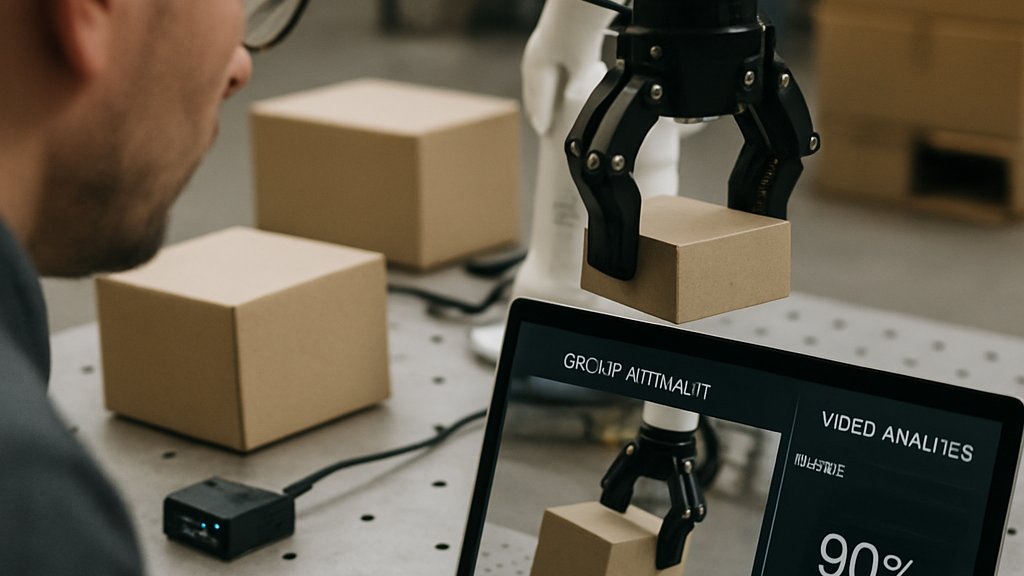
Furthermore, the paper augments gating with semantic masks that relax noncritical Cartesian axes. Therefore, constrained refinement improves tabletop success against both video prior and IK-only baselines. Authors describe grasp feasibility as trajectory-conditioned, not local, echoing long-standing manipulation wisdom.
GenVid2Robot adopts another filter based on rigid-geometric consistency. Consequently, only motions explainable by sparse depth anchors reach the arm controller. The strategy frames generated clips as uncertain hypotheses rather than authoritative programs.
These approaches mark a pivot from blind trust toward probabilistic screening. Such feasibility completion pipelines, though still experimental, underpin safer manipulation transfer. Nevertheless, gating introduces new compute and sensing demands.
Robust gating elevates reliability but adds complexity. Next, geometry infusion shows how models further close the embodiment gap.
Geometry Infusion Boosts Transfer
Geometry signals complement Video Robot Learning appearance cues. GEM-4D injects 4D geometric supervision and a learned inverse dynamics extractor. Moreover, real-world Droid tasks jumped from 61 percent to 81 percent success.
VideoWorld2 reports up to seventy percentage points improvement when disentangling dynamics from appearance. Such numbers confirm geometry enriched embodied vision models outperform vanilla video generators. Additionally, geometry helps during feasibility completion because kinematic solvers require metric context.
Researchers also integrate semantic masks into geometric spaces, yielding finer control freedoms. Consequently, the robot keeps task-relevant axes rigid while ignoring background clutter motions. This balance accelerates manipulation transfer across object scales and viewpoints.
Infusing geometry thus transforms statistical video models into actionable robot planners. However, latency challenges still threaten real-time deployment, as the next section details.
Latency Remains Critical Bottleneck
GenVid2Robot exposes Video Robot Learning pipeline delays dominated by cloud components. Video generation needs about 185 seconds, while vision-language grounding spends nearly 225 seconds. Meanwhile, local geometric checks finish within ten seconds.
Therefore, round-trip times impede on-line adaptation or reactive safety stops. In contrast, many video-to-robot factories demand sub-second responsiveness. Researchers plan lighter on-device diffusion and caching to shrink response budgets.
Furthermore, feasibility completion stages add their own costs, especially with high-dof manipulators. Nevertheless, most groups accept extra milliseconds for reduced crash risk. Hardware accelerators for embodied vision inference may eventually offset gates.
Current latency figures limit field trials beyond controlled benches. Subsequently, benchmark analysis helps quantify progress despite timing hurdles.
Benchmarks Reveal Mixed Success
Open-X, CALVIN, Droid, and RLBench remain staple video-to-robot evaluation suites. PhysV2A authors showed fewer kinematic failures in Video Robot Learning pick-and-place templates. Moreover, GEM-4D and VideoWorld2 improved long-horizon scores by wide margins.
Yet, scenarios stay mostly tabletop, single-arm, and low-speed. Consequently, transfer results in cluttered household setups or contact-rich assembly are scarce. Evaluation metrics also vary, making cross-paper comparison tricky.
Key reported gains appear in the following list.
- VideoWorld2: up to +70 points improvement on handcrafted sequences.
- GEM-4D: real Droid success rose from 61% to 81%.
- PhysV2A: fewer feasibility failures than IK-only baselines, exact tables pending.
- GenVid2Robot: cloud modules dominate 400+ second latency budget.
Additionally, many Video Robot Learning authors provide code, but peer review status varies.
These mixed successes underscore both promise and caution. Therefore, practitioners demand clearer standards before large-scale manipulation transfer rollouts. Practical guidance emerges from early adopters, as discussed next.
Practical Integration Guidance Today
Integration teams should treat Video Robot Learning outputs as probabilistic motion suggestions, never gospel. Moreover, layering feasibility completion gates filters out doomed grasps early. Projects must log gate rejection reasons to refine models iteratively.
Teams should allocate compute for mesh-based collision checking and semantic masks extraction. Furthermore, pre-processing depth frames simplifies rigid-geometric validation downstream. Adopting embodied vision backbones with 4D supervision accelerates convergence.
Professionals can boost expertise via the AI Video Specialist™ certification. Consequently, graduates grasp video-to-robot pipelines, gating concepts, and design trade-offs. Such knowledge positions engineers for coming commercial pilots.
Disciplined integration mitigates risk while preserving the scalability promise. Future research priorities will sharpen these guidelines further. Meanwhile, early adopters report shorter development cycles once clear gating templates guide developers. The next section highlights those priorities.
Future Research Priorities Emerge
Researchers aim to compress latency through on-device diffusion accelerators. Additionally, they seek universal geometry benchmarks crossing household, warehouse, and outdoor scenes. Such goals will define next-generation Video Robot Learning testbeds. Broader manipulation transfer requires dexterous grippers and tactile feedback fused with video priors.
In contrast, safety certification pathways remain ambiguous. Nevertheless, model verification tools from autonomous driving may port well. Embedding formal reachability proofs inside feasibility completion loops is another goal.
Researchers also plan richer semantic masks covering force, temperature, and contact semantics. Consequently, gate decisions will reflect more than kinematics and visuals. Embodied vision models must integrate those multimodal cues gracefully.
The field appears ready for cross-institution testbeds and shared telemetry. Therefore, community standards could accelerate reproducible Video Robot Learning breakthroughs. A concise conclusion now wraps our analysis.
Conclusion And Next Steps
Video Robot Learning now anchors many robotics research roadmaps. However, embodiment mismatch demands robust gates, geometry infusion, and inverse dynamics extraction. Recent preprints show double-digit gains once gating pipelines enter the loop. Geometry modules and semantic masks further refine manipulation transfer across scenes and objects. Nevertheless, latency and limited benchmarks still hinder wide deployment. Consequently, upcoming work targets faster generation, richer embodied vision, and standardized evaluation.
Professionals who master these topics will guide the next automation wave. Therefore, readers should explore the linked certification and stay tuned for field trials. Moreover, iterative community benchmarks will reveal whether promises translate into household reliability. Stakeholders should monitor cloud costs, latency budgets, and safety audits before scaling fleets.
Disclaimer: Some content may be AI-generated or assisted and is provided ‘as is’ for informational purposes only, without warranties of accuracy or completeness, and does not imply endorsement or affiliation.


