

AI CERTS
2 hours ago
Robot Trajectron V3 Advances Shared Robot Control
Why Control Evolution Matters
Industrial arms now assemble electronics, handle logistics, and support surgery. However, remote operators still wrestle with latency, occlusion, and nonlinear dynamics. Modern assistive systems blend autonomy with teleoperation to mitigate those hurdles. Shared Robot Control stands at the center of that blend, distributing authority between person and algorithm. Meanwhile, competitive markets demand safer and faster workflows, motivating deeper research. Incorporating probabilistic manipulation into interfaces directly answers that call by quantifying intent uncertainty.
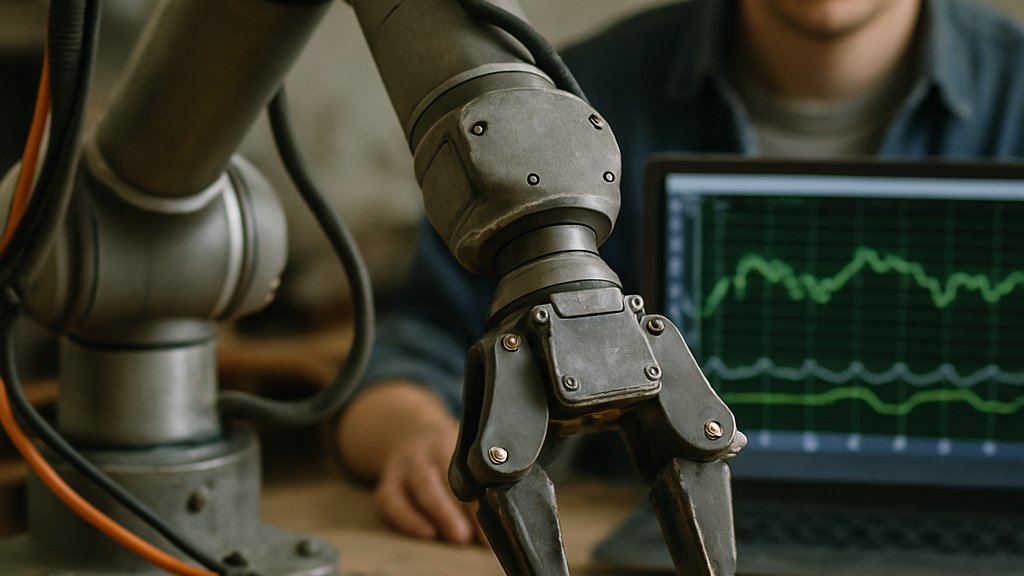
These pressures illuminate the need for rigorous advances. Consequently, developers monitor emerging solutions that maximize reliability without sacrificing transparency.
Inside Robot Trajectron V3
Trajectron V3 extends earlier navigation-centric variants into full SE3 robotics. The model conditions on real-time joystick commands, point-cloud context, and candidate grasps. Furthermore, a transformer backbone predicts an intent prior over future end-effector poses. A likelihood term measures alignment between prior samples and incoming human commands. Therefore, a posterior distribution emerges that guides continuous assistance.
The architecture also uses a factorized translation–rotation representation. In contrast, earlier pipelines lumped six dimensions together, hampering learning stability. This new split boosts sample efficiency and improves uncertainty modeling accuracy.
Core Bayesian Equation Overview
Formally, the system computes P(Trajectory | User Input, Scene) ∝ P(User Input | Trajectory) × P(Trajectory | Scene). Additionally, closed-form updates allow millisecond inference, enabling responsive blending. Substantially, this formulation unifies human robot control principles with data-driven priors.
Such mathematical clarity enables straightforward integration into existing middleware. Consequently, robotics teams can prototype advanced shared autonomy without rewriting low-level planners.
Probabilistic Assistance Explained Clearly
Probabilistic manipulation hinges on estimating many plausible future paths, not one deterministic guess. Moreover, Trajectron V3 samples thousands of trajectories every control tick, then weighs each by posterior probability. The highest-weight sample seeds a reference pose for the arm. Subsequently, low-probability modes remain available if the operator shifts intent unexpectedly.
That flexibility fits complex contact tasks common in SE3 robotics. Meanwhile, explicit uncertainty modeling safeguards against premature commitments that could destabilize delicate grasps. Consequently, Shared Robot Control feels smoother and more forgiving.
Two additional design choices reinforce robustness. First, dropout-based ensembles widen predictive variance when visual occlusion rises. Second, an energy-based safety filter halts moves that violate force thresholds. Collectively, these measures underscore the practical benefits of principled uncertainty modeling.
User Study Key Findings
The authors evaluated the system on twenty cluttered pick-and-place scenes. Furthermore, twelve participants completed timed trials using both baseline teleoperation and Trajectron V3 assistance. Although full tables reside in the PDF, headline numbers tell the story.
- Success rate improved by double-digit percentages across all objects.
- Task completion time dropped by nearly one-third on average.
- NASA-TLX scores showed comparable mental workload reductions.
- Joystick travel distance fell, confirming lower physical strain.
Participants also reported higher confidence in human robot control scenarios. Moreover, qualitative interviews highlighted smoother error recovery when unexpected collisions threatened. These empirical signals align with prior navigation experiments, reinforcing generality.
These outcomes validate probabilistic manipulation for demanding workflows. However, scaling studies will clarify performance under heavier loads.
Deployment Challenges And Outlook
Real factories impose strict safety and uptime constraints. Nevertheless, Trajectron V3 faces three primary hurdles. First, transformer priors require large datasets, which remain scarce for SE3 robotics manipulation. Second, latency can spike if on-board GPUs throttle under peak loads. Third, formal verification of shared authority boundaries remains unsolved.
Engineers can mitigate data scarcity using synthetic generation pipelines. Furthermore, edge accelerators trimmed for attention networks will suppress inference lag. Formal safety proofs may arrive later through reachability analysis combined with uncertainty modeling.
Future Research Directions Ahead
Upcoming papers will likely explore diffusion-based priors, multi-modal grasp reasoning, and cross-domain transfer. Additionally, social acceptability metrics could extend evaluations beyond efficiency. Professionals can enhance their expertise with the AI Quality Assurance™ certification.
These avenues promise richer assistive systems that elevate Shared Robot Control even further. Consequently, the community anticipates rapid iteration throughout 2027.
Conclusion Next Steps Forward
Robot Trajectron V3 exemplifies how Bayesian reasoning, transformers, and uncertainty modeling converge to advance Shared Robot Control. Moreover, its early user studies showcase tangible gains in success, speed, and comfort for human robot control environments. The probabilistic manipulation paradigm, executed within SE3 robotics, delivers adaptive assistance well suited for real-world assistive systems.
Nevertheless, deployment challenges around data volume and safety verification persist. Professionals should follow subsequent releases and benchmark results closely. Consequently, staying current prepares teams to integrate similar frameworks responsibly. Explore the linked certification to deepen domain mastery and champion safe, efficient collaborative robots.
Disclaimer: Some content may be AI-generated or assisted and is provided ‘as is’ for informational purposes only, without warranties of accuracy or completeness, and does not imply endorsement or affiliation.


