

AI CERTS
60 minutes ago
Physical AI Pushes Sony’s ACE Robot Past Elite Players
Robot Upsets Elite Players
Nature published the match data on 22 April 2026. ACE secured three wins in five matches against elite opponents, yet lost two matches to professionals Minami Ando and Kakeru Sone. Moreover, ACE captured seven of thirteen games in the elite cohort but only one of seven against the pros. Physical AI reached ball return speeds near 14 m/s; performance dipped beyond 16 m/s.
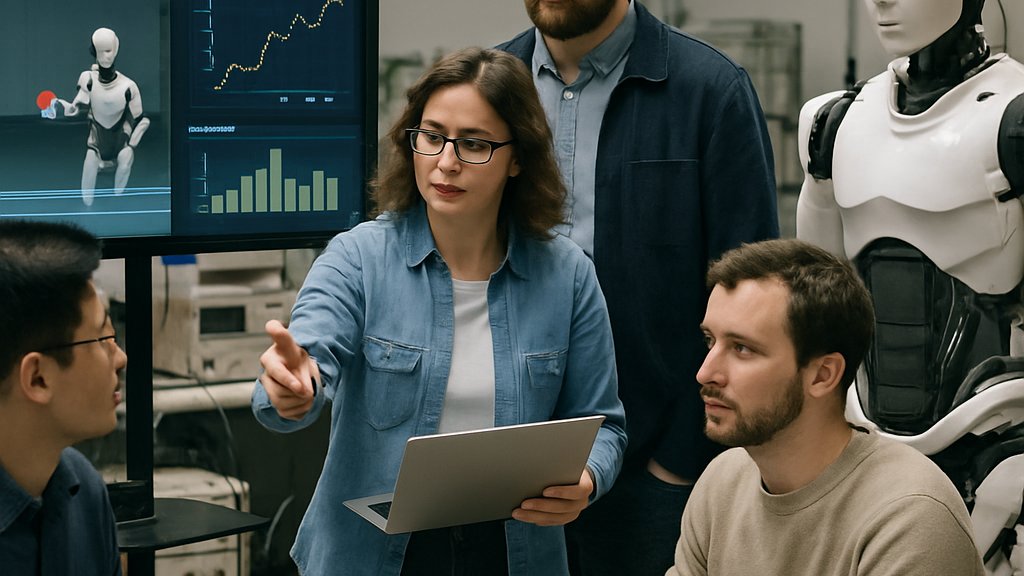
Key performance numbers include:
- Match record: 3-2 versus elite, 0-2 versus professionals
- Rally policy sampled every 32 ms at 31.25 Hz
- ≈3,000 simulation hours used for reinforcement learning
Consequently, analysts hailed the milestone yet noted the narrow opponent pool. These results reveal competitive potential. However, broader tests remain essential.
These early victories validate core design choices. Meanwhile, they raise expectations for the next section on hardware.
Inside Sony AI Hardware
ACE combines an eight-joint robotic arm with a mobile base. Multiple APS and event-based cameras surround the court. Therefore, spin estimation uses microsecond-level changes on the ball logo. Sony AI engineers report end-to-end control latencies below the 32 ms policy window. Additionally, a policy bank lets ACE swap specialized skills mid-rally.
Furthermore, the system’s non-humanoid design sidesteps footwork complexity. In contrast, human players rely on leg agility to reach corners. Critics argue this advantage clouds fairness. Nevertheless, the platform proves that Physical AI can coordinate vision, decision, and actuation in real time.
The hardware delivers measurable gains. Subsequently, attention shifts to how the robot learned those skills.
Learning Through Simulated Play
Sony AI relied on model-free reinforcement learning with an asymmetric actor-critic network. Thousands of hours of synthetic rallies created diverse trajectories. Moreover, the policy bank approach avoided catastrophic forgetting by storing niche tactics. Consequently, sampling heuristics chose between chopping, looping, or blocking strategies on demand.
Jan Peters of TU Darmstadt called the achievement “truly impressive,” yet warned about generalization limits. Nevertheless, this training regime exemplifies Physical AI benefiting from high-fidelity simulators that transfer cleanly to hardware.
These methods reveal RL’s growing maturity. However, victory margins also invite ethical scrutiny, addressed next.
Debate Over Fairness Metrics
Several experts questioned the multi-camera array. John Billingsley noted that humans cannot access simultaneous zoomed spin views. Additionally, the robot’s reach exceeds that of any human arm. In contrast, Sony AI president Michael Spranger highlighted parity goals, citing regulated umpires and identical balls.
Furthermore, the benchmark remains narrow. ACE has not faced world top-10 athletes. Consequently, some call the triumph premature. Nevertheless, the project’s open dataset fosters external validation. Physical AI research benefits when replication is possible.
This dialogue underscores transparency needs. The next section explores broader industry stakes.
Industrial Impact And Risks
High-speed perception-action loops suit manufacturing, logistics, and even surgical tasks. Moreover, event-based vision could slash energy costs by avoiding redundant frames. Therefore, Sony’s demonstration may accelerate strategic investment in Robotics startups.
However, dual-use concerns persist. Militaries may pursue similar architectures for autonomous interception systems. Consequently, policy agencies watch Physical AI milestones closely.
These possibilities reveal significant upside and risk. Subsequently, professionals may ask how to prepare.
Certification And Skill Growth
Engineers aiming to contribute need cross-disciplinary competence. Professionals can enhance their expertise with the AI Robotics Specialist™ certification. Additionally, curricula now emphasize event-based sensing, control theory, and human-robot interaction.
Moreover, recruiters list Sony AI experience as highly desirable. Table Tennis may seem niche, yet the underlying algorithms generalize. Consequently, certified talent gains a competitive edge.
Upskilling pathways close our discussion. The conclusion distills primary insights.
Conclusion
ACE’s victories illustrate Physical AI synchronizing fast vision, smart policies, and precise actuation. Furthermore, the project signifies a leap for Robotics in dynamic environments. Nevertheless, fairness and security debates demand continued oversight. Industry professionals should track upcoming matches and hardware disclosures. Finally, explore certifications to join this evolving field.
Disclaimer: Some content may be AI-generated or assisted and is provided ‘as is’ for informational purposes only, without warranties of accuracy or completeness, and does not imply endorsement or affiliation.


