

AI CERTS
5 months ago
Pentagon Blacklists Anthropic as Supply Chain Risk Fallout
Industry analysts immediately labeled the step unprecedented against a domestic developer. However, government officials argued national interests outweighed contractual guardrails embedded by the vendor. Consequently, integrators, cloud platforms, and venture funds scrambled to audit exposure before Monday trading opened. Meanwhile, lawmakers and civil-liberties advocates warned the order created a new Security Hazard for responsible AI governance.
Open letters and petitions surged, gathering hundreds of signatures from across the sector. This article unpacks the legal, operational, and strategic fallout now unfolding. Moreover, it offers practical guidance for leaders navigating escalating uncertainty.
Designation Sparks Legal Debate
The designation landed without the usual Federal Register notice or congressional briefing. Under 10 U.S.C. § 3252, the Pentagon must issue a written determination when flagging a Supply Chain Risk. However, practitioners have found no such document on public portals. Consequently, many scholars argue branding a domestic developer as a Supply Chain Risk violates due-process norms. Nevertheless, contracting officers already pause task orders referencing Anthropic code. Litigators predict a speedy injunction request once a formal notice appears.
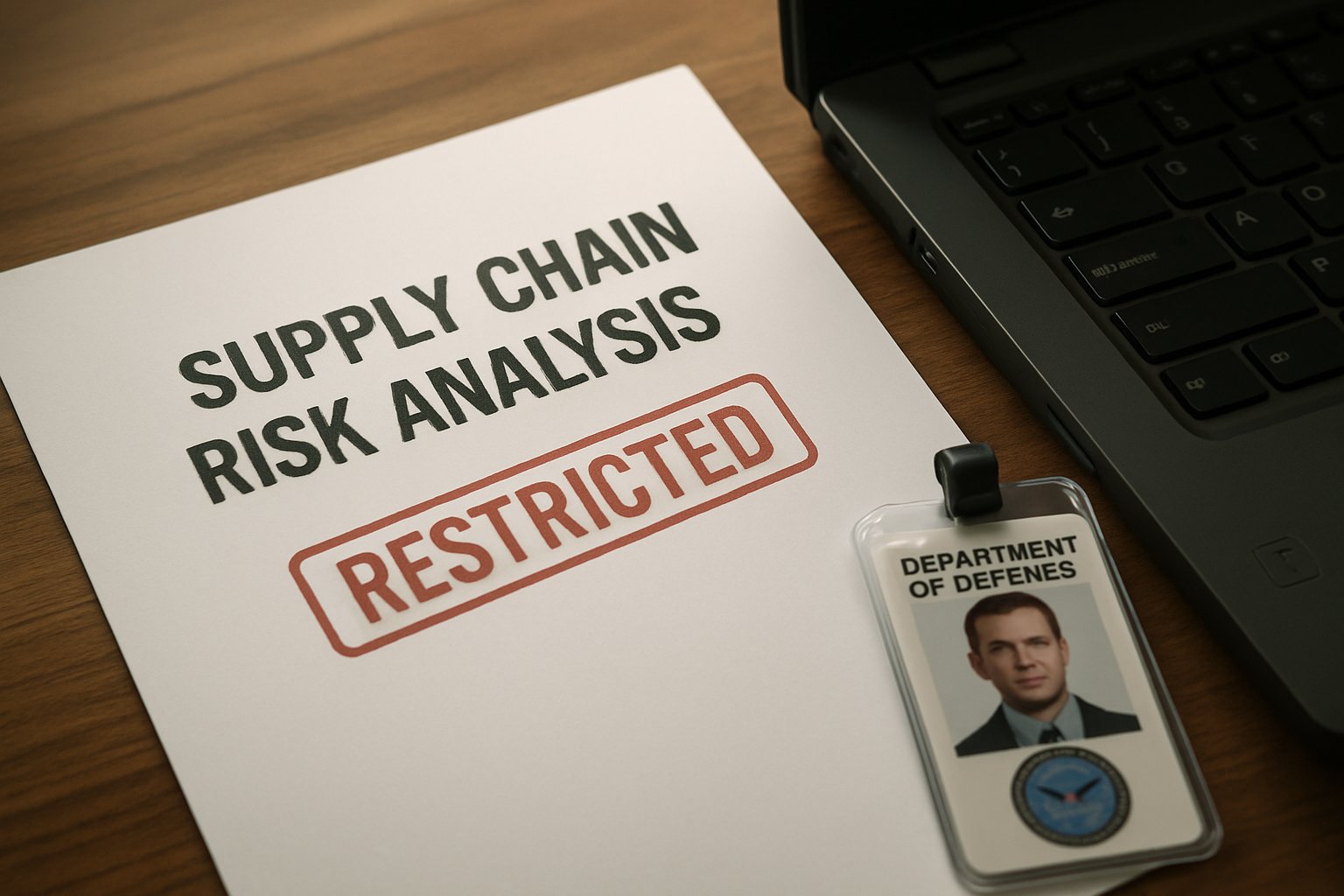
These legal doubts sow confusion across acquisition teams. In contrast, clarity on statutory steps will define enforcement strength moving forward. Consequently, attention now zeroes in on the process itself.
Statutory Process Under Scrutiny
DoD supply-chain authorities demand coordination among security, acquisition, and intelligence offices. Furthermore, the statute compels written analysis of how an adversary might sabotage classified workloads. Analysts highlight the requirement to brief four committees within Congress before restrictions lock. In contrast, the Pentagon statement appeared only on social media, labeling Anthropic a Security Hazard. Subsequently, compliance lawyers warned primes against relying solely on the informal post. Therefore, mandated actions include the following critical steps:
- Draft formal risk determination signed by the Secretary
- Complete classified threat assessment summarizing exploitation scenarios
- Notify House and Senate defense committees within 10 days
- Provide vendors an opportunity for rebuttal unless mission urgency overrides
Key Recent Data Points
DoD awarded Anthropic a prototype contract worth $200 million in July 2025. Furthermore, the White House granted agencies exactly six months to migrate away from the tools. Open letters have amassed hundreds of signatures across Google, OpenAI, and smaller startups. Consequently, the financial and human stakes continue rising daily.
Process gaps expose the action to legal headwinds. Nevertheless, industry backlash amplifies attention beyond statutory nuance. The community response therefore deserves focused examination next.
Industry Reacts With Backlash
Tech employees circulated several letters denouncing the Blacklist and urging reversal. Moreover, one petition titled “We Will Not Be Divided” listed 266 Google signatories. Investors meanwhile warned that portfolio companies face cascading deal clauses if classified as a Supply Chain Risk. Consequently, share prices for sensitive integrators dipped during early trading. Anthropic labeled the decision unprecedented and reiterated two non-negotiable red lines. Lawmakers such as Senator Edward Markey demanded immediate congressional review of the Pentagon move.
Public criticism frames the step as punishing ethical safeguards. Therefore, government security arguments stand in the spotlight. Next, we analyze those national-security claims.
National Security Arguments Examined
Officials contend they need unrestricted usage rights to address emergent battlefield scenarios. However, safety guardrails like the company’s surveillance ban allegedly hamper lawful intelligence collection. Missy Cummings nevertheless argues frontier models still misclassify critical targets under stress. Additionally, Jennifer Huddleston praises strong contractual ethics as alignment incentives. Supporters of the designation claim undisclosed model weights could embed malicious sleepers, posing a grave Security Hazard. In contrast, critics note no independent audit has confirmed embedded sabotage.
Evidence remains anecdotal, leaving national-security benefits speculative. Consequently, contractor readiness impacts demand immediate attention. Let us therefore assess operational fallout.
Operational Impact For Contractors
Palantir reportedly integrates Claude within classified analytic dashboards supporting deployed units. Therefore, engineers face a six-month clock to replace or harden those workflows. AWS architects similarly examine training pipelines that ingest model outputs for missile-defense simulations. Moreover, primes like Lockheed, Northrop, and RTX are mapping subcontractor dependencies. Compliance teams consequently elevate Supply Chain Risk scoring across every purchasing tier.
Extra reviews now delay hardware orders that reference scripts built on the disputed API. In contrast, abrupt discontinuation could disrupt mission planning systems used by forward commanders. Subsequently, several integrators requested temporary waivers while alternative models undergo validation. Professionals classify the timeline mismatch itself as a hidden Security Hazard.
Tight schedules magnify cost overruns and readiness exposure. Nevertheless, most contractors expect to comply before penalties mature. Policy watchers therefore consider possible off-ramps.
Possible Paths Moving Forward
Several scenarios could shape the coming quarter. Firstly, DoD might publish a compliant assessment, cementing the Supply Chain Risk label. Secondly, Congress could override the action through must-pass defense authorization language. Thirdly, a court may enjoin enforcement if due-process flaws prove substantial. Additionally, private negotiation could remove contentious clauses and restore purchasing eligibility.
Meanwhile, boardrooms adopt layered mitigation strategies to blunt volatility. Key measures include scenario planning, dual-sourcing, and staff upskilling in secure model integration. Professionals can enhance expertise through the AI Security-3™ certification. Moreover, automated software bills of materials now track latent Supply Chain Risk across components. Consequently, these efforts aim to reassure auditors and investors alike.
Ultimate resolution will hinge on statutory compliance and political dynamics. Therefore, leaders should monitor filings and update playbooks weekly. We close with practical takeaways and next actions.
The Pentagon decision has ignited a complex policy storm across government and industry. Legal gaps, tight schedules, and competing missions underscore why precise Supply Chain Risk governance matters. However, the present Blacklist challenges domestic norms by targeting a U.S. developer instead of a foreign adversary. Consequently, every contractor must treat downstream dependencies as a potential Supply Chain Risk until clarity emerges.
Investors and policymakers likewise confront the prospect that ethics clauses might trigger future Blacklist actions. Nevertheless, structured mitigation, continuous monitoring, and specialized training can narrow exposure. Therefore, security professionals should pursue certifications, including the linked AI Security-3™, to strengthen organizational defenses. Act now to review inventories, refresh response plans, and stay ahead of evolving Supply Chain Risk realities.
Disclaimer: Some content may be AI-generated or assisted and is provided ‘as is’ for informational purposes only, without warranties of accuracy or completeness, and does not imply endorsement or affiliation.


