

AI CERTS
2 hours ago
NVIDIA US AI Buildout: Partners Forge National Infrastructure
Therefore, industry observers see the blueprint as the most consequential domestic infrastructure push since rural electrification. This article dissects the technology stack, economic forecasts, policy backdrop, and emerging risks. Along the way, readers will learn why NVIDIA US AI momentum matters for engineering leaders and investors. Moreover, we outline practical steps for talent seeking to navigate this rapidly scaling ecosystem. Let’s begin with the scope.
Program Scope Explained Clearly
NVIDIA positions the program as an “AI industrial revolution” with an Apollo-style sense of urgency. Furthermore, partner lists span chip foundries, system OEMs, cloud titans, construction giants, and power specialists. Omniverse DSX sets the reference design for modular, gigawatt-scale AI factories capable of rapid replication. Meanwhile, the Vera Rubin platform details server racks built around the Blackwell GPU architecture and NVLink fabrics. These elements converge in a new research center at Digital Realty’s Manassas, Virginia campus. Subsequently, validated blueprints will become templates for additional regions, including Texas, Georgia, and California.
The NVIDIA US AI program claims the collective build could support trillions of parameters and multi-exaflop throughput. However, many capacity figures remain vendor projections awaiting independent confirmation. In contrast, partner contracts already cover land acquisition, substation upgrades, and supply-chain allocations through 2027. These commitments anchor the roadmap; yet oversight mechanisms will decide ultimate success.
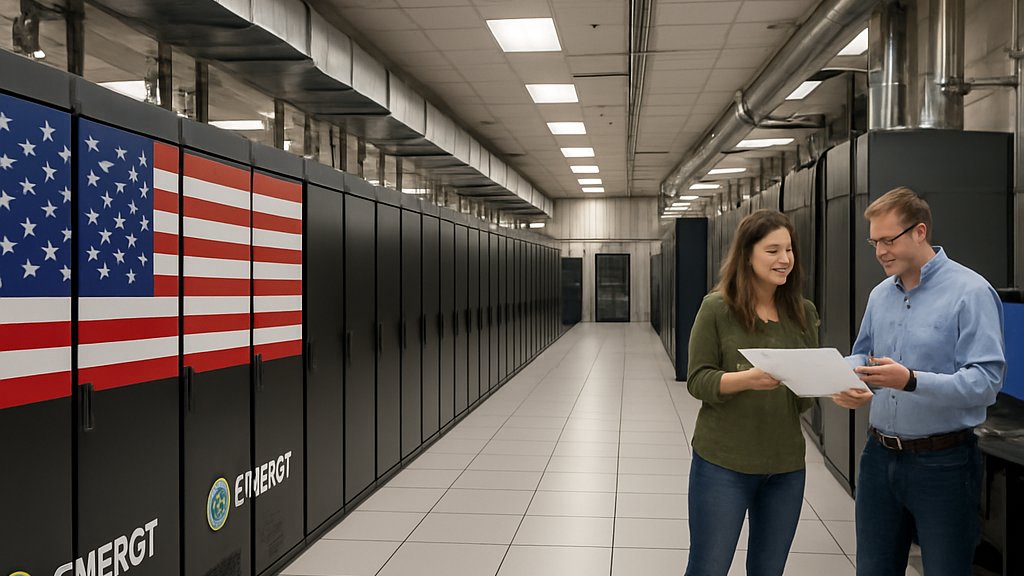
The scope illustrates unprecedented coordination across industries. Nevertheless, technical validation remains essential before scale accelerates. With that context, we examine incoming DOE systems.
DOE Systems Arrive Soon
Seven new machines targeting Argonne and Los Alamos headline the governmental side of the initiative. Additionally, codenamed Equinox delivers roughly 10,000 Blackwell GPU units according to lab statements. Argonne officials state first racks ship in early 2026, with acceptance testing by year’s end. Meanwhile, larger follow-on clusters promise 100,000-plus accelerators spanning several national labs. Those totals would dwarf existing supercomputing installations like Frontier or Aurora.
Key technical highlights include:
- ~10,000 Blackwell GPU nodes for Equinox.
- Federated networking across national labs using NVIDIA Quantum-3 switches.
- Projected 6 exaflops of AI performance once systems interconnect.
Consequently, DOE expects multi-exaflop capability dedicated to fusion, climate, and biosecurity workloads. NVIDIA US AI program materials claim cross-site networking will create a federated research lattice. However, funding packages still await final congressional appropriations during the 2027 fiscal cycle. In contrast, procurement contracts for power-distribution equipment have already entered production queues. Therefore, supply-chain readiness should remain under scrutiny through each project milestone. These schedules underscore the NVIDIA US AI scale and urgency. Next, we unpack the underlying blueprint guiding every site.
Omniverse DSX Blueprint Unpacked
The Omniverse DSX framework links design, construction, and ongoing operations via persistent digital twins. Moreover, AI agents continuously adjust cooling loops, workload placement, and power orchestration. Engineers can simulate gigawatt loads before pouring concrete, drastically cutting change orders. Subsequently, verified models become reference kits for independent operators. Cisco, Vertiv, Siemens, and Schneider contribute network, cooling, and switchgear modules pre-validated within the digital workflow. Additionally, Blackwell GPU clusters integrate through standardized NVL72 cabinets, reducing on-site cabling complexity.
Therefore, construction timelines could shrink from years to months given synchronized supply windows. Nevertheless, energy provisioning remains the primary gating factor because each block demands hundreds of megawatts. Grid operators must model contingency events within the same twin to protect reliability. The NVIDIA US AI blueprint offers a technical map; yet economics still drive adoption decisions. Understanding those economics is vital before wider rollout. Consequently, we now assess projected benefits.
Economic Impact Claims Reviewed
The NVIDIA US AI initiative asserts up to $500 billion in domestic AI infrastructure spending over several years. Moreover, 2026 GDP contributions are pitched at $485 billion, rivaling aerospace exports. Company slides underline NVIDIA US AI promises for tens of thousands of construction and semiconductor jobs. However, independent economists caution that multiplier assumptions lack peer-reviewed support. In contrast, the Brookings Institution cites more conservative gains near $120 billion when discounting double counting.
Still, local tax bases stand to benefit from early AI factories already breaking ground. Digital Realty indicates the Manassas AI factory could add 1,500 permanent data-center roles. Additionally, suppliers like Corning report new fiber-optic production shifts into upstate facilities. Therefore, some monetary upside appears tangible for the NVIDIA US AI push despite headline uncertainty. These forecasts offer promise alongside caveats. Next, we investigate critical risks complicating momentum.
Risks And Critiques Detailed
Dominant reliance on NVIDIA US AI accelerators raises antitrust questions already highlighted by Yale scholars. Furthermore, joint projects nicknamed “Stargate” involve OpenAI, Oracle, and Microsoft, deepening concentration concerns. DOE officials insist competitive procurements remain open, yet volume discounts favor a single vendor. Moreover, gigawatt power draws threaten regional grids already juggling electrification and renewables integration. Tom’s Hardware estimates one full AI factory equals a midsize nuclear reactor's output. Consequently, utilities demand long lead times for substations, water rights, and distribution upgrades.
Supply-chain fragility adds another layer because advanced packaging still relies on overseas hubs. Nevertheless, TSMC’s Arizona fab expansion could reduce that exposure after 2028. The final risk involves verifying vendor performance claims for supercomputing throughput and energy efficiency. Therefore, third-party audits by national labs and research councils will be crucial. These risks demand skilled oversight. Accordingly, workforce development becomes the next focal point.
Skills For Talent Pipeline
Massive deployments require architects, reliability engineers, and energy strategists with deep multidisciplinary acumen. Moreover, familiarity with digital twins, high-density cooling, and Blackwell GPU tuning will differentiate candidates. Professionals can validate expertise through the AI Architect™ certification, aligning with NVIDIA US AI deployment needs. Additionally, continuous learning on grid interconnection, cybersecurity, and supercomputing workload orchestration remains essential.
Universities and community colleges now coordinate with DOE apprenticeship programs at national labs. Consequently, emerging graduates gain hands-on exposure to AI factories before full commercial scale launches. Nevertheless, mid-career technologists should build specialized credentials to stay competitive. These talent initiatives address oversight gaps. Finally, we recap strategic insights.
America’s AI buildout is accelerating from concept to concrete. Moreover, the coalition spans fabs, clouds, and national labs with rare alignment. Nevertheless, power, policy, and competition risks could derail timelines. Rigorous audits and diversified supply chains will therefore remain indispensable. Professionals who master digital-twin engineering and supercomputing operations will shape outcomes. Consequently, the NVIDIA US AI roadmap offers both opportunity and responsibility. Take action now by exploring industry-recognized certifications and joining collaborative pilot projects. Your expertise can guide this infrastructure toward inclusive, sustainable innovation.
Disclaimer: Some content may be AI-generated or assisted and is provided ‘as is’ for informational purposes only, without warranties of accuracy or completeness, and does not imply endorsement or affiliation.


