

AI CERTS
6 months ago
Nvidia Chip Licensing Deal Adds Groq Inference Tech and Talent
Consequently, regulatory lawyers question whether the structure skirts antitrust filings despite the massive talent migration. This article unpacks the pact’s mechanics, technology implications, market context, and what comes next for enterprise buyers. Furthermore, we examine how SRAM integration could complement Nvidia’s existing AI stack and diversify supply risks. Finally, executives can explore advanced credentials through the AI Executive™ certification to stay ahead of hardware roadmaps. Nevertheless, pragmatic procurement teams require concrete takeaways to guide 2026 budget planning.
Nvidia Chip Licensing Context
Initially announced on 24 December 2025, the Nvidia chip licensing pact surprised even seasoned semiconductor watchers. Groq called the arrangement a “non-exclusive licensing agreement” rather than a sale. However, multiple outlets repeated an unconfirmed twenty-billion-dollar figure sourced from CNBC. In contrast, Nvidia and Groq declined to disclose financial terms, fueling speculation. Consequently, investors scrambled to adjust models for Nvidia’s fiscal 2026 earnings trajectory.
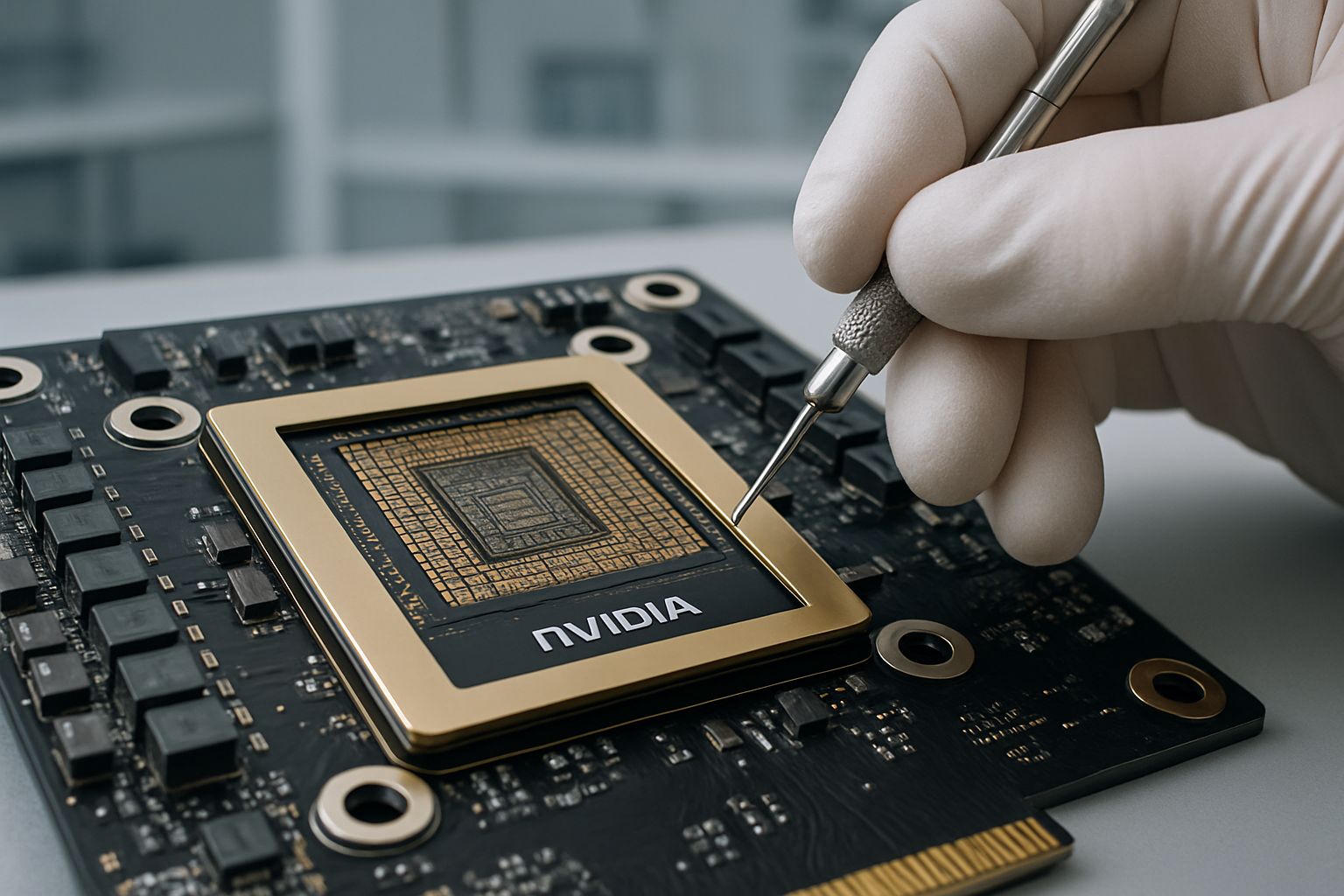
Moreover, the non-exclusive clause theoretically allows Groq to license the same IP elsewhere. Yet, the parallel leadership hire of founder Jonathan Ross complicates that openness. Analysts therefore debate whether competition will truly remain intact or merely formal. The announcement created immediate buzz yet left crucial economic details unverified. Subsequently, deeper technical questions began to dominate the conversation.
According to Groq’s release, Nvidia will obtain design files, software stack components, and support services. Meanwhile, GroqCloud continues operating under new chief executive Simon Edwards. Therefore, customers should see no immediate service disruption. Nvidia will integrate the licensed designs into its broader AI stack, which already spans GPUs, DPUs, and networking. Groq receives unspecified royalty or milestone payments, according to insiders briefed on the strategic deal terms.
Additionally, around 150 engineers, including president Sunny Madra, will transfer to Nvidia following customary retention reviews. Consequently, Groq’s remaining staff will focus on cloud operations and new licensing prospects. Analysts label the move a textbook leadership hire strategy that neutralizes a fast-rising rival. Nevertheless, legal language confirms Groq remains independent and could court other partners. These structural nuances set the stage for a deeper technical exploration. Next, we examine the underlying silicon choices shaping that integration.
Technology Behind The License
Groq’s Language Processing Unit employs massive on-chip SRAM, minimizing external memory latency during inference. Moreover, the SRAM integration eliminates expensive HBM packages that currently constrain supply chains. Therefore, each LPU can deliver superior tokens-per-watt figures for real-time language tasks. In contrast, GPUs excel at training but often idle waiting for memory fetches during small-batch inference. Consequently, Nvidia intends to position LPU blocks alongside GPUs within a unified AI stack.
- Latency: Groq claims 30μs end-to-end for 70B-parameter models.
- Efficiency: Tests show 4X tokens-per-watt versus comparable GPU servers.
- Footprint: On-chip SRAM halves board area by removing HBM stacks.
Engineers highlight the compiler-driven deterministic pipeline that streams weights across the chip’s fabric. Additionally, tight SRAM integration supports micro-batching techniques that preserve latency under heavy concurrency. Nevertheless, LPU capacity tops out below models requiring tens of billions of parameters. Therefore, hybrid deployments will likely sequence high-volume inference requests toward GPU memory pools when needed. These tradeoffs define how Nvidia chip licensing complements, rather than replaces, existing products. Groq’s SRAM-first design offers latency wins but imposes capacity ceilings. Subsequently, business context determines where each architecture shines.
Market Context And Drivers
Global AI workloads are now dominated by inference, not training, according to IDC models. Moreover, user-facing chatbots require millisecond latency, penalizing memory-bound designs. Consequently, cloud operators seek hardware that slashes watt-hours per million tokens. Nvidia chip licensing accelerates access to a proven low-latency substrate without starting from zero. Meanwhile, Groq gains global distribution and potential co-marketing muscle.
SRAM integration also sidesteps persistent HBM shortages that inflate data-center bills. In contrast, competitors like AMD and Cerebras bet on ever-larger memory footprints. Additionally, hyperscalers develop in-house ASICs but still purchase Nvidia volume for mission-critical inference. Therefore, analysts view the strategic deal as pre-emptive defense against diversified procurement. These market forces set the stage for regulatory scrutiny. Demand for efficient inference now drives silicon roadmaps more than headline training TOPS. Next, we assess how watchdogs may respond.
Regulatory And Antitrust Lens
Bernstein analyst Stacy Rasgon warns the structure could still attract FTC or DOJ attention. However, Nvidia argues that a non-exclusive license preserves market competition. Groq similarly maintains independence and points to ongoing customer contracts. Nevertheless, transferring pivotal engineers looks like a de facto acquisition to some lawyers. Consequently, regulators might request deal documents or impose behavioral remedies.
Additionally, European authorities may examine potential impacts on cloud competitiveness across the region. In contrast, structuring the transaction as a strategic deal rather than a merger could lower thresholds. Therefore, both parties submitted voluntary notices but avoided mandatory HSR filings, according to sources. These uncertainties will linger until agencies choose a formal stance. Regulatory exposure remains plausible, yet not guaranteed. Subsequently, talent implications deserve closer attention.
Talent Moves And Impact
Groq founder Jonathan Ross once helped design Google’s first TPU generations. Therefore, his migration strengthens Nvidia’s inference brain-trust overnight. Sunny Madra and 150 engineers accompany him, classifying the action as a major leadership hire. Moreover, Nvidia gains compiler teams crucial for SRAM integration optimizations. Consequently, Groq resets its org chart under new CEO Simon Edwards.
Analysts note that culture assimilation remains a key risk. However, Nvidia has integrated earlier acquisitions like Mellanox with limited attrition. Additionally, Ross will report directly to CEO Jensen Huang, signaling strategic priority. These moves elevate Nvidia chip licensing from paperwork to human capital upgrade. Subsequently, competitive positioning shifts across the broader AI stack landscape. Talent consolidation accelerates roadmap execution yet may trigger retention challenges. Next, we zoom out to competitive dynamics.
Competitive Landscape Snapshot Now
AMD, Cerebras, and Broadcom each promote alternative inference chips targeting low latency. However, none combine Groq’s deterministic compiler with Nvidia’s entrenched developer ecosystem. Consequently, the strategic deal raises barriers for startups seeking market entry. SRAM integration could pressure rivals reliant on scarce HBM during 2026 allocation cycles. In contrast, hyperscalers may welcome multiple inference paths to avoid single-vendor lock-in.
Additionally, software differentiation will matter because customers crave seamless AI stack portability. Nvidia plans to extend CUDA compilers to support LPU kernels, according to internal memos. Nevertheless, independent benchmarks will determine real competitive advantage. These factors shape strategic procurement choices for 2026 budgets. Rival responses will clarify the market hierarchy within months. Finally, we outline future scenarios for Nvidia.
Strategic Outlook For Nvidia
Industry watchers expect sampling of hybrid GPU-LPU boards by late 2026. Moreover, Nvidia chip licensing creates optionality if HBM shortages worsen. Therefore, OEM partners gain diversified bill-of-materials configurations. Additionally, corporate buyers will reevaluate performance-per-dollar metrics once reference designs emerge. In contrast, Nvidia must reassure developers that tooling remains unified across the AI stack.
Analysts foresee revenue shifting from training chips toward bundled inference services. Consequently, monetizing tokens processed could eclipse board sales by 2027. Nvidia positions itself to capture that stream before competitors mature. These projections underscore why the transaction received fast executive approval. Consequently, stakeholders should monitor integration milestones and pending regulatory feedback. Nvidia now holds a dual-path roadmap covering training and inference fronts. These factors will define competitive fortunes through the decade.
Nvidia chip licensing has quickly shifted industry assumptions about the future of inference silicon. Moreover, the Nvidia chip licensing arrangement pairs proven LPU hardware with unmatched distribution and software reach. Consequently, competitors face compressed timelines to answer the Nvidia chip licensing gambit. Regulators will determine whether Nvidia chip licensing remains a clever workaround or crosses merger thresholds. Meanwhile, enterprise buyers should benchmark latency, model capacity, and total cost before refreshing fleets. Therefore, keeping engineering skills sharp becomes vital as architectures converge. Professionals can strengthen strategic judgment through the AI Executive™ certification highlighted earlier. Act now to align roadmaps with the rapidly evolving hardware landscape.
Disclaimer: Some content may be AI-generated or assisted and is provided ‘as is’ for informational purposes only, without warranties of accuracy or completeness, and does not imply endorsement or affiliation.


