

AI CERTS
2 hours ago
Meta accelerates AI Chip Production with MTIA roadmap
This article dissects the roadmap, partnerships, design choices, and market impact behind the MTIA initiative. Additionally, it highlights risks, talent needs, and certification paths for engineering leaders. Understanding these elements clarifies why custom acceleration now defines scalable AI hardware strategies. In contrast, dependence on merchant GPUs still shapes near-term economics. Nevertheless, Meta believes its iterative chiplet approach will slash inference cost per token. Therefore, stakeholders should track the next September production milestone and the broader four-chip rollout.
Roadmap Accelerates Meta Chips
First, Meta disclosed a four-generation schedule stretching from MTIA-300 to MTIA-500. Moreover, leadership claims internal teams can iterate every six months thanks to modular chiplets. That cadence dwarfs traditional server refresh cycles. Custom silicon therefore becomes a living product, not a static release. Consequently, September production targets for MTIA-400 look realistic, according to engineers familiar with the plan.
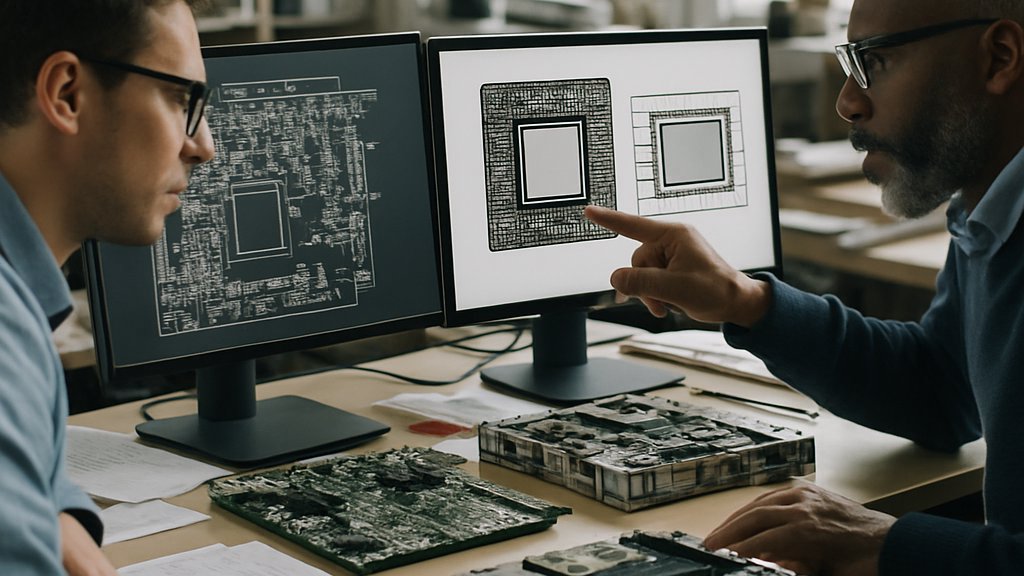
Meta already deploys hundreds of thousands of MTIA-300 dies across recommendation and ads pipelines. Additionally, the firm states that MTIA silicon handles GenAI inference for early assistant features. Industry analysts calculate this fleet represents several percent of global AI hardware shipments. However, volumes will soar once MTIA-400 lands and MTIA-450 enters pilot fabs.
In summary, the roadmap shows how AI Chip Production gains speed through internal control. Subsequently, partnership dynamics become the next decisive element.
Broadcom Partnership Powers Scale
Broadcom extends the roadmap into manufacturing reality. Furthermore, an initial agreement covers more than one gigawatt of MTIA capacity. Broadcom CEO Hock Tan framed the deal as a strategic collaboration spanning multiple gigawatts through 2029. Meanwhile, Mark Zuckerberg emphasized the flexibility unlocked by joint silicon and networking design.
TSMC supplies advanced nodes and 3D packaging for this custom silicon stack. Consequently, memory bandwidth and interconnect latencies match Meta’s inference stack requirements. Analysts argue that owning the full supply pyramid reduces exposure to GPU shortages. Nevertheless, such vertical control demands vast capital and meticulous vendor coordination.
Overall, Broadcom ensures AI Chip Production capacity while Meta directs architectural choices. Therefore, design highlights warrant closer study next.
Design Highlights And Efficiency
MTIA cores rely on an open RISC-V style ISA optimized for low-precision arithmetic. In contrast, merchant GPUs maintain broader compatibility, adding unused features and power overhead. Meta integrates high-bandwidth memory directly beside compute chiplets using 2.5D packaging. Moreover, the inference stack leverages PyTorch, Triton, and internal compilers to squeeze latency.
- Hundreds of thousands MTIA-300 chips already deployed.
- Roadmap targets four generations within two years.
- Broadcom supports more than one gigawatt rollout.
Engineering leaders note that instruction scheduling tailored to ranking models boosts utilization. Subsequently, total cost of ownership improves versus general AI hardware in certain workloads. Custom silicon also reduces cooling demands because clocks stay moderate. However, absent public benchmarks, external validation remains limited.
These design choices favor predictable, energy-efficient AI Chip Production at hyperscale. Consequently, competitive pressures now shift across the wider market.
Competitive Landscape Quickly Shifts
Nvidia still commands roughly 70 percent of the AI hardware market according to TrendForce. Nevertheless, analysts forecast ASIC share will reach almost 28 percent during 2026. Google TPU, Amazon Trainium, and Microsoft Maia follow similar custom silicon paths. Meanwhile, OpenAI reportedly evaluates external ASIC partners to lower inference cost.
Meta infrastructure teams argue that owning design allows faster model-hardware co-optimization. Additionally, tight integration simplifies fleet management because firmware and telemetry share one codebase. Competitive responses may include vendor financing, software bundling, or exclusive supply deals. Consequently, customers could see diversified pricing rather than the current GPU scarcity premium.
To summarize, AI Chip Production with custom silicon accelerators is grabbing credible share despite Nvidia’s incumbency. Subsequently, operational risks deserve equal scrutiny.
Operational Risks And Constraints
Capital expenditure remains the clearest hurdle. Moreover, HBM availability often lags demand, constraining September production schedules across the industry. Thermal limitations of advanced packaging also threaten yield at high volumes. Nevertheless, Meta infrastructure planners secure multi-year contracts with Samsung and Hynix for memory supply.
Software ecosystem maturity presents another risk. However, Meta open-sourced compilation tools to attract community contributions. Developers still compare debugging on the inference stack against familiar CUDA pipelines. Consequently, training engineers may face a learning curve during migration.
Risk factors around AI Chip Production concentrate on supply, tooling, and skills. Therefore, workforce development merits focused attention next.
Talent And Certification Needs
Hiring momentum intensifies as hyperscalers chase scarce chip and systems engineers. Additionally, operational managers must understand both silicon roadmaps and services impact. Professionals can deepen expertise through the AI Cloud Architect™ certification. Moreover, coursework covers inference stack optimization, distributed scheduling, and Meta infrastructure monitoring.
Teams fluent in RISC-V, Triton, and HBM packaging enjoy premium compensation. Consequently, AI Chip Production skill sets now rival classic full-stack engineering packages. In contrast, organizations lacking internal silicon literacy depend heavily on external vendors. Subsequently, project cycles may elongate because third parties dictate firmware updates.
In brief, AI Chip Production success demands certification and training. Meanwhile, future benchmarks will inform remaining investment questions.
Future Benchmarks And Outlook
Independent performance data remains scarce. However, Meta promised to publish standardized throughput and efficiency metrics after MTIA-400 achieves September production. Third-party labs are negotiating nondisclosure terms to run comparative tests against leading AI hardware. Moreover, analysts expect MTIA-500 tape-out by late 2027 on a 2-nanometer process.
Regulatory pressure around energy usage may accelerate disclosure because governments want transparent carbon metrics. Consequently, data center operators seek chips that maximize tokens per watt. AI Chip Production volumes will likely hinge on those published numbers. Nevertheless, Meta infrastructure upgrades continue irrespective of external commentary.
To conclude this section, broad visibility into real benchmarks will shape investment and adoption. Therefore, stakeholders should prepare contingency plans while awaiting data.
Meta’s MTIA program illustrates how internal strategy can reshape semiconductor economics. Moreover, Broadcom and TSMC partnerships prove scale is feasible beyond merchant GPUs. Design efficiencies, though impressive, still await independent validation. Nevertheless, AI Chip Production momentum appears irreversible across top hyperscalers. Engineers who grasp inference stack tuning will dictate competitive advantage. Consequently, earning the linked certification can fast-track leadership readiness. Act now, expand expertise, and join the architects powering tomorrow’s Meta infrastructure.
Disclaimer: Some content may be AI-generated or assisted and is provided ‘as is’ for informational purposes only, without warranties of accuracy or completeness, and does not imply endorsement or affiliation.


