

AI CERTS
1 week ago
MediaTek Processor Rumored To Power OpenAI Phone
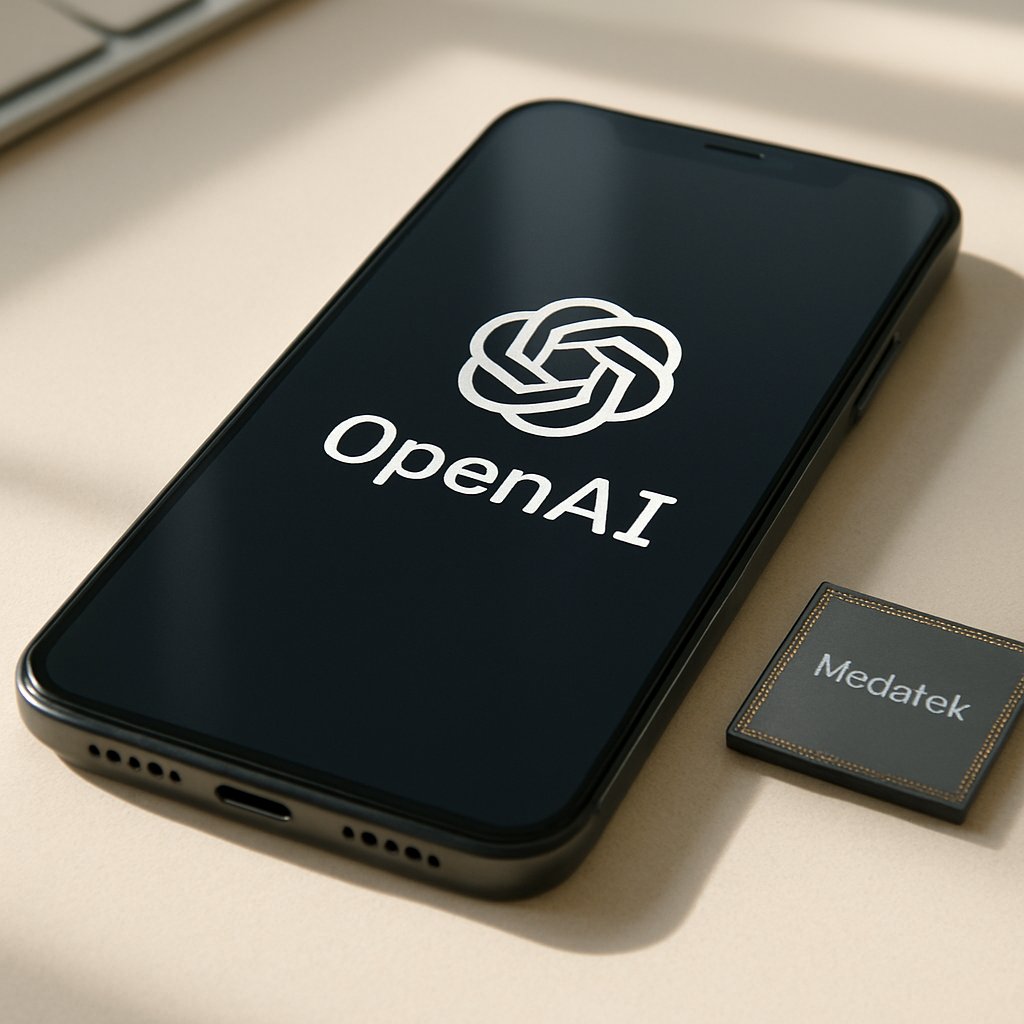
Readers will gain an authoritative snapshot of what is known, what remains rumor, and why it matters.
Meanwhile, every sentence stays concise for rapid scanning.
Let us dive into the supply-chain breadcrumbs now surfacing from Asia and Wall Street.
Consequently, decision makers can benchmark risk before the first prototype appears.
Rumor Overview And Context
Analyst Ming-Chi Kuo ignited headlines on 27 April when he posted about collaboration between OpenAI, MediaTek, and Qualcomm.
Further reports amplified his claim that a customised MediaTek Processor could anchor the device, with Luxshare building the chassis.
However, no party has issued public confirmation despite intense requests from Bloomberg, Reuters, and TechCrunch.
Consequently, timelines vary between 2028 mass production and an accelerated first-half 2027 target referenced in newer notes.
These conflicting dates underscore the speculative stage of development.
In short, analyst chatter drives the narrative, not corporate statements.
Nevertheless, the rumor mill still shapes budgets and design choices.
Therefore, the following section dissects the potential supply chain map.
Potential Supply Chain Map
Early supply-chain whispers place MediaTek in pole position for silicon design, with Qualcomm possibly offering reference IP blocks.
Additionally, Luxshare Precision appears ready to co-design the handset and oversee final assembly.
Press summaries also link TSMC’s advanced N2P foundry node to the prospective MediaTek Processor, implying bleeding-edge production capacity.
However, analysts acknowledge that node allocation remains fluid until wafers are booked.
OpenAI would integrate proprietary firmware and agent software above that silicon stack.
- MediaTek: custom SoC design and possible sole supplier.
- Qualcomm: fallback partner or IP contributor.
- Luxshare: exclusive system co-design and assembly.
- TSMC: likely 2nm N2P wafer fabrication.
The candidate chain spans design, fabrication, and assembly across four companies.
Nevertheless, official purchase orders have not surfaced.
Subsequently, we examine why MediaTek holds a competitive edge.
MediaTek Competitive Edge Explained
MediaTek has risen from mid-tier supplier to leader in AI-first silicon within five years.
Moreover, its Dimensity lineup already integrates dual NPU blocks tuned for transformer inference.
Analysts say that heritage enables a tailored MediaTek Processor to balance power, thermals, and cost for agent workloads.
In contrast, Qualcomm’s roadmap still emphasizes modem leadership over edge AI acceleration.
Consequently, Kuo’s updated note shifted probability toward a single-supplier path favoring MediaTek.
That possibility jolted Qualcomm shares, demonstrating investor sensitivity to supply decisions.
Furthermore, MediaTek’s open reference designs let partners alter the chipset microarchitecture faster than rival offerings.
The company is already sampling 2nm N2P test silicon, according to Taiwanese trade papers.
MediaTek combines process access and architectural agility.
Therefore, OpenAI could gain faster iteration cycles.
Next, technical specifications and node details deserve closer inspection.
Tech Specs And Node
Current leaks describe a 64-bit octa-core CPU cluster flanked by a dual NPU matrix engine.
Additionally, integrated LPDDR6 memory controllers would boost bandwidth for multimodal agent inference.
Reporters cite a 2nm N2P process, promising 15% speed gains versus N3E while lowering leakage by 30%.
The customised MediaTek Processor may also feature on-package LPDDR to reduce board space in compact hardware.
However, none of these specs hold until datasheets reach certification bodies.
Leaks paint a powerful yet efficient silicon profile.
Nevertheless, until fabrication starts, performance remains hypothetical.
The following section quantifies potential market impact.
Market Impact And Forecasts
IDC logged 1.26 billion smartphone shipments in 2025.
Consequently, Kuo’s suggested 300-400 million annual target would represent almost one-third of the entire market.
Observers doubt such volume is feasible for a first-generation device from a software company.
Nevertheless, even 30 million pilot units would pressure supply lines and lift MediaTek revenue materially.
Furthermore, a MediaTek Processor win could redirect design wins away from Qualcomm in premium mobile tiers.
Equity markets already reacted, with Qualcomm stock spiking 5% after the initial rumor before retreating.
- Bear case: project stalls, partners pivot elsewhere.
- Base case: 10 million units ship by 2028.
- Bull case: 300 million units achieved within three years.
Projected volumes swing wildly across scenarios.
Therefore, executives must prepare flexible sourcing plans.
Next, we weigh the unresolved risks.
Risks And Remaining Unknowns
First, privacy regulators may scrutinize always-on sensors required for contextual agents.
Moreover, building new mobile ecosystems that replace apps demands developer incentives and distribution channels.
Additionally, OpenAI lacks historical hardware experience, increasing manufacturing yield and logistics risk.
In contrast, Apple and Google might restrict integration with their respective services, complicating user adoption.
Consequently, even a capable MediaTek Processor cannot guarantee market success without supportive policy and ecosystem groundwork.
Risks span regulation, supply, and competition.
Nevertheless, proactive planning can mitigate many obstacles.
Finally, strategic lessons emerge for technology leaders.
Strategic Takeaways For Leaders
C-suite teams should maintain optionality across chipset vendors until contracts solidify.
Furthermore, product managers must design modular hardware platforms that allow processor swaps without complete retooling.
Meanwhile, engineering leads can pilot dual NPU workloads on existing development boards to accelerate software readiness.
Professionals can enhance their expertise with the AI+ Quantum Specialist™ certification.
Such upskilling ensures in-house knowledge keeps pace with on-device model advances.
Consequently, partnering early with the MediaTek Processor team grants visibility into forthcoming reference designs.
Moreover, diversified memory suppliers reduce single-point failure if a MediaTek Processor revision slips.
Strategic flexibility beats headline chasing.
Therefore, leaders should distill rumor into actionable roadmaps.
OpenAI’s rumored handset project remains unconfirmed yet already shapes silicon strategies.
However, evidence suggests that a tuned MediaTek Processor could deliver on-device intelligence at competitive power budgets.
Furthermore, the same MediaTek Processor would give OpenAI freedom from incumbent platform tolls.
Nevertheless, every forecast hinges on supply agreements, 2nm yields, and developer acceptance within crowded mobile markets.
Consequently, leaders should monitor chipset roadmaps, privacy legislation, and assembly capacity before locking budgets.
Meanwhile, reskilling through the AI+ Quantum Specialist™ program positions teams to exploit any MediaTek Processor breakthrough.
Explore the certification today to stay ahead of the agentic hardware revolution.
Disclaimer: Some content may be AI-generated or assisted and is provided ‘as is’ for informational purposes only, without warranties of accuracy or completeness, and does not imply endorsement or affiliation.


