

AI CERTS
6 days ago
Instructure Data Breach: 231M Emails Exposed Across Canvas
Meanwhile, the extortion group ShinyHunters claims it stole 3.65 terabytes across thousands of institutions. TechCrunch analysis suggests 231 million unique email addresses sit within the stolen dataset. Therefore, industry professionals need clear facts, practical guidance, and strategic preparation right now. This report delivers a concise timeline, verified numbers, institutional impacts, and forward-looking defence actions. Read on to equip your organisation before phishing lures land in student inboxes.
Breach Timeline Quick View
Understanding the chronology clarifies decision windows. First suspicious outages surfaced on 30 April when API integrations abruptly failed campus tools. Subsequently, Instructure opened an incident response bridge and revoked several privileged credentials. By 1 May, executives publicly labeled the situation the second major Instructure Data Breach in three years. Moreover, external forensics partners were engaged within hours to accelerate log analysis.
Critical Incident Date Summary
Key milestones appear below for quick reference.
- 30 April: API disruptions trigger investigation.
- 1 May: Company confirms Instructure Data Breach publicly.
- 3 May: ShinyHunters posts ransom demands online.
- 6 May: Company declares containment and service restoration.
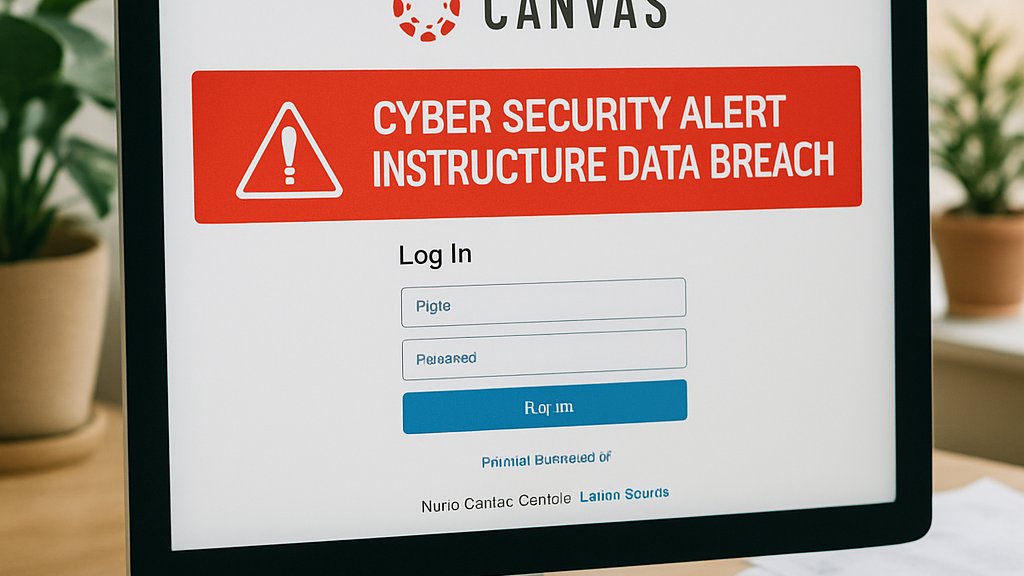
- 7 May: Defaced login pages observed by reporters.
These milestones highlight rapid attacker escalation and equally rapid containment efforts. However, time between intrusion and detection remains under review.
Consequently, attention shifted toward who stole what and how reliable their boasts seemed.
ShinyHunters Claimed Breach Details
ShinyHunters framed the haul as 275 million records spanning 9,000 institutions. In contrast, independent analysts found 231 million unique emails, underscoring usual threat-actor exaggeration. The Instructure Data Breach has quickly become a case study in attacker marketing. Nevertheless, a dataset of that magnitude fuels mass phishing and targeted social engineering. The gang leaked small samples, including UW-Madison classroom threads, to prove authenticity. Meanwhile, investigators confirmed the samples matched real roster information and message timestamps. Therefore, security teams must treat ShinyHunters statements seriously while awaiting definitive forensic counts. These conflicting figures complicate communication strategies for campus leadership.
Clearer numbers emerged once journalists compared leaked hashes with institutional directories.
Verified Email Exposure Scope
TechCrunch reporters cross-referenced 50,000 sample addresses against Have I Been Pwned. Consequently, they estimated 231 million unique emails within the stolen trove. Importantly, this analysis aligns with internal logs shared confidentially by UW-Madison administrators. However, message content volume and storage size still await final verification. Instructure insists no passwords or government identifiers were touched during the Instructure Data Breach. Moreover, multi-tenant architecture supposedly limited cross-institution credential hopping. Still, exposed conversation snippets provide enough context to craft credible spear-phishing attempts.
Analysts currently confirm exposure of:
- Names and institutional email addresses
- Student ID numbers stored in Canvas
- Private message threads between users
Those fields create a complete social map for attackers. Therefore, proactive awareness campaigns must launch before the next academic term.
With scope understood, institutions turned to damage control.
Early Institutional Impact Responses
Colleges reacted at varying speeds once the incident went public. For example, UW-Madison forced global token rotation within twelve hours. Meanwhile, European universities waited for formal notices under GDPR timelines. Some campuses paused grading activities because LTI integrations malfunctioned after revocation. Additionally, call centers fielded waves of concerned parents requesting breach explanations. Institutional counsels now weigh mandatory disclosure obligations against reputational cost. These divergent actions illustrate inconsistent preparation across the sector. However, most share one goal: reduce phishing fallout before final exams.
Consequently, leadership dashboards now track every communication referencing the Instructure Data Breach for compliance evidence.
Swift communication and key revocations reduced immediate technical risk. Nevertheless, cultural trust may take longer to rebuild.
Attention now shifts to individual security hygiene and scalable defence playbooks.
Risk Mitigation Preparation Steps
Security leaders can deploy several low-cost controls immediately. Moreover, these measures strengthen posture against future SaaS compromises. Consider the following recommended actions:
- Enforce institution-wide multi-factor authentication on Canvas and linked tools.
- Audit third-party LTI integrations and remove unused applications.
- Update phishing simulations using leaked message motifs for realistic training.
- Subscribe to ShinyHunters leak monitoring with automated alerting.
- Create a student-friendly FAQ covering the Instructure Data Breach facts.
Consequently, organisations improve readiness while awaiting official forensic numbers. Additionally, professionals can sharpen breach expertise with the AI+ Sales Strategist™ certification. These steps illustrate practical preparation that scales across resource levels.
Measured implementation builds resilience before semester turnover. Consequently, faculty disruptions stay minimal during assessment periods.
Longer-term questions now dominate board discussions.
Key Future Security Considerations
EdTech supply chains now demand deeper vendor vetting. Therefore, procurement teams should require penetration testing reports and incident reporting clauses. In contrast, many legacy contracts reference obsolete standards from pre-cloud eras. Regulators may also tighten breach notification windows after the Instructure Data Breach spotlighted student privacy.
Moreover, cyber insurers will recalibrate premiums for institutions with inadequate preparation. This Instructure Data Breach lesson will likely echo during upcoming accreditation reviews. CISOs expect renewed MFA mandates and expanded API logging across learning platforms. Subsequently, shared higher-ed security frameworks could accelerate maturity across smaller colleges. These emerging trends require budget alignment and sustained executive support.
Failing to adjust leaves schools vulnerable to the next supply-chain compromise. However, proactive governance converts painful lessons into competitive trust advantages.
The conversation now returns to overarching insights.
Conclusion And Next Steps
Higher-education security teams have navigated one of the sector’s largest SaaS compromises to date. The timeline shows detection, containment, and communication occurred within a single intense week. Nevertheless, 231 million verified email addresses now circulate among cybercriminal marketplaces. Consequently, targeted phishing and impersonation will likely rise throughout the summer enrollment window. The Instructure Data Breach also highlights differing preparation maturity across global institutions.
Therefore, leaders should operationalize the mitigation checklist and revisit vendor contract language immediately. Furthermore, investing in specialised training empowers staff to respond decisively during inevitable future incidents. Explore the linked certification to strengthen commercial acumen while reinforcing technical resilience. Act now, and next semester’s crises may look far less severe.
Disclaimer: Some content may be AI-generated or assisted and is provided ‘as is’ for informational purposes only, without warranties of accuracy or completeness, and does not imply endorsement or affiliation.


