

AI CERTS
1 hour ago
Humanoid Robot Teleoperation: China’s Next Data-Driven Workforce
Furthermore, startups abroad post similar operator roles, confirming a global wave. The trend signals fresh career paths, new economic models, and complex ethical debates. In contrast, sceptics worry about repetitive console work replacing traditional shop-floor positions. This article dissects the drivers, technologies, jobs and future of Humanoid Robot Teleoperation in China’s vast manufacturing engine. Readers will gain data, expert quotes, and actionable certification resources to navigate this accelerating domain.
Key Market Drivers Unpacked
China installed about 295,000 industrial robots in 2024, equal to 54% of global demand. Moreover, the country now operates more than two million units, according to the IFR. These figures create relentless appetite for demonstration clips that refine embodied models. Therefore, companies embrace Humanoid Robot Teleoperation to gather diverse training data faster than simulation alone. Subsequently, heavy investment flows into Shenzhen robotics clusters where hardware, sensors, and compute remain abundant.
Manufacturers also face an urgent labor shift as younger workers avoid repetitive assembly lines. Consequently, remote operator teams can plug gaps without relocating staff to inland plants. Moreover, Humanoid Robot Teleoperation offers immediate scalability for many midsize exporters. Meanwhile, supportive policies and subsidized loans reduce adoption risk for mid-size suppliers. Demand, policy, and demographics collectively propel teleoperation forward. However, data creation facilities now shape the story’s next chapter.
Rapid Rise Of Data-Factories
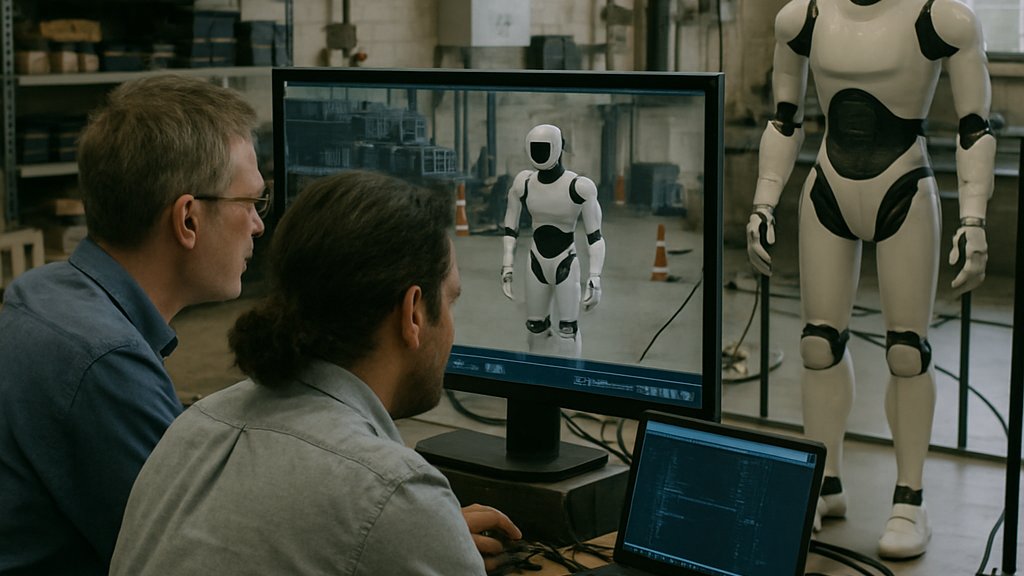
Reuters highlighted AgiBot’s warehouse where operators guide dozens of humanoids for 17 hours daily. Consequently, the site functions like a motion mine, extracting terabytes of labeled trajectories. Each joystick nudge becomes precious training data for future autonomous releases. Furthermore, UBTech pilots similar pipelines as its Walker S1 learns inside BYD’s facilities. Therefore, AgiBot positions Humanoid Robot Teleoperation as the backbone of its learning workflow. In contrast, Western startups rely on smaller pods, yet follow identical philosophies. VR control rigs let staff switch robots swiftly, maximizing usable footage per shift. Moreover, shared autonomy software filters low-level balance, easing cognitive load on human pilots.
- IFR: 295,000 robot installs in China during 2024.
- Reuters: 17 hours average teleoperated shift at AgiBot site.
- SCMP: UBTech secured over 500 Walker S1 orders.
- 1X posting: $22–$31 hourly pay for robot operators.
These numbers illustrate industrial hunger for scalable Humanoid Robot Teleoperation infrastructure. Consequently, career opportunities bloom around console bays and annotation suites. The next section explores emerging roles and required skills.
Emerging Teleop Job Profiles
Operator vacancies appear across Shenzhen robotics job boards and global startup sites. Typical listings demand quick reflexes, situational awareness, and comfort with VR control helmets. Consequently, recruiters now list Humanoid Robot Teleoperation prominently within their adverts. Additionally, firms request data labeling discipline because every mis-tagged frame degrades downstream policies. Consequently, pay bands vary: Reuters notes long Chinese shifts, while 1X offers $22–$31 in California.
Nevertheless, ergonomics remain a concern as prolonged sitting strains backs and eyes. New supervisory posts manage fleet health, schedule updates, and track training data completeness. Meanwhile, curriculum designers craft micro-credentials for console navigation, safety, and ethical compliance. Professionals can enhance their expertise with the AI + Robotics Specialist™ certification. Teleoperation introduces diverse roles, yet skills converge around attention and quick reasoning. However, understanding the technology stack is equally vital.
Core Technology Stack Overview
Humanoid Robot Teleoperation relies on low-latency networks, haptic devices, and robust perception pipelines. Moreover, real-time physics engines smooth motion commands into joint-level torque outputs. Edge GPUs from NVIDIA process vision, while cloud clusters archive incoming training data streams. VR control stations feature stereoscopic headsets combined with ergonomic controllers for natural mapping. Additionally, shared autonomy algorithms predict operator intent, reducing bandwidth and fatigue.
In contrast, some Shenzhen robotics firms experiment with exoskeleton suits for immersive guidance. Subsequently, collected motion snippets feed imitation learning frameworks to update onboard brains overnight. These components must harmonize; otherwise, lag jeopardizes safety and user trust. A tight feedback loop secures smooth teleoperation today. The following section weighs benefits against attendant risks.
Benefits And Core Risks
First, Humanoid Robot Teleoperation accelerates data gathering, letting models mature months earlier than simulation-only strategies. Secondly, remote operation mitigates injury risk for tasks involving heat, chemicals, or heavy loads. Moreover, companies fill labor shift gaps without costly migration schemes. Nevertheless, job displacement fears persist as autonomy improves and console ratios shrink. Additionally, repetitive screen work can cause cognitive fatigue, raising safety and retention concerns.
Privacy also surfaces when home or service robots stream footage to distant centres. Consequently, regulators consider audit trails, encryption, and access controls mandatory. In contrast, proponents argue that better wages and certifications will uplift operator status. Consequently, effective rules will decide how Humanoid Robot Teleoperation scales responsibly. Benefits remain significant, yet unresolved issues need coordinated responses. Therefore, stakeholders study future scenarios to balance progress and protection.
Likely Future Outlook Scenarios
Short term, data-factories will expand across coastal provinces, especially within Shenzhen robotics hubs. Meanwhile, richer shared autonomy will reduce hands-on dwell time per robot. Consequently, one operator may oversee multiple units through VR control dashboards with automated alerts. Medium term, console work will shift toward anomaly triage, model validation, and maintenance scheduling. Additionally, labor shift patterns may stabilise as displaced assemblers retrain for teleop supervision. Moreover, experts project Humanoid Robot Teleoperation will focus on rare edge scenarios by 2030. Long term, episodic oversight could dominate, making Humanoid Robot Teleoperation an exception handler instead of primary driver.
Nevertheless, success hinges on sustained supplies of high-quality training data and affordable humanoid hardware. Therefore, investors monitor sensor costs, compute prices, and regulatory signals closely. Scenarios indicate growing sophistication alongside shrinking manual footprints. The conclusion summarises actionable insights for professionals and policymakers.
Conclusion And Next Steps
China is crafting a unique labor-technology blend through large-scale humanoid teleoperation at industrial scale. Reuters, IFR, and SCMP together reveal surging installs, data-factories, and humanoid orders. Consequently, operators, annotators, and supervisors now form a fast-growing professional cohort. However, ergonomic, ethical, and employment questions require proactive policy design. Furthermore, robust technology stacks, from VR control rigs to shared autonomy, continue advancing rapidly. Stakeholders should track dataset integrity, privacy safeguards, and workforce transition programs. Professionals seeking an edge can pursue the linked certification and join pilot projects early. Ultimately, timely collaboration across industry, academia, and government will decide the trajectory of humanoid teleoperation employment.
Disclaimer: Some content may be AI-generated or assisted and is provided ‘as is’ for informational purposes only, without warranties of accuracy or completeness, and does not imply endorsement or affiliation.


