

AI CERTs
5 months ago
How Code Refactoring Bots Transform Release Velocity
Modern release cadences keep shrinking across competitive industries. Consequently, engineering leaders search for tools that compress maintenance overhead. Among emerging options, Code Refactoring Bots promise compelling speed gains. These automated agents propose or even commit structural code improvements without changing behavior. Moreover, their scope now ranges from single-line suggestions to fleet-wide pull requests. Beta data from GitHub Copilot Autofix shows median vulnerability fixes dropping to 28 minutes. Meanwhile, academic groups release recipes and multi-agent frameworks focused on safe transformations. Market analysts estimate AI development tooling could exceed USD 15.7 billion by 2033. However, questions about correctness, trust, licensing and reviewer load remain unresolved. This article examines drivers, evidence, risks and future directions surrounding the bots. It also outlines practical steps for organizations adopting the technology. Readers gain context, metrics, and governance advice for the journey ahead.
Market Shift Drivers Now
The past year delivered seismic market momentum for automated refactoring. Furthermore, Microsoft repositioned Copilot as a platform with agentic capabilities spanning Autofix and Studio. Satya Nadella described the constellation as “the UI layer for AI” during FY25 earnings. Vendor announcements coincided with rising developer interest. Stack Overflow surveys show 51 percent of professionals use AI tools daily. In contrast, only 29 percent fully trust them, underlining a credibility gap. Grand View Research projects 42.3 percent CAGR for AI development tooling through 2033. Such forecasts highlight the business urgency behind Software Acceleration mandates. Investor enthusiasm aligns with stronger technical foundations for Code Refactoring Bots adoption. Subsequently, tooling ecosystems evolved to match enterprise scale demands. Nevertheless, executive pressure for faster release trains intensifies every quarter.
Key Platform Advances Rise
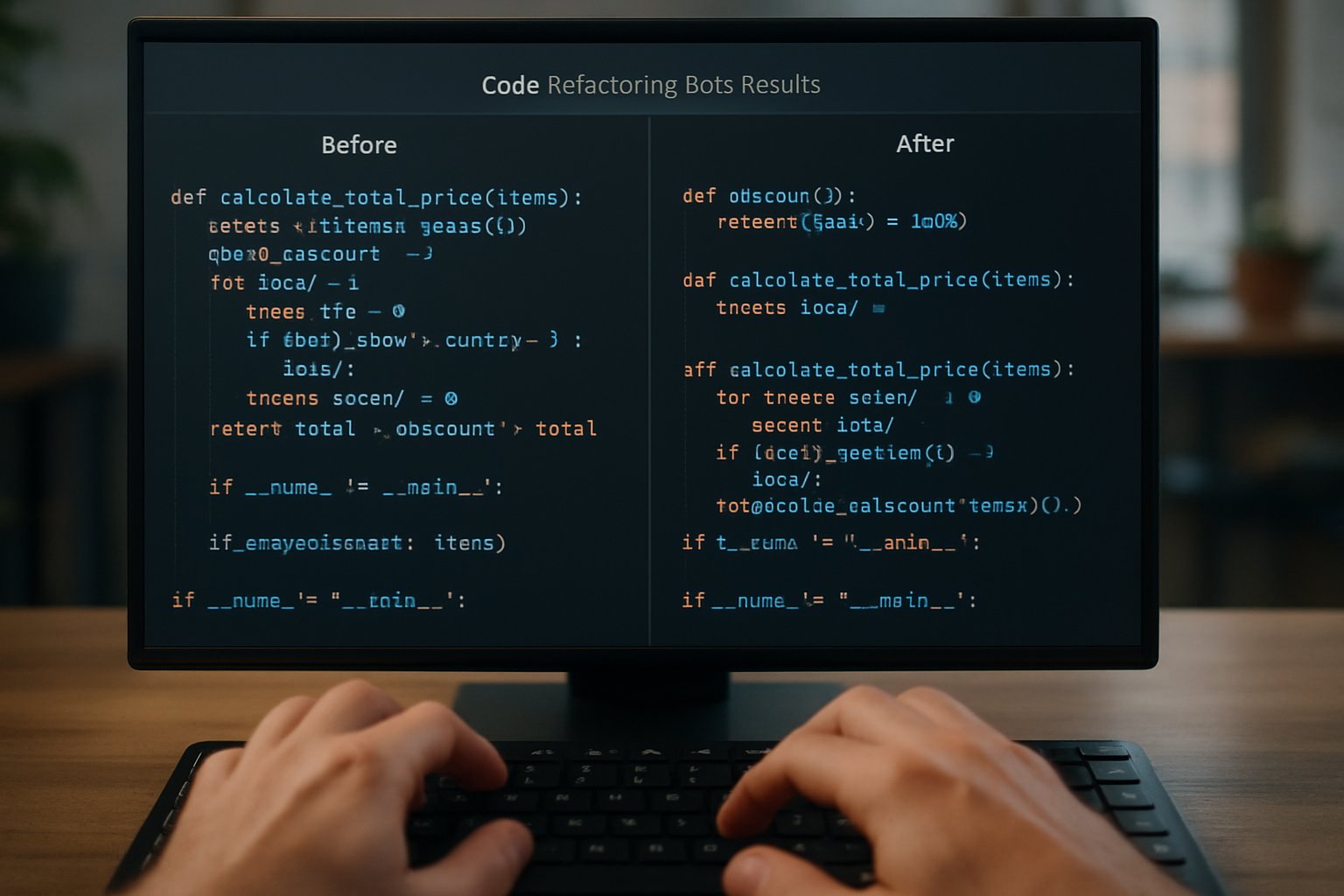
Major platforms transformed prototypes into shipping features during 2024 and 2025. GitHub Copilot Autofix now auto-generates pull requests for security alerts within minutes. Moreover, beta data shows threefold faster remediation compared with manual workflows. Sourcery expanded from Python suggestions to integrated chat and triage pipelines. OpenRewrite recipes let teams run deterministic, type-aware changes across thousands of repositories. Consequently, organizations achieve consistent policy enforcement without bespoke scripting. These advances prove Code Refactoring Bots can operate safely within continuous integration gates. Therefore, attention shifts toward measurable developer outcomes. Meanwhile, Microsoft is integrating Autofix telemetry into Azure DevOps dashboards for continuous governance.
Productivity Data Signals Surge
Quantitative studies remain scarce, yet vendor and customer metrics reveal promising patterns. Notable examples include the following results:
- 60% faster security reviews at Optum.
- 3× quicker fix times in Copilot beta.
- 7× speed gain for XSS remediation.
Additionally, the company saw a 25 percent jump in overall Engineering Productivity. Meanwhile, Stack Overflow data links daily AI tooling usage with higher perceived Software Acceleration. Spotify case studies confirm that automated pull requests can update fleets, yet merge backlogs persist. Furthermore, internal GitHub telemetry indicates defect reopening rates stayed flat during the beta. Taken together, the evidence suggests Code Refactoring Bots deliver tangible productivity gains when scoped carefully. Nevertheless, organizations must weigh these gains against growing risk factors.
Risks And Trust Gaps
Despite performance claims, trust remains a central hurdle. Developers fear silent semantic breakage, licensing exposure, and review overload. Furthermore, automated changes can bypass nuanced business rules unless robust tests exist. Academic projects like MANTRA mitigate hallucinations using retrieval-augmented generation and compilation checks. In contrast, legal challenges around training data continue progressing through US courts. Consequently, some enterprises demand indemnity clauses before authorizing large-scale bot adoption. Addressing these issues is critical for sustained Code Refactoring Bots expansion. Next, practical governance patterns illustrate viable mitigation strategies. Regulators are also scrutinizing automated code generation under emerging AI safety frameworks.
Implementation Best Practice Tips
Successful teams introduce bots incrementally rather than across every repository at once. Moreover, they restrict automerge privileges until statistical confidence surpasses predefined thresholds. Dedicated dashboards track merge latency, defect density, and Engineering Productivity over time. Rule-based recipes address repetitive security or API migrations while preserving legacy logic. Therefore, OpenRewrite scripts often serve as a safe starter set before enabling learning agents. Professionals upskill via the AI Security Compliance™ certification. Additionally, champions publish playbooks that explain review expectations and rollback procedures. Consequently, governance playbooks evolve alongside technical rollouts. These practices foster controlled Code Refactoring Bots deployments that support Software Acceleration. Subsequently, eyes turn toward future research directions shaping next-generation capabilities.
Future Outlook And Research
Research momentum is accelerating. ActRef and similar frameworks orchestrate multiple agents, compile checks, and unit tests before proposing changes. Additionally, vendors integrate telemetry feedback loops that refine models based on post-merge outcomes. Consequently, standard benchmarks such as BUG-SINCE-FIX may evolve to cover structural refactors. Marketplace competition will intensify as AWS, Google, and smaller startups introduce differentiated offerings. Grand View numbers imply enormous headroom for both Software Acceleration platforms and consulting services. Nevertheless, independent longitudinal studies must validate long-term maintainability and Engineering Productivity impacts. If those studies affirm benefits, Code Refactoring Bots could become default infrastructure like CI pipelines. The final section synthesizes actionable insights and outlines next steps.
Conclusion Actions Forward Now
Automated refactoring has left the lab and entered daily production workflows. Consequently, early adopters enjoy measurable Software Acceleration without large staffing changes. However, sustained Engineering Productivity gains demand disciplined governance, testing, and licensing oversight. Organizations should begin with narrow recipes, expand coverage gradually, and track regression metrics continually. Meanwhile, investing in human review capacity preserves trust until predictive safety metrics mature. Crucially, Code Refactoring Bots thrive when paired with robust security training and certification pathways. Readers seeking structured guidance can pursue the AI Security Compliance™ credential. Moreover, strategic upskilling ensures teams stay aligned with evolving governance requirements. Therefore, start small, measure impact, and iterate fast to stay competitive.
Disclaimer: Some content may be AI-generated or assisted and is provided ‘as is’ for informational purposes only, without warranties of accuracy or completeness, and does not imply endorsement or affiliation.


