

AI CERTS
2 months ago
Hangzhou Ruling Advances AI Labor Rights In Corporate China
Furthermore, the decision affirms earlier Beijing arbitration that reached a similar conclusion. Observers see the case as a critical precedent within China’s rapidly expanding AI sector. Employers, investors, and policy analysts must now reassess automation plans through the lens of AI Labor Rights. Meanwhile, workers gain new legal ammunition when confronting algorithmic displacement. This article unpacks the timeline, reasoning, and implications of the Unlawful dismissal finding. It also outlines compliance steps and relevant certification opportunities for HR leaders.
Court Draws Clear Line
The appellate panel affirmed lower findings that the dismissal violated statutory procedure. In contrast, judges emphasized that AI deployment resembles any ordinary restructuring decision. Therefore, it cannot satisfy the "major change in objective circumstances" clause of Chinese labor Law. Moreover, the employer’s salary-cutting reassignment offer was judged unreasonable and coercive.
Consequently, the act of Replacement was ruled Unlawful. The court ordered additional compensation beyond the CNY 311,695 already tendered. Experts celebrate the clarity, arguing the opinion reinforces AI Labor Rights without stifling innovation.
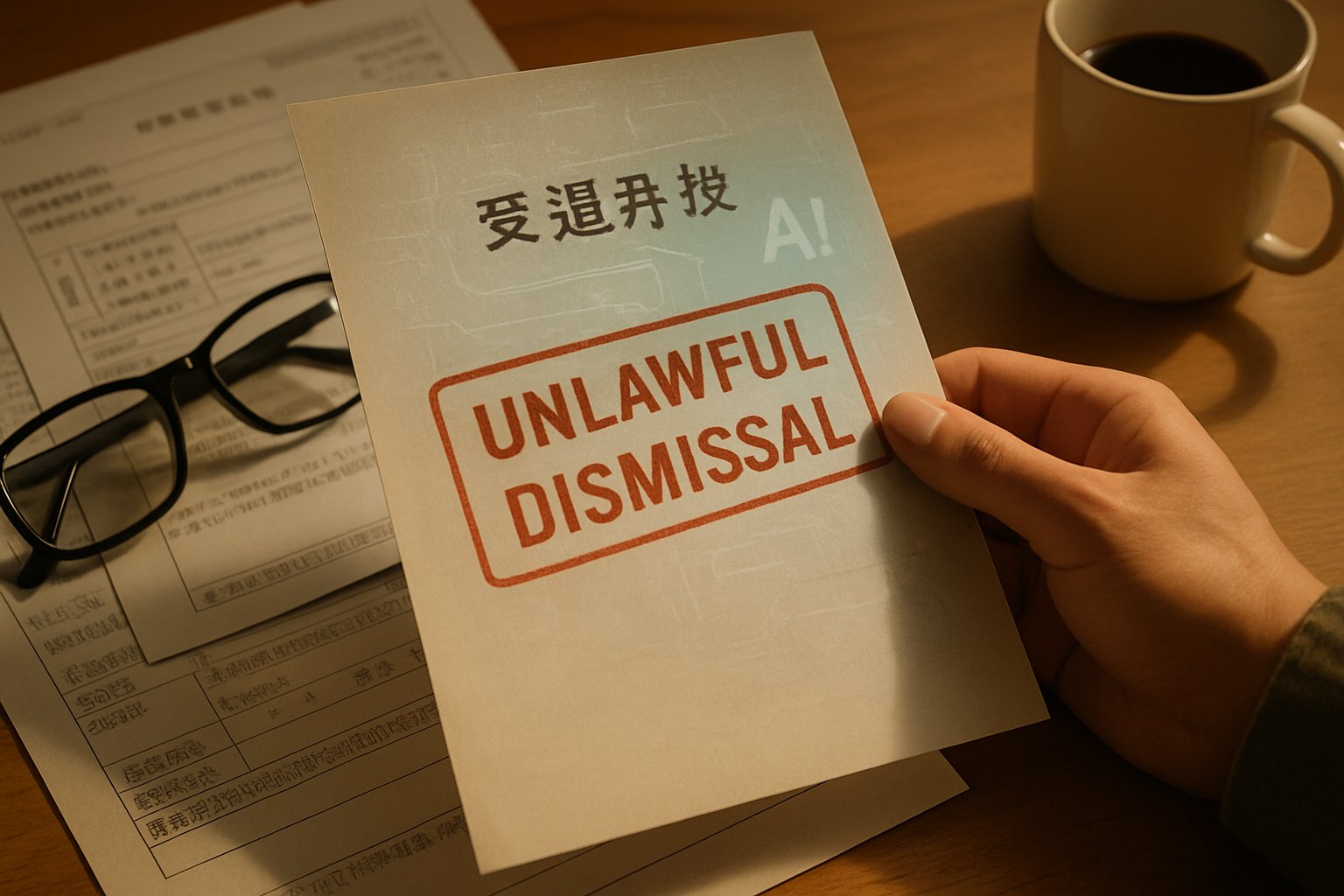
The decision draws a firm boundary around permissible restructuring grounds. However, it still allows firms to adopt AI under proper procedures.
Timeline And Case Context
Understanding the chronology reveals how precedent accumulated before the pronouncement. Initially, employee Zhou joined the unnamed software firm in November 2022. Subsequently, management introduced large language models during mid-2024 productivity experiments. They proposed demoting Zhou with a 40 percent pay cut. When Zhou refused, management terminated him, citing cost savings from AI Replacement. Zhou sought arbitration, which ruled the dismissal Unlawful in early 2025.
The Yuhang district court upheld the award in August 2025. Finally, the Hangzhou Intermediate Court published its affirmed judgment on 30 April 2026. Meanwhile, Beijing authorities released a similar arbitration case in December 2025, signaling alignment across China.
The multistage dispute shows predictable escalation from arbitration to appeal. Consequently, companies should expect workers to exhaust every legal venue before conceding.
Key Legal Reasoning Explained
Judges focused on three legal pillars. First, technological upgrades are foreseeable and controllable business choices. Therefore, they fail the unforeseeability test that anchors the statutory exemption. Second, section 40 of the Labor Contract Law demands mutual negotiation, not unilateral downgrading. Third, proportionality requires any reassignment to preserve core Employment conditions, including wage stature. Consequently, the abrupt 10,000-yuan salary reduction breached proportionality.
Moreover, the employer’s compensation offer did not reflect the worker’s past performance value. The court cited earlier Beijing arbitration and academic commentary to bolster its doctrinal analysis. Notably, experts like Wang Xuyang stress that AI Labor Rights must evolve within existing legal frameworks.
The reasoning blends doctrine with pragmatic fairness. Therefore, it guides future tribunals evaluating AI-driven dismissals.
Business Impact And Insights
For executives, the verdict changes risk calculations. Instead of instant headcount cuts, firms must weigh training, redeployment, or generous exits. Moreover, investors now scrutinize automation plans for hidden legal liabilities.
- Detailed consultation with workers before algorithmic Replacement.
- Cost models that include litigation and compensation buffers.
- Retraining budgets aligned with evolving Employment pathways.
- Board reports tracking AI Labor Rights exposure quarterly.
L&E Global notes that similar findings are emerging across China’s coastal provinces. Consequently, multinationals operating in China must draft groupwide protocols reflecting the precedent. Professionals can enhance their expertise with the AI Human Resources™ certification. The credential equips HR leaders to navigate complex Employment redesigns responsibly.
The message for business is unmistakable. Nevertheless, compliant restructuring still unlocks AI efficiency without breaching AI Labor Rights.
Worker Protections Strengthened Today
From a labor perspective, the decision offers concrete protections. Employees now possess persuasive precedent when contesting algorithmic layoffs. Additionally, arbitration panels will likely reference this case to award higher damages. Workers can document unreasonable downgrades and compare them against the Hangzhou facts. Consequently, bargaining power shifts, fostering more balanced Employment negotiations.
Union organizers also frame the ruling as validation of collective input during tech transitions. In contrast, some employer groups fear slower adoption curves if litigation risk escalates. Yet analysts remind stakeholders that the court did not ban AI use, only abusive Replacement.
Protections have tightened without halting innovation. Meanwhile, documented fairness can still expedite ethical AI Labor Rights compliance.
Broader Global Policy Signals
The ruling resonates beyond Zhejiang. International observers compare it with European debates on algorithmic Employment safeguards. Moreover, Goldman Sachs forecasts of 300 million at-risk jobs add urgency. Consequently, governments everywhere juggle productivity ambitions against rising job-security anxiety. Beijing aims for 90 percent intelligent terminal penetration by 2030, heightening tension within China.
Legal scholars note that AI Labor Rights discourse now influences industrial policy drafts. In the United States, lawmakers monitor Asian jurisprudence while crafting algorithmic transparency bills. Subsequently, multinational compliance officers track divergent obligations across markets.
The Hangzhou case adds judicial weight to global human-centric AI governance. Therefore, corporate policy teams should harmonize strategies before regulatory fragmentation deepens.
Practical Compliance Action Steps
Legal counsel should begin with a workforce inventory against projected algorithmic functions. Next, HR must map critical skills, potential Replacement overlaps, and retraining costs. Moreover, any contract modification requires documented negotiation and written consent. Consequently, employers should draft standard templates reflecting the Hangzhou reasoning.
- Issue AI impact notices 30 days before planned changes.
- Offer equal or better Employment packages wherever feasible.
- Record all meetings and obtain employee signatures.
- Set aside severance reserves exceeding statutory minimums.
- Review AI Labor Rights litigation every quarter.
Additionally, boards should schedule annual audits of AI Labor Rights exposure metrics. Nevertheless, transparent dialogue with staff often prevents disputes before they escalate.
Following these steps reduces courtroom surprises. Furthermore, proactive action supports brand reputation while honoring AI Labor Rights.
Conclusion
Hangzhou’s judgment underscores that technology gains must align with established worker protections. Courts positioned AI as a tool, not an excuse for abrupt terminations. Consequently, employers need structured change processes, transparent dialogue, and robust compensation planning. Meanwhile, employees gain stronger bargaining chips through clear judicial language and growing arbitration precedent.
Policy makers worldwide will watch how Chinese firms implement these guidelines while still scaling automation. For leaders intent on ethical transformation, targeted upskilling remains critical. Consider enrolling in the accredited AI Human Resources™ program to build forward-looking workforce strategies. Proactive preparation today will secure competitive, compliant growth tomorrow.
Disclaimer: Some content may be AI-generated or assisted and is provided ‘as is’ for informational purposes only, without warranties of accuracy or completeness, and does not imply endorsement or affiliation.


