

AI CERTS
55 minutes ago
AI Industry Leaders Face Murati’s Bold Frontier Comeback
Moreover, we examine startup rivalry dynamics, compute deals, and safety debates that could reshape frontier labs. Industry veterans suggest that real-time interaction models may force incumbents to overhaul product roadmaps. Meanwhile, talent churn and lofty valuations introduce execution risks that cannot be ignored. Therefore, professionals should follow each milestone closely to anticipate future market competition. Subsequently, this report provides context, numbers, and expert insights to guide strategic decisions.
Murati Returns, Stakes Claim
Mira Murati left OpenAI in early 2025 and quickly incorporated Thinking Machines Lab. In February 2025, the stealth outfit surfaced with thirty researchers and grand ambitions. However, her public profile dimmed until a Bloomberg interview in June 2026 thrust her back into headlines. During that interview, she framed the lab as a collaborator rather than a mercenary scaling factory. Nevertheless, analysts noted how the narrative still challenged entrenched AI Industry Leaders.
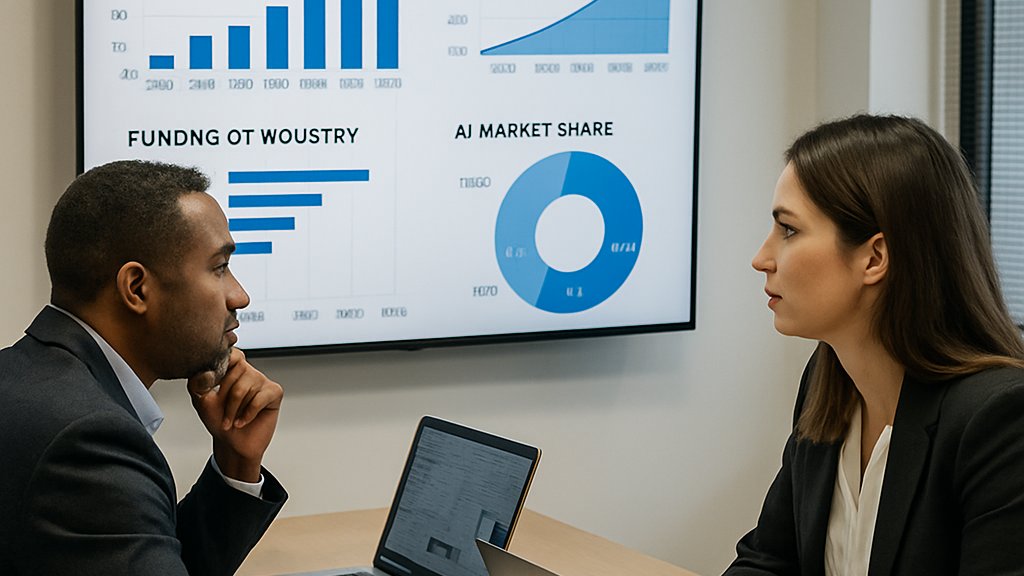
Murati’s reemergence positions her as a visible alternative to incumbents. Consequently, early messaging already influences boardroom conversations.
Next, funding details reveal how that positioning gained real backing.
Funding Fuels Early Momentum
Thinking Machines stunned investors by raising roughly $2 billion in a record-size seed round. Reports placed the post-money valuation near $12 billion, dwarfing typical frontier labs launches. Moreover, Bloomberg later noted talks that could push valuation toward $50 billion. Such numbers escalate startup rivalry and amplify founder dynamics across Sand Hill Road. In contrast, skeptics argue that extreme valuations compress execution timelines and magnify downside if milestones slip. Therefore, some AI Industry Leaders quietly question whether revenue projections justify those figures.
- $2 billion seed round
- $10–12 billion post-money valuation
- Talks targeting $50 billion valuation
- Backers: Andreessen Horowitz, Accel, AMD Ventures
The capital positions her among AI Industry Leaders seeking scale. However, it also sets performance expectations at orbital altitude.
The Nvidia alliance illustrates how she plans to meet those expectations.
Nvidia Deal Alters Landscape
On 10 March 2026, Nvidia committed at least one gigawatt of Vera Rubin systems to Thinking Machines. Additionally, the chipmaker took a strategic stake, though financial terms remain undisclosed. Jensen Huang lauded timing, stating Rubin arrived when compute-hungry frontier labs need fresh architectures. Consequently, the agreement arms Murati with scarce hardware and signals credibility to cautious customers. Moreover, AI Industry Leaders must now secure comparable supply or risk slower iteration cycles.
The pact narrows Murati’s infrastructure risk. Nevertheless, escalating the compute arms race heightens environmental and cost concerns.
Attention then shifts to the software side, where interaction models differentiate the story.
Interaction Model Tech Explained
The May 2026 research preview introduced TML-Interaction-Small, a multimodal Mixture-of-Experts network with 276 billion parameters. It processes audio, video, and text in 200-millisecond micro-turns, reporting 0.40-second perceived latency. Furthermore, an asynchronous background model handles deeper reasoning without blocking the conversational loop. Such responsiveness could redefine user expectations and intensify market competition among voice assistants. Developers already experimenting through the limited preview praise smoother handoff between modalities. However, independent replication remains pending, leaving room for cautious optimism.
- 276 billion total parameters; 12 billion active
- 200 millisecond micro-turn processing
- 0.40 second perceived latency
- Full audio, video, text support
Subsequently, AI Industry Leaders tracking latency metrics will benchmark their portfolios against these figures. That comparison may pressure incumbents to accelerate similar capabilities.
Interaction models showcase Murati’s technical edge. Therefore, hardware gains translate into tangible product differentiation.
Yet technology alone cannot offset organisational volatility, as the talent section reveals.
Talent Flux Raises Questions
Reports describe several founding researchers leaving in late 2025, only to return months later. Meanwhile, headcount estimates vary from 100 to 150, signalling fluid structures. Such churn fuels debates about founder dynamics and execution discipline. In contrast, Murati argues the lab’s culture prioritises autonomy, attracting mavericks uncomfortable inside larger organisations. Nevertheless, investors compare stability metrics when ranking frontier labs for follow-on rounds. Consequently, AI Industry Leaders will scrutinise retention rates as closely as benchmark scores.
Talent turbulence represents both agility and risk. Moreover, leadership cohesion will shape delivery timelines.
Competitive positioning further illustrates why cohesion matters.
Competitive Chessboard Shifts Rapidly
Thinking Machines now competes with OpenAI, Anthropic, Google DeepMind, Meta, and xAI in real-time multimodal research. However, its interaction emphasis differentiates the narrative and fuels fresh startup rivalry. Furthermore, Murati leverages her inside knowledge of OpenAI’s pipelines to anticipate opponents’ next releases. Analysts predict feature convergence yet expect divergent governance stances to influence market competition. Therefore, AI Industry Leaders must track not just model quality but also deployment philosophy. Founders across the valley cite her cross-lab insight when debating founder dynamics and scaling playbooks.
Competition will intensify as interaction features proliferate. Subsequently, governance could become the next decisive front.
That prospect drives the ongoing safety debate.
Governance And Safety Debate
Murati testified during the Musk v. Altman trial, describing leadership conflicts and opaque oversight at OpenAI. Moreover, she cautioned that concentrating decisions among few actors imperils public trust. Thinking Machines publicly invites peer review of interaction models, promising staged deployment gates. Additionally, the lab highlights alignment challenges introduced by continuous audio and video streams. Experts may upskill through the AI Executive Essentials™ certification. Nevertheless, critics warn that vendor ties like Nvidia’s could dilute independent oversight despite open rhetoric. Consequently, AI Industry Leaders engaged in policy forums will weigh these trade-offs carefully.
Governance strategies may define public adoption curves. In contrast, technical prowess alone rarely secures lasting legitimacy.
The final section summarises strategic implications for decision makers.
Consequently, Murati’s comeback carries implications far beyond one startup. AI Industry Leaders now face a competitor equipped with capital, compute, and unconventional architecture. Mira Murati has re-entered the arena with momentum and renewed scrutiny. Moreover, startup rivalry will intensify as interaction models mature and valuations climb. Nevertheless, sustained success demands stable teams, transparent governance, and measured scaling. Professionals should monitor upcoming benchmarks, funding rounds, and policy filings. Finally, consider bolstering strategic skills through recognised credentials to remain competitive in this accelerating field.
Disclaimer: Some content may be AI-generated or assisted and is provided ‘as is’ for informational purposes only, without warranties of accuracy or completeness, and does not imply endorsement or affiliation.


