

AI CERTS
3 hours ago
AI Healthcare Boosts India’s Smart Crop Disease Detection
The result is an ecosystem racing to catch blight before it spreads. Yet questions remain about true field performance, privacy, and farmer adoption. This article unpacks policy moves, technical progress, and business realities. Readers will see which metrics matter and where gaps persist. Finally, we highlight credentials that help professionals guide the next deployment wave.
Policy Drives Scale Up
Delhi’s Digital Agriculture Mission anchors the national push. Furthermore, officials report 7.63 crore farmer IDs and 23.5 crore surveyed plots. These records feed labeling pipelines for disease Detection models. Meanwhile, the National Pest Surveillance System covers 66 crops and 432 pests. Consequently, more than 10,000 extension workers upload photos daily. Such supply lines shorten data scarcity for AI Healthcare algorithms. In contrast, earlier pilots relied on ad-hoc datasets scraped from research portals. Two key quotes illuminate intent.
Secretary Devesh Chaturvedi said, “NPSS will be widened nationally.” Krishna Kumar of CropIn added the seven-day risk forecast ambition. These statements show policy and private aims aligning. The section underscores how public platforms scale datasets rapidly. However, volume alone cannot guarantee precision, leading to technical considerations ahead.
Emerging AI Tool Landscape
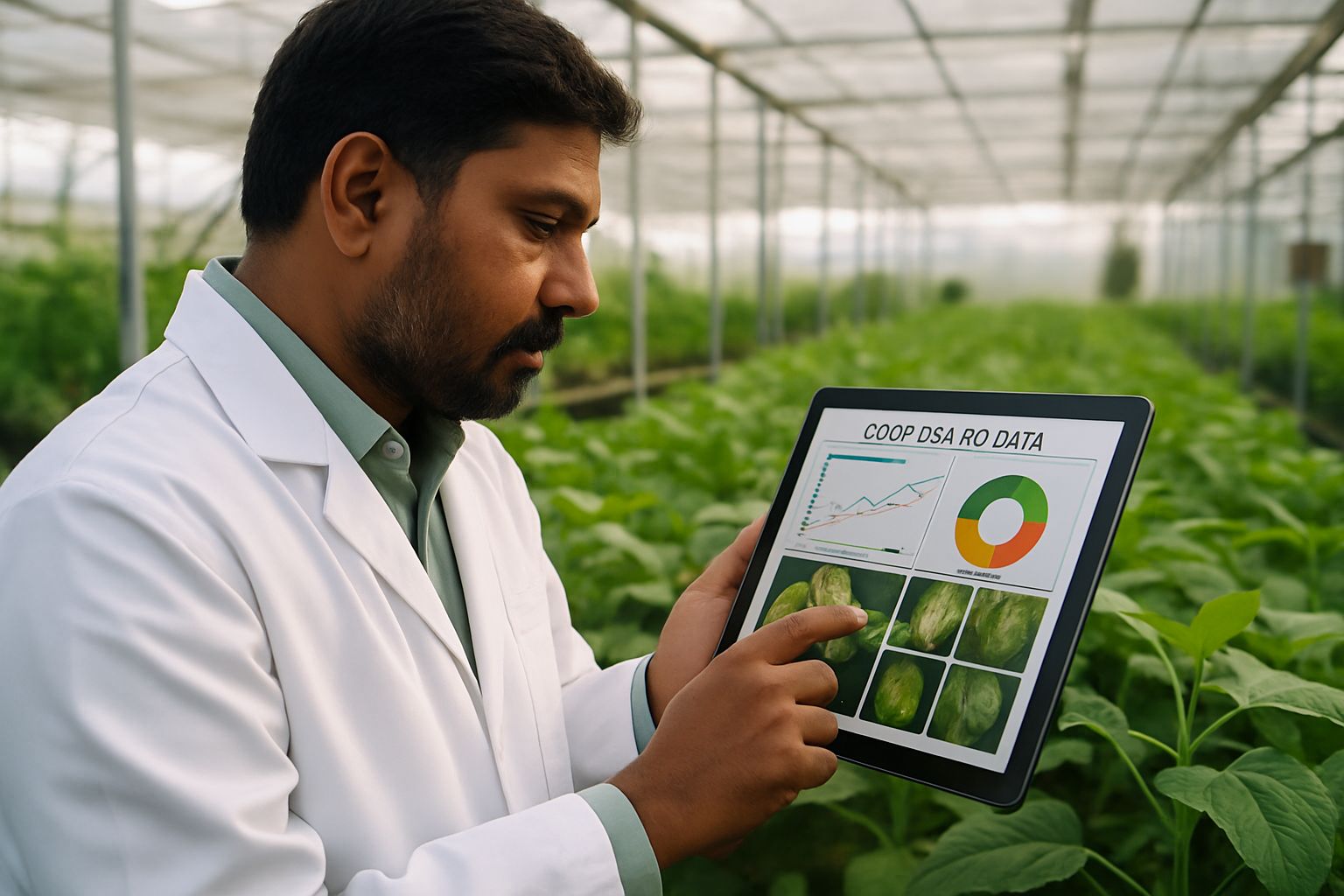
Startups, institutes, and global apps crowd the tool shelf. Plantix, PlantVillage, and ICRISAT’s Plant Health Detector dominate downloads. Moreover, CropIn combines satellite data with field images for early Detection. AgNext applies spectral imaging, while DeHaat offers multilingual chatbots. Additionally, Fasal.ai promotes a Bharat Compute narrative stressing data sovereignty. Government labs focus on edge models to support poor connectivity. Therefore, farmers can receive instant advice even when networks fail.
AI Healthcare vendors integrate these services into broader agronomic dashboards. Accuracy climbs when models fuse imagery with weather and soil feeds. Yet trade-offs between edge and cloud persist. The landscape shows vibrant experimentation across India. Subsequently, understanding individual players gives clearer market signals.
Key Indian Startup Profiles
- CropIn: Claims 0.5 billion farm records powering seven-day risk forecasts with 93% laboratory Accuracy, delivering AI Healthcare dashboards.
- Fasal.ai: Beta edge model aligned to Bharat Compute, stressing sovereign Agriculture data stewardship.
- AgNext: Spectral cameras for quality and disease Detection during procurement.
- DeHaat: Digital advisory network spanning 11 states and 1.6 million farmers.
These snapshots illustrate diverse data strategies and revenue models. However, laboratory gains must translate into reliable field Accuracy. The following section evaluates performance claims.
Accuracy At Field Level
Controlled pilots often headline impressive numbers near 93% Accuracy. Plantix and ICRISAT produced that figure across 8,100 test images. Nevertheless, real farms throw unpredictable lighting, occlusion, and mixed symptoms. Researchers note performance drops of 10-20 percentage points in uncontrolled settings. Consequently, teams enrich datasets with multiple crops, seasons, and device types. Multimodal AI Healthcare frameworks merge satellite stress maps with leaf close-ups. Additionally, federated learning protects privacy while broadening sample diversity. Benchmarks now require per-crop confusion matrices, not single aggregate scores.
Meanwhile, extension workers demand offline inference under 500 milliseconds. Such constraints push aggressive model compression. Field Accuracy matters because misdiagnosis triggers wasted pesticides and lost yield. In summary, precision depends on data breadth, model design, and deployment context. Therefore, the user journey deserves equal scrutiny next.
Adoption Barriers Persist Today
Smartphone ownership in rural India remains uneven at 42% per GSMA. Moreover, connectivity lags in rain-fed belts where disease pressure peaks. Language diversity makes text UIs brittle; voice bots still lack nuance. Consequently, many programs rely on extension intermediaries to bridge gaps. Farmers often distrust AI Healthcare predictions without human validation. Additionally, false positives can erode credibility and income rapidly. Subsidy or freemium models attempt to lower cost barriers.
In contrast, enterprise APIs target exporters and insurers, not smallholders. These factors slow mass scaling despite technical readiness. Nevertheless, tailored outreach and training show encouraging pilot uptake. This overview stresses that adoption equals value realization. Subsequently, data ethics surfaces as the next hurdle.
Data Governance Concerns Rise
High-resolution farm photos embed geotags, personal names, and crop patterns. Therefore, privacy advocates warn against unchecked centralization. Bharat Compute supporters argue for domestic processing within India’s borders. Federated AI Healthcare training offers one compromise by keeping images local. Furthermore, open audits of model drift improve transparency. The Digital Public Infrastructure guidelines now mandate consent banners in local languages. Nevertheless, compliance varies across private platforms. Experts urge clear retention policies and deletion timelines.
- Deploy differential privacy when aggregating sensitive Agriculture imagery.
- Publish quarterly Detection error reports detailing bias trends.
These steps build trust without stalling innovation. Consequently, a healthy governance framework supports sustainable market growth. The next section assesses financial signals.
Market Outlook And Opportunities
India mirrors a global AI in Agriculture CAGR of 23.1%. Market observers expect domestic revenue to cross USD 850 million by 2028. Moreover, policy funding and venture rounds accelerate platform consolidation. Startups integrating AI Healthcare with fintech or carbon services attract premium valuations. Meanwhile, enterprises pay for disease forecasts that de-risk supply chains. Professionals seeking roles in product design, data science, or regulation face rising demand. Individuals can deepen skills through the AI Healthcare Specialist™ certification. Additionally, universities partner with agritech firms for capstone deployments.
- Multimodal models outpace single-image Detection precision.
- Edge inference modules ship inside low-cost cameras.
- Regulated data exchanges monetize anonymized farm records.
In essence, opportunity hinges on uniting technical rigor with farmer trust. Consequently, continuous upskilling becomes non-negotiable. The concluding section recaps actionable insights.
Indian crop disease AI now sits at a pivotal junction. Policy infrastructure feeds unprecedented datasets into agile research labs. Moreover, AI Healthcare platforms translate that data into timely field alerts. Yet phone access, model precision, and privacy still limit universal benefit. Nevertheless, startups and institutes iterate quickly on multilingual, edge, and federated breakthroughs. Professionals who master these dynamics can shape sustainable Agriculture growth. Therefore, consider earning the referenced certification to stay market-ready. Explore further reports, share feedback, and drive ethical innovation today.


