

AI CERTS
7 months ago
Amazon Monitron Shift Signals Industrial IoT AI Evolution
Meanwhile, market forecasts predict robust growth for predictive maintenance solutions despite this shake-up. Therefore, understanding the latest technical, commercial, and privacy changes becomes essential. This article examines key updates, migration paths, and strategic takeaways for manufacturing executives. Additionally, we highlight certified learning options to strengthen in-house Industrial IoT AI expertise. Let us dive into the details.
Monitron Service Wind Down
AWS closed Amazon Monitron to new customers on 31 October 2024, citing portfolio realignment. However, existing deployments remain supported under the standard five-year hardware warranty. Devices can still be purchased until July 2025, according to the official AWS blog. Nevertheless, AWS stopped shipping new firmware features and clarified no roadmap extensions. Consequently, organizations planning new sites must consider alternative Industrial IoT AI vendors or partners. AWS instead lists Tactical Edge, IndustrAI, and Factory AI as preferred migration allies. In contrast, some companies like Treon signed agreements to embed Monitron technology within their own stacks. These directions signal an ecosystem shift toward mixed sensor fleets.
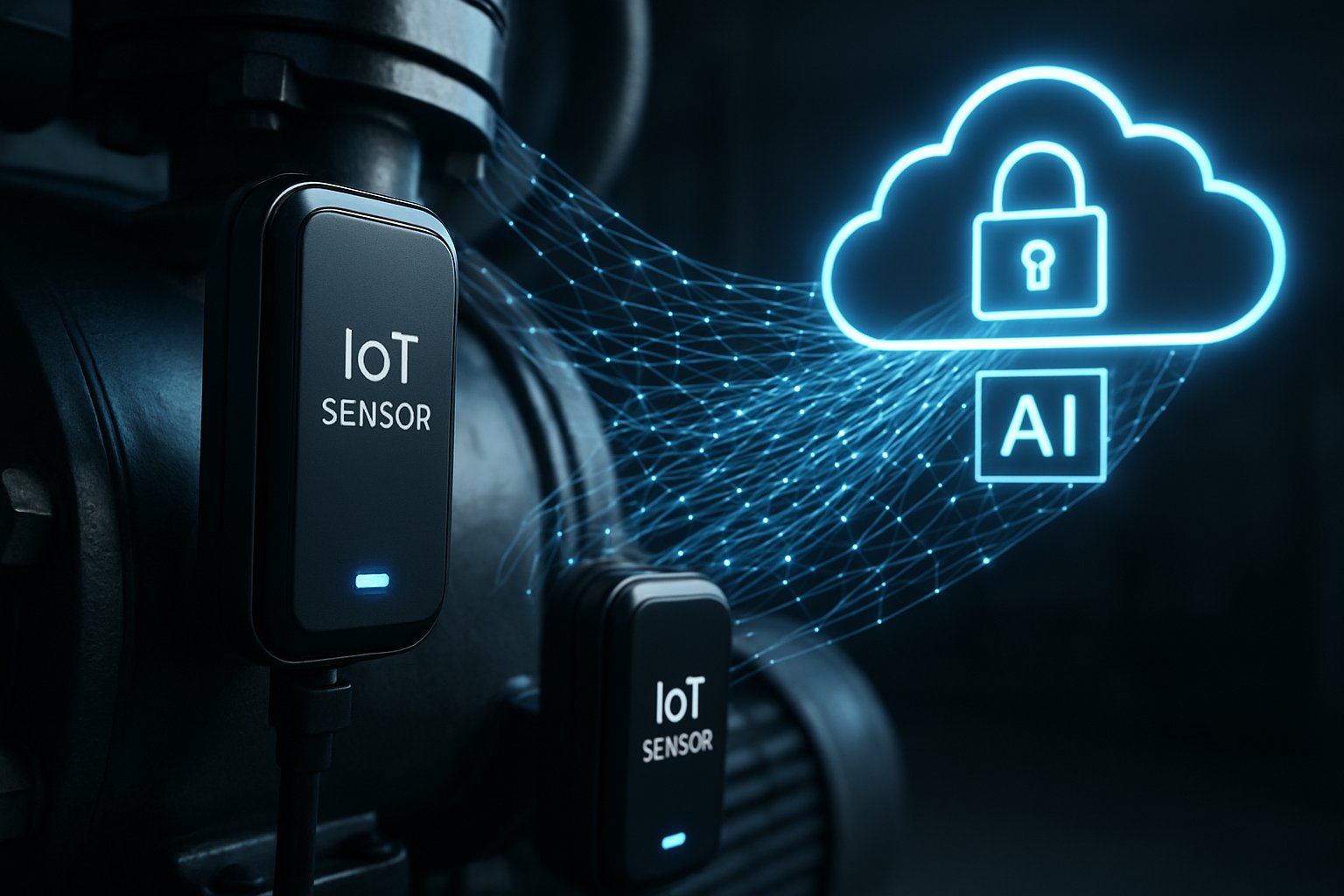
Monitron’s commercial freeze locks feature scope and device availability. Therefore, strategic timelines should align with the July 2025 cutoff before reviewing migration options. Next, we review the hardware specifics guiding those decisions.
Technical Specs Key Overview
The Monitron stack blends wireless sensors, a Bluetooth gateway, and a cloud inference engine. Furthermore, each gateway manages roughly twenty sensors, although range and enclosure obstacles influence totals. Sensors measure vibration and temperature every hour, enabling granular vibration analysis for rotating assets. Moreover, AWS advertises five-year battery life, aligning sensor maintenance with broader asset overhaul cycles. Pricing remains simple: USD 4.17 per sensor per month and about USD 715 for a starter kit. Consequently, small manufacturing plants found the economics appealing for pilot predictive maintenance programs. Quota tables limit one hundred assets per site and fifty sites per project. Additionally, Kinesis streaming exports raw sensor data for deeper Industrial IoT AI analytics in customer clouds. Gateway firmware updates still arrive for security, yet they deliver only bug fixes. Nevertheless, confirm update windows before scheduling plant shutdowns.
These specifications define Monitron’s deployment scale and upkeep rhythm. However, privacy policies also influence long-term retention strategies. Let us explore the recent documentation update.
Data Privacy Update Details
On 9 September 2025 AWS added a Data Management and Privacy chapter to the Monitron guide. Subsequently, customers received clarity on collection cadence, storage locations, and deletion workflows. The document confirms hourly capture of device telemetry alongside vibration analysis measurements. In contrast, AWS states it never shares data with third parties without customer instruction. Export APIs support bulk downloads or live streaming via Kinesis, easing platform migrations. Nevertheless, ultimate data responsibility remains with asset owners under most manufacturing governance policies.
Clear privacy guidance reduces legal uncertainty during vendor transitions. Consequently, teams can schedule exports before sensor retirements or Industrial IoT AI platform changes. Industry growth trends contextualize those choices.
Market Context And Impact
Forecasts from Fortune Business Insights value the 2024 predictive maintenance market at almost USD 11 billion. Furthermore, analysts expect USD 13.65 billion in 2025, reflecting mid-teen compound annual growth. Other studies put the segment between USD 7 and USD 11 billion, yet all agree on acceleration. Consequently, vendors stepping into the Monitron gap see significant upside across hardware and software layers. Treon publicly announced a March 2025 deal to incorporate Monitron technology, aiming to capture displaced customers. Moreover, migration specialists like Thinaer and Fluke launched assessment programs for manufacturing plants. In contrast, some analysts caution that vendor consolidation could slow open standards adoption.
- Fortune Business Insights: 2024 market USD 10.93B; CAGR above 15%.
- MarkNtel Advisors: mid-2020s CAGR projected at 18% for AI-based solutions.
- Astute Analytica: Predictive maintenance revenue could surpass USD 30B by 2032.
These numbers illustrate resilient demand independent of Monitron’s fate. Therefore, Industrial IoT AI suppliers continue investing despite AWS exiting new sales. The next section outlines practical migration paths.
Migration Paths For Manufacturers
Companies keeping legacy sensors may stockpile devices before the July 2025 cutoff. Alternatively, teams can migrate to partner offerings that reuse Monitron firmware while adding new analytics. Tactical Edge and IndustrAI provide turnkey swap solutions using similar hardware footprints. Meanwhile, Treon’s agreement promises refurbished sensors integrated with its Treon Connect platform. Chief maintenance officers should prioritize data export before physical replacement begins. Moreover, planners must update CMMS systems to accept new vibration analysis schemas from replacement devices.
- Audit current sensor inventory and gateway allocations.
- Schedule bulk data export using Kinesis streams.
- Issue RFPs to vendors for uptime continuity.
Disciplined planning minimizes downtime during platform transitions. Consequently, manufacturing leaders sustain Industrial IoT AI value throughout sensor lifecycles. Finally, we outline actionable next steps.
Actionable Steps Moving Forward
First, validate purchase channels to secure remaining Monitron hardware before inventories vanish. Secondly, map data retention needs and schedule exports aligned with the new privacy guidance. Thirdly, engage at least two partner vendors for proof-of-concept pilots using modern predictive maintenance frameworks. Additionally, train internal staff on emerging Industrial IoT AI architectures and reliability engineering. Professionals can enhance their expertise with the AI Product Manager™ certification. Nevertheless, remember to measure pilot outcomes against historical baseline alerts before full rollout.
These steps build resilience while maximizing existing investments. Therefore, leaders maintain uptime and data continuity across evolving Industrial IoT AI ecosystems. The following conclusion distills our discussion.
Amazon’s Monitron exit marks a pivotal inflection point for condition monitoring practitioners. However, the broader predictive maintenance market continues expanding, encouraging robust vendor competition. Consequently, organizations possess multiple migration paths, ranging from stockpiling sensors to adopting partner platforms. Privacy documentation updates reduce uncertainty and simplify historical data extraction workflows. Moreover, clear technical specifications help finance teams budget residual hardware purchases and new deployments. Meanwhile, certifications such as AI Product Manager™ elevate in-house Industrial IoT AI capabilities. Therefore, decisive action today safeguards uptime, talent readiness, and competitive advantage tomorrow. Act now by auditing assets, exporting data, and engaging certified experts to future-proof factory reliability.
Disclaimer: Some content may be AI-generated or assisted and is provided ‘as is’ for informational purposes only, without warranties of accuracy or completeness, and does not imply endorsement or affiliation.


