

AI CERTS
9 hours ago
BayesContact Redefines Robot Pose Estimation Accuracy
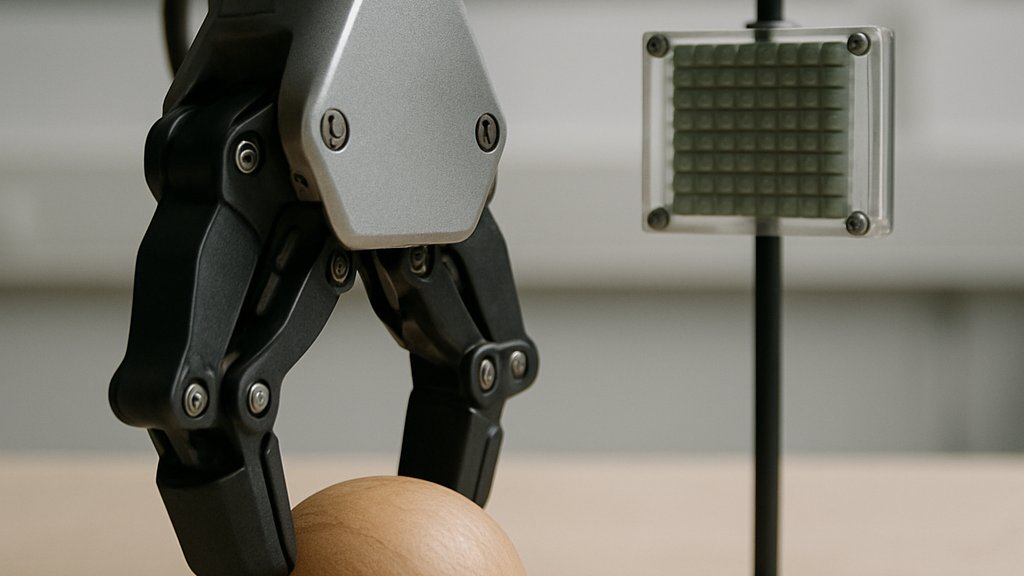
The paper reports up to thirty percent higher pose observability versus vision-only baselines. Industry teams following visuo-tactile fusion trends will find these results significant. This article dissects the pipeline, numbers, strengths, and deployment questions engineers must consider. Meanwhile, manufacturers push cycle times lower, amplifying the cost of each misaligned attempt. Therefore, perception modules must act decisively without sacrificing flexibility.
Why Tactile Data Matters
Vision alone often leaves symmetrical ambiguities unresolved. In contrast, even slight contacts deliver rich geometric clues. Consequently, visuo-tactile fusion exploits complementary modalities for sharper scene understanding.
Force vectors reveal surface normals while depth images describe global shape. BayesContact encodes both cues within a simulation inference loop. Each candidate pose becomes a particle weighted by consistency with rendered depth and simulated wrenches.
Therefore, unexpected torques immediately penalize implausible hypotheses that vision alone accepted. Such dual sensing underpins reliable Robot Pose Estimation when contact events dominate. Industrial lines inserting pegs, plugs, or bolts illustrate these contact-rich tasks daily.
Moreover, tactile reasoning improves manipulation accuracy by catching misalignments before binding friction escalates. Bayesian filtering lets the robot maintain uncertainty instead of committing prematurely. Such prudence proves crucial when slots share repeating patterns along their perimeter. Engineers appreciate that deeper sensing reduces fixture precision requirements.
This integrated sensing raises confidence while reducing alignment error. Next, we examine BayesContact’s internal mechanics that implement this concept.
Inside BayesContact Inference Pipeline
BayesContact follows the simulation inference paradigm, iteratively comparing synthetic and real observations. Initially, a vision-only detector seeds 256 pose particles around the observed tool. Subsequently, each particle passes through a renderer that produces depth maps.
The same particle also reaches a Drake physics engine predicting contact wrenches. Measured depth and force signals update weights using likelihood ratios. Moreover, sequential Monte Carlo resamples particles, keeping high-weight hypotheses alive.
Because the method stays model-based, it avoids retraining when geometries change. Consequently, Robot Pose Estimation remains stable across variant slots and pegs. Authors implemented the pipeline in GenJAX, enabling parallel GPU inference.
Meanwhile, simulation inference costs remain a concern for real-time lines. Overall, Robot Pose Estimation quality rises when direct physical reasoning supports images. The pipeline blends tractable physics with statistical sampling for adaptive perception.
Active probing further accelerates convergence, as the following section details. Particles not matching depth quickly lose weight, keeping computation bounded. Additionally, vectorized rendering pipelines exploit GPU texture units for throughput. Authors report four particle sets processed simultaneously on one workstation GPU. Nevertheless, clock times per update remain unpublished, prompting calls for openness.
Active Probing Strategy Explained
Passive sensing may leave multiple pose modes unpruned. Therefore, BayesContact selects wrist motions that maximise expected information gain. The robot lightly taps predicted surfaces, gathering discriminative wrench feedback.
A greedy baseline probed at fixed offsets, yet converged slower. In contrast, the information-gain planner reduced average probes by 46 percent. Consequently, manipulation accuracy improved because fewer blind corrections were necessary.
Furthermore, Robot Pose Estimation errors dropped as ambiguous particles vanished sooner. The strategy exemplifies visuo-tactile fusion used actively rather than passively. Researchers note that probe computation still depends on simulation inference speed.
Intelligent touches complement vision, sharpening belief while saving cycle time. Quantitative results underline this benefit. Active control halves probes and heightens certainty. Now, simulation figures quantify those gains.
Probes follow a search tree built from expected entropy reduction per face. This heuristic mirrors active vision policies used in SLAM research. By reusing physics gradients, planners refine torque predictions between attempts. Consequently, contact forces stay within safe thresholds, protecting high-value tooling.
Simulation Results In Numbers
The authors evaluated four geometries inside a simulated pegboard. Vision-only baseline BCv-SMC achieved mean ADD-S of six point one millimetres. Meanwhile, BayesContact with information gain converged at three point nine millimetres.
Consequently, position error dropped 46.3 percent and orientation error plummeted 67.1 percent.
- 30% higher pose observability versus vision only baselines.
- Average ADD-S cut by 35.8% across evaluated shapes.
- Orientation error improved up to 73% on complex slots.
- Particle count 256 with maximum ten information-gain probes.
Such gains translate directly to manipulation accuracy during tight insertions. Moreover, Robot Pose Estimation variance decreased, boosting planner stability. These figures validate integrating contact reasoning within pose estimation pipelines. Simulation metrics depict consistent benefits versus vision-only competitors.
Nevertheless, real hardware often reveals hidden challenges. Next, we look at physical trials. Information gain also reduced variance across random initializations, indicating robust convergence. Standard deviation of ADD-S dropped below one millimetre for three geometries.
Meanwhile, orientation variance shrank by half, easing downstream control. Such consistency simplifies feed-forward motion planning around tight tolerances. Engineers can replicate experiments using the released CAD models and configuration files.
Real Robot Benchmark Findings
Experiments moved from Drake to a KUKA iiwa14 arm with an ATI sensor. Researchers tested ten random poses per geometry on actual hardware. BCv-SMC succeeded three of ten rectangle insertions.
BayesContact information-gain succeeded five, cutting ADD-S by thirty-four percent. Rectangle-teeth trials showed six of ten successes, doubling baseline performance. Additionally, maximum orientation error shrank nearly seventy-three percent.
Consequently, contact-rich tasks that previously stalled now complete reliably. Lower ADD-S directly indicates better pose estimation during live operation. Nevertheless, authors omitted wall-clock timing, leaving latency questions unanswered.
Yet Robot Pose Estimation quality clearly improves when tactile evidence guides inference. Real trials mirror simulation gains though broader validation remains pending. Understanding advantages and caveats aids deployment decisions.
Hence, strengths and drawbacks deserve balanced review. Investigators used identical controller gains between baselines to isolate estimator impact. Trials executed on a wooden pegboard with millimetre-level manufacturing tolerances. Toolpaths adhered to industry clearance standards set by IEC guidelines. Consequently, results translate well to automotive harness insertion scenarios.
Key Strengths And Limitations
Several strengths emerge from the study. Firstly, no offline retraining is required; new shapes only need meshes. Secondly, visuo-tactile fusion retains multimodal beliefs, preventing premature mode collapse.
Thirdly, active probing minimizes unnecessary forces, protecting fragile components. However, simulation inference remains computationally heavy, especially with high particle counts. Moreover, sensor calibration errors may distort contact likelihoods.
Consequently, overall manipulation accuracy could fall if physics models diverge from reality. In contrast, learned neural surrogates deliver faster but less adaptable inference. Meanwhile, limited real-robot trials restrict statistical certainty.
The same framework generalizes across many pose estimation challenges. Professionals can deepen robotics expertise through the AI+ Robotics™ certification program. Strengths outweigh current drawbacks for research setups.
Industry impact now comes into focus. Future work might integrate learned surrogate likelihoods to speed scoring. Authors also mention exploring implicit neural representations for faster rendering. Such hybrids could preserve flexibility while cutting power consumption. Stakeholders will monitor these updates before large-scale rollout.
Industrial Adoption Outlook Ahead
Manufacturers demand reliable insertion under variable tolerances. BayesContact offers an appealing path, given its geometry flexibility and sensor generality. However, deployment teams must benchmark runtime against cycle-time budgets.
GPU acceleration and adaptive particle counts could help maintain throughput. Furthermore, certification of simulation models will reassure safety auditors. Robotic integrators already employ Robot Pose Estimation in welding, sanding, and fastening.
Adding tactile reasoning can lift pose estimation success without costly cameras or lighting. Consequently, contact-rich tasks within aerospace and battery assembly stand to benefit. Market analysts expect mixed sensing to spread across smart factories within three years.
Industrial traction depends on measured latency and maintenance overhead. The journey thus continues toward robust, adaptive manipulation. Regulatory bodies increasingly ask for traceable uncertainty metrics in collaborative lines.
BayesContact's particle weights deliver that traceability by design. Additionally, mesh updates alone accommodate product variants appearing weekly. Therefore, integrators forecast reduced changeover downtime across high-mix facilities.
BayesContact tightens uncertainty using simulation, vision, and touch harmoniously. Consequently, Robot Pose Estimation accuracy climbs alongside insertion success. Visuo-tactile fusion supplies critical evidence where optics falter.
Active probing halves unnecessary contacts, thus preserving hardware and schedule margins. Compute cost and small sample sizes remain open research concerns. Researchers are already refining code for public release, inviting industrial feedback.
Open benchmarks will further clarify comparative total cost of ownership. Nevertheless, early adopters gain geometry agility without expensive network retraining. Upgrade your Robot Pose Estimation projects through the highlighted certification and stay ahead in adaptive automation.
Disclaimer: Some content may be AI-generated or assisted and is provided ‘as is’ for informational purposes only, without warranties of accuracy or completeness, and does not imply endorsement or affiliation.


