

AI CERTS
9 hours ago
Robotic Manipulation Learning Cuts Data For Contact Tasks
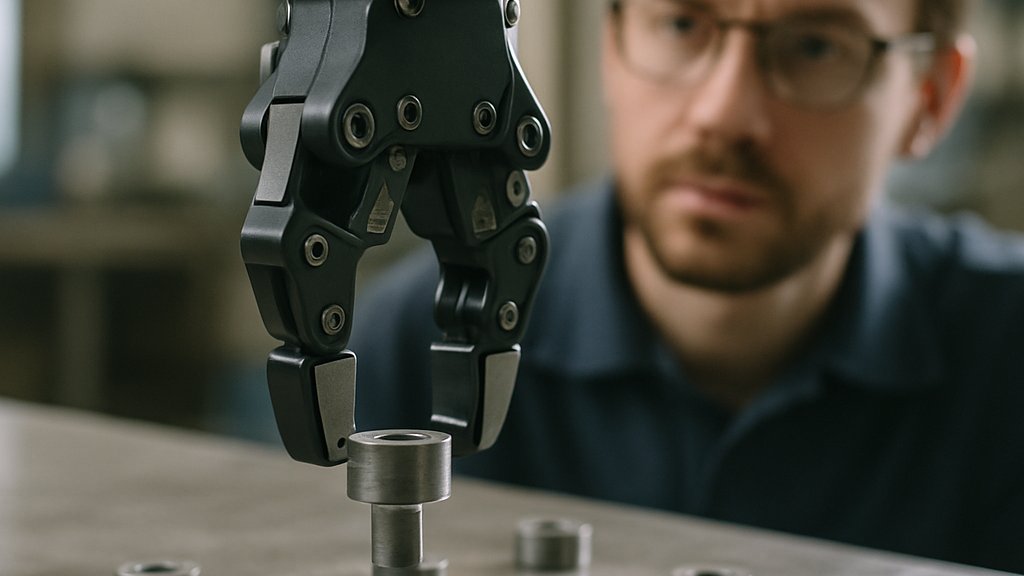
This hybrid view underpins the proposal titled “Data and Learning Where it Matters for Contact-Rich Manipulation.”
Moreover, the authors report ninety-six percent success after only two hours of autonomous data gathering.
Such numbers surpass previous benchmarks by a wide margin.
Therefore, many experts foresee substantial industrial impact.
Our analysis explores what the findings mean for Robotic Manipulation Learning and future production lines.
Why Contact Data Matters
Contact-rich tasks involve tight clearances, frictional forces, and uncertain object geometry.
In contrast, free motion only requires simple kinematics.
Consequently, engineers label the former domain as contact-rich control, because precise force regulation remains mandatory.
Experts classify this contribution under advanced Robotic Manipulation Learning.
Errors here can ruin parts, halt assembly lines, or injure collaborators.
Therefore, algorithms that master these moments yield outsized gains in overall task performance.
The new paper embraces this reality by targeting data collection on the contact slice alone.
Moreover, it employs planners for the easier segments, preserving robot data efficiency.
Focusing on contact simplifies learning and slashes sampling costs.
However, hybrid design demands careful integration, an idea unpacked next.
Hybrid Approach Explained Simply
The authors split every manipulation episode into reach, engage, and retract phases.
During reach and retract, a geometric planner computes collision-free trajectories.
Meanwhile, the engage phase collects high-frequency proprioceptive and tactile streams.
Such modularity enhances Robotic Manipulation Learning scalability across platforms.
Offline deep reinforcement learning then trains a local policy from that narrow window.
Consequently, the resulting controller excels at dexterous interaction while avoiding bloated datasets.
The framework still supports imitation learning to seed exploration when expert demonstrations exist.
Furthermore, the full system stitches plans and policies seamlessly at runtime.
This division leverages structure without losing adaptability.
Next, we examine empirical evidence supporting the scheme.
Key Experimental Findings Highlighted
Hausdörfer’s team evaluated four real assembly tasks on a Franka Emika Panda arm.
The tasks included peg-in-hole insertion and angled gear alignment.
Moreover, results show dramatic improvements over end-to-end baselines.
- 2–2.5 hours autonomous data collection
- 96% mean success across tasks
- 55% success for strongest baseline
- Robust performance on out-of-distribution variants
Consequently, robot data efficiency improves by an order of magnitude.
Dexterous interaction quality also rises, as the controller exploits precise contact cues.
The dataset fuels next-generation Robotic Manipulation Learning benchmarks.
Therefore, overall success nearly doubles relative to comparable studies.
Numbers confirm benefits in speed, accuracy, and stability.
However, comparisons matter, which we address now.
Comparisons With Prior Work
Recent methods like VITAL and DexSkin also separate reaching from contact handling.
Nevertheless, many still rely on dense global data or heavy imitation learning throughout.
The new paper differs by allocating sensors only where contact-rich control matters.
Consequently, storage requirements drop, and training cycles shorten.
In contrast, fully learned pipelines often suffer when confronted with unseen object placements.
Robotic Manipulation Learning frameworks lacking structure often overfit training poses.
The authors report ninety-six percent success even when objects shift several millimeters.
Meanwhile, baseline policies collapse toward thirty percent under identical perturbations.
Such resilience highlights superior task performance under variation.
Robot data efficiency therefore aligns with sustainability goals, reducing wear on hardware.
Hybrid learning now appears more scalable than monolithic networks.
Consequently, industry stakeholders forecast tangible returns, explored next.
Industrial Impact Outlook Assessment
Manufacturers face strict uptime targets and rising labor costs.
Therefore, they need robots that learn new assemblies overnight, not over weeks.
By limiting data capture to contact intervals, firms can keep production lines running.
Moreover, shortened calibration cycles lower capital expenditure.
Dexterous interaction aids premium sectors such as electronics, where force control prevents micro-damage.
Contact-rich control also matters for medical device assembly inside clean rooms.
Improved robot data efficiency reduces downtime for sensor cleaning and logging.
Furthermore, higher task performance lessens rejected parts, improving margins.
Therefore, Robotic Manipulation Learning promises faster commissioning within legacy factories.
Professionals can enhance their expertise with the AI Robotics™ certification.
Yet, integration still demands staff skilled in hybrid planning stacks.
Economic incentives thus align strongly with the presented methodology.
Next, we outline pathways for skills development.
Skill Building Opportunities Ahead
Engineering teams must grasp both planning algorithms and machine-learning libraries.
Consequently, curricula now blend control theory, sensor fusion, and Robotic Manipulation Learning.
Imitation learning remains valuable for rare expert skills, yet sample efficiency prevails.
Workshops increasingly emphasize contact-rich control safety checks.
Moreover, hands-on labs measure task performance using standardized benchmarks.
Continuous Robotic Manipulation Learning research now shapes academic course outlines.
Meanwhile, certifications validate practical mastery and accelerate hiring.
Therefore, managers gain confidence when deploying graduates to production cells.
Educational pipelines mirror emerging industrial needs.
Consequently, research and practice now reinforce each other.
Closing Thoughts And Outlook
The evidence paints a clear picture.
Hybrid planners plus focused data boost reliability while shrinking costs.
Robotic Manipulation Learning now shifts from marathon data crawls to targeted sprints.
Consequently, factories gain agile lines that adapt within days.
Moreover, contact-rich control advances open doors to sensitive sectors, from batteries to satellites.
Robot data efficiency, dexterous interaction, and stellar task performance converge in this framework.
Nevertheless, sustained collaboration between academia and industry will refine benchmarks and safety norms.
Organizations investing early in Robotic Manipulation Learning stand to capture decisive advantages.
Consider enrolling in trusted certifications to stay ahead of the curve.
Forward-looking teams already draft pilot projects to explore the possibilities.
Disclaimer: Some content may be AI-generated or assisted and is provided ‘as is’ for informational purposes only, without warranties of accuracy or completeness, and does not imply endorsement or affiliation.


