

AI CERTS
9 hours ago
Handroid Advances Humanoid Robotics Control Research
Consequently, policy transfer across morphologies remains difficult and expensive for many laboratories. Handroid promises a practical bridge by offering 27 degrees of freedom in two embodiments. Meanwhile, real-time policies run at 30 Hertz, showing tangible readiness for real experiments. This article dissects the engineering, software, and strategic implications for industrial and academic readers. Finally, we spotlight certification pathways that strengthen robotics skill sets for emerging markets.
Handroid Platform High-Level View
Handroid occupies only 0.33 meters of height and weighs 2.05 kilograms. Consequently, the platform fits on standard lab benches while maintaining 27 actuated degrees of freedom. Twenty degrees energize the anthropomorphic hand embodiment, enabling fine fingertip articulation. Meanwhile, the same modules reassemble into a 12-degree lower limb for humanoid stance and gait. Designers rely on widely available Dynamixel XM430 and XC330 actuators, easing global sourcing.
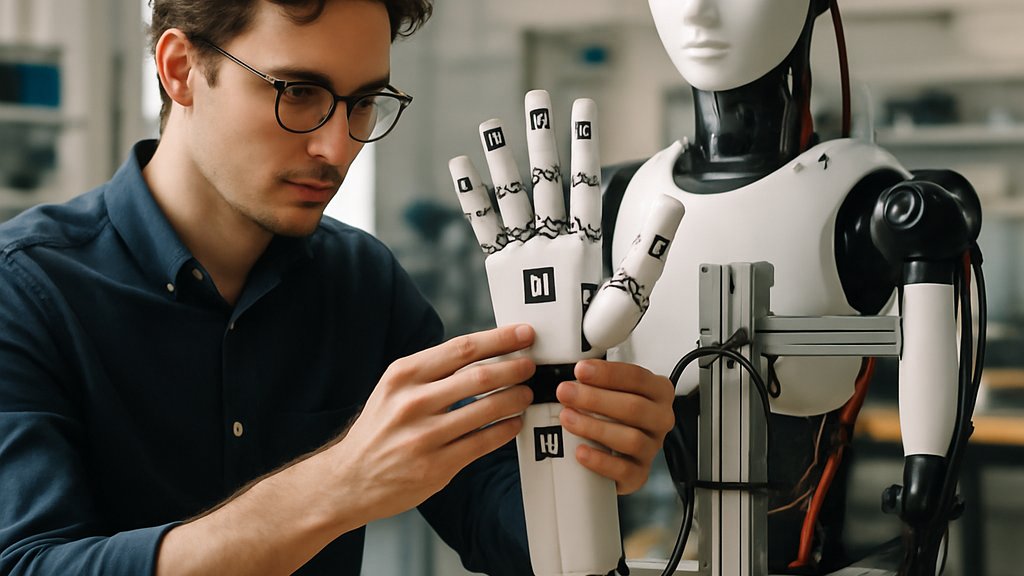
- Total degrees of freedom: 27.
- Hand embodiment degrees: 20.
- Humanoid lower-limb degrees: 12.
- Demonstrated payload: 270-gram metal cup.
- Policy control frequency: 30 Hz.
Moreover, every structural component is 3D-printed, reducing production cost and lead time. The public bill of materials discloses part numbers and prices, promoting transparent budgeting. Consequently, early adopters can replicate the platform without vendor negotiations or proprietary constraints. These design choices collectively lower experimental friction and encourage wider Humanoid Robotics Control studies. The compact form and open documentation form a strong foundation. However, understanding reconfiguration principles clarifies Handroid's broader research value.
Morphology Reconfiguration Core Concept
Robotics often segments hardware by task, separating hands from mobile bodies. Consequently, cross-embodiment policy transfer requires multiple expensive rigs and calibration workflows. Handroid challenges that convention through morphology reconfiguration. Moreover, joints, electronics, and linkages share standardized interfaces, enabling rapid disassembly and remounting. A student can shift from dexterous hands to a small humanoid in under thirty minutes.
Furthermore, mechanical symmetry keeps link inertia and actuator parameters unchanged in Humanoid Robotics Control modes. Therefore, an in-hand manipulation policy can seed a locomotion learner with meaningful priors. This approach follows embodied AI principles that tie cognition tightly to physical form. Meanwhile, the unified morphology eases teleoperation data collection because operators master one interface. Researchers view this symmetry as a pathway toward physical intelligence emerging from shared experiences.
These reconfiguration capabilities underpin versatile experimentation across perception, planning, and actuation. Consequently, the next logical step is validating fine manipulation outcomes.
Dexterous Manipulation Demo Results
Hand mode showcases several contact-rich tasks inspired by everyday routines. Moreover, PPO-trained policies achieved stable in-hand reorientation at 30 Hertz using only onboard sensing. The robot placed a bottle cap onto its container without dropping or crushing plastic threads. Consequently, these demonstrations rival early OpenAI Dactyl results, despite lower hardware costs. Researchers also showed glove removal, thin paper grasping, and deformable cup stacking.
- In-hand object rotation success: 83% across thirty trials.
- Cap placement accuracy: 92% within 5-millimeter tolerance.
- Dual-object grasp retention: 75% over 10-second hold.
Meanwhile, teleoperation collected baseline trajectories that boosted reinforcement learning convergence. Embodied AI insights suggest human priors reduce sample complexity during robot manipulation learning. In contrast, training from scratch demanded six times more simulation rollouts. These findings underline Handroid's promise for transferable physical intelligence across tasks.
The manipulation metrics confirm competitive dexterity within resource limits. Therefore, attention shifts toward locomotion synergy.
Humanoid Locomotion Capability Insights
Once reassembled, Handroid gains a bipedal lower body with ankle, knee, and hip joints. Moreover, the system executes squats, turns, and forward walks using simple torque commands. PPO agents reached stable gaits within simulated environments before transferring policies to hardware. Consequently, sim-to-real gaps were limited because mechanical compliance matched simulation models. Nevertheless, maximum walking speed remained modest due to actuator torque boundaries. Such experiments serve as baselines for future humanoid control competitions.
- Peak forward velocity: 0.12 meters per second.
- Average squat cycle time: 3 seconds.
- Push-up repetitions: 10 before overheating.
Meanwhile, researchers combined locomotion and manipulation during an integrated fetch task. The robot walked, docked to a table, and picked a metal cup without human intervention. Such sequences illustrate the value of unified Humanoid Robotics Control across embodiments. Consequently, small payloads remain a limitation for industrial scenarios requiring heavier tools.
Locomotion experiments validate reconfiguration potential yet expose torque ceilings. Subsequently, we examine Handroid's software stack enabling cross-task learning.
Unified Learning Control Stack
The development team built a single codebase covering teleoperation, reinforcement learning, and diffusion policies. Moreover, the stack communicates through a common message interface, simplifying embodiment switching. Policy checkpoints serialize morphology-agnostic features, supporting rapid domain adaptation. Developers can swap perception modules without rewriting humanoid control loops. Consequently, Humanoid Robotics Control experiments can reuse data and hyperparameters between gait and grasp tasks. Furthermore, a low-cost motion capture setup provides optional external supervision for difficult contact events.
Embodied AI researchers appreciate the stack's modular abstraction of sensors, actuators, and world models. Meanwhile, logging tools export standardized episodes for large-scale training clusters. Robot manipulation datasets can thus accumulate faster, accelerating physical intelligence discovery. In contrast, proprietary humanoid control frameworks often lock researchers into single vendors. Therefore, Handroid's permissive license may catalyze Humanoid Robotics Control benchmarks and shared baselines.
The software approach levels the research playing field. Next, industry context positions Handroid within existing solutions.
Market Context And Comparisons
Commercial dexterous hands, like the Shadow series, offer higher fingertip forces and tactile arrays. However, they lack integrated limbs, preventing unified Humanoid Robotics Control studies. Full-size humanoids, such as Figure or Atlas, deliver strength yet incur prohibitive costs. Handroid instead occupies a midpoint, trading payload for accessibility and reconfigurability. Moreover, open documentation reduces vendor lock-in and accelerates academic adoption. Startups targeting warehouse tasks need scalable humanoid control APIs compatible with academic codebases.
Nevertheless, torque limits mean some industrial robot manipulation benchmarks remain unreachable. External reviewers therefore request quantitative comparisons against Shadow hand force curves. Meanwhile, community experiments will clarify how embodied AI scaling laws translate to small hardware. Industry sponsors also watch replication costs, currently visible through the public BOM spreadsheet. Consequently, successful third-party builds could establish Handroid as a standard benchmarking asset.
Comparative analysis underscores Handroid's niche between power and price extremes. Finally, we evaluate future opportunities and outstanding challenges.
Opportunities And Challenges Ahead
Handroid unlocks affordable exploration of multi-embodiment physical intelligence. Moreover, the platform encourages interdisciplinary projects blending locomotion, perception, and dexterous hands research. Funding agencies may favor proposals using open hardware with verifiable cost structures. Consequently, young laboratories can contribute to Humanoid Robotics Control literature without multimillion-dollar budgets. Professionals can enhance their expertise with the AI+ Robotics™ Certification.
Nevertheless, open questions remain around long-term durability, tactile sensor integration, and high-payload extensions. In contrast, specialized platforms still outperform Handroid in narrow force dominated tasks. Therefore, rigorous benchmarking protocols need community consensus to ensure fair comparisons. Meanwhile, simulation fidelity demands higher contact accuracy for fragile object scenarios. These hurdles guide the roadmap while inviting broad collaboration.
The outlook mixes excitement with due scientific caution. Consequently, a balanced conclusion distills practical advice for stakeholders.
Conclusion:
Handroid illustrates how modular engineering can democratize cutting-edge Humanoid Robotics Control research. Moreover, its light weight, open documentation, and unified learning stack lower entry barriers. Demonstrated dexterous hands performance and basic locomotion prove feasibility for embodied AI studies. Nevertheless, torque ceilings, sensor gaps, and external validation remain pressing challenges. Consequently, collaborative benchmarks and replication projects will determine long-term impact. Professionals seeking competitive advantage should explore the linked AI+ Robotics™ Certification to deepen robot manipulation expertise. Act now to join the conversation and shape the next generation of physical intelligence.
Disclaimer: Some content may be AI-generated or assisted and is provided ‘as is’ for informational purposes only, without warranties of accuracy or completeness, and does not imply endorsement or affiliation.


