

AI CERTS
9 hours ago
VTLoc Advances Tactile Localization for Point Cloud Robotics
Consequently, robots gain centimetre-level accuracy from a single gel-based touch. This article dissects the architecture, benchmark evidence, and industry implications. It also maps future research avenues for contact detection and autonomous perception professionals.
Why Tactile Localization Matters
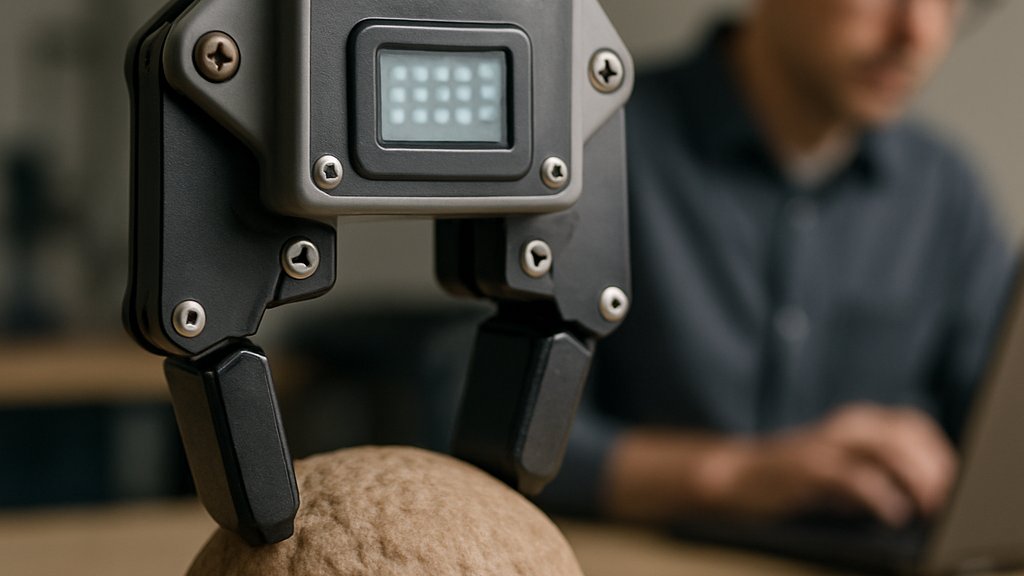
Industrial robots lift, sort, and assemble under rigid programming. However, uncertainty spikes when visual occlusion hides the grasp point. Accurate Tactile Localization closes that uncertainty by grounding each taxel reading in a global frame. Moreover, point cloud robotics supplies the geometric map that bridges the tactile sensor and the camera. Consequently, integration of tactile sensing with 3D data minimizes slip and misplacement during manipulation.
Businesses report rising demand for dexterous automation in e-commerce, food handling, and collaborative manufacturing. Furthermore, contact detection precision directly influences cycle time and damage rates. In contrast, blind grasping often forces conservative trajectories that slow throughput.
Reliable localization therefore underpins safer, faster manipulation. Nevertheless, current pipelines still trade speed for precision.
The next section explains how the VTLoc framework addresses that compromise.
How VTLoc Framework Works
VTLoc tackles Tactile Localization through two coupled modules. Firstly, Geometric Multi-Modal Alignment fuses the tactile image with the visual point cloud. Meanwhile, the module reconstructs a pseudo-cloud to align against camera data by minimizing Chamfer distance. This explicit geometry promotes robust point cloud robotics performance when lighting varies.
Secondly, the Iterative Localizing Updater refines a coarse contact guess over N steps; sixteen loops deliver the best trade-off. Moreover, tactile sensing latency rises only five milliseconds, keeping real-time control feasible. Consequently, contact detection accuracy improves while retaining smooth actuation.
The network finally outputs a probability heatmap across surface vertices. Therefore, planners can retrieve Top-K candidates and execute compliant grasps. This closed-loop design supports visuomotor mapping strategies that co-opt force feedback into motion planning.
VTLoc thus transforms raw gel images into actionable coordinates. In contrast, earlier codebook methods lacked such geometric grounding.
The following section examines quantitative evidence from the ObjectFolder Real benchmark.
Benchmark Results In Focus
Researchers evaluated VTLoc on 100 diverse real objects. Consequently, the system cut mean error in multi-touch scenes from 16.22 mm to 9.01 mm versus MidasTouch. Moreover, Top-1 accuracy climbed to 80.62% on the non-uniform subset. Such improvements illustrate how Tactile Localization accuracy scales with geometric alignment.
- Single-touch normalized distance dropped from 22.97% to 20.17% after iterative refinement.
- Inference time rose modestly from 123.6 ms to 128.1 ms at N=16.
- Unknown object Top-1 accuracy remained low at 8.65%, highlighting generalization limits.
These figures indicate tangible gains for point cloud robotics tasks that demand fine positioning. However, performance still lags on unseen geometries, limiting deployment in open-set warehouses.
Overall, VTLoc delivers measurable accuracy benefits without prohibitive latency for autonomous control systems. Nevertheless, generalization remains a pressing research question.
The next part weighs those strengths against known constraints.
Strengths And Limitations
VTLoc’s geometric reasoning offers visible strengths. Firstly, interpretable pseudo-clouds let engineers diagnose failure cases. Secondly, iterative refinement ensures graceful accuracy gains with trivial compute overhead. Moreover, the design integrates smoothly with existing visuomotor mapping stacks.
Nevertheless, limitations persist. Unknown-object trials expose a sharp accuracy drop, implying inadequate shape priors. Additionally, the method assumes a clear camera view of the contact region. Occlusions or sensor drift could, therefore, degrade Tactile Localization performance.
Transferability across different touch-sensing hardware also lacks empirical proof. Consequently, researchers must test silicone skins, optical fibers, and capacitive arrays before industrial rollout.
Strengths outweigh weaknesses for controlled settings. However, real-world variability demands further validation.
The impact of these findings on perceptual automation appears next.
Impact On Robot Perception
Better contact cues enrich robot perception pipelines that already fuse RGB-D, proprioception, and force. Consequently, planners can adjust grasps on the fly rather than relying on pre-scripted waypoints. Moreover, Tactile Localization strengthens closed-loop feedback, enabling stable interaction with deformable goods.
For warehouses, precise contact detection unblocks rapid singulation of irregular packages. Meanwhile, fleets share scene maps through cloud geometry, while touch sensing supplies individual touch data. This multimodal cooperation accelerates fulfilment operations.
In surgical robotics, finer visuomotor mapping of instrument tips lowers tissue trauma. Additionally, consistent millimetre-scale localization encourages regulators to approve autonomous suturing trials.
Enhanced perception thus widens commercial and clinical frontiers. Subsequently, researchers are outlining next research milestones.
The following section explores those future directions.
Future Research Directions Ahead
Several open challenges remain. Firstly, domain adaptation could bolster Tactile Localization on unseen shapes by learning transferable shape priors. Moreover, self-supervised contact detection using synthetic perturbations may reduce annotation cost.
Secondly, scaling datasets beyond 100 objects should capture richer surface statistics. Consequently, geometric models will generalize to cluttered logistics scenes. Researchers also plan to merge VTLoc outputs with differentiable planners for end-to-end visuomotor mapping.
Thirdly, community benchmarks must track real-time perception under occlusion. Additionally, cross-sensor studies will measure robustness across varied touch-sensing platforms.
Addressing these gaps will lift multimodal manipulation to new reliability levels. Nevertheless, progress depends on a skilled workforce.
The next section outlines upskilling opportunities for practitioners.
Upskilling Paths For Practitioners
Companies need engineers who can implement multimodal stacks and evaluate millimetre errors. Consequently, practitioners should study depth processing, gel-based touch sensing, and real-time control.
Formal credentials accelerate hiring decisions. Professionals can enhance their expertise with the AI Engineer™ certification. Moreover, laboratories value portfolios demonstrating Tactile Localization experiments on ObjectFolder Real.
- Implement VTLoc and compare against MidasTouch on single-touch trials.
- Extend visuomotor mapping code to fuse heatmaps with grasp planners.
- Publish findings to drive geometric robotics adoption across industries.
Structured learning shortens ramp-up time for new hires. Therefore, certified engineers can lead upcoming perception projects.
The conclusion recaps core insights and invites further exploration.
VTLoc demonstrates that geometry-aware learning can uplift Tactile Localization accuracy by large margins while keeping inference fast. Moreover, the framework showcases how cloud-based geometry, tactile sensing, and visuomotor mapping converge to unlock safer handling. Nevertheless, researchers must resolve generalization gaps and broaden cross-sensor evaluations. Consequently, organizations now eye multimodal talent to industrialize these findings. Practitioners should prototype VTLoc, share benchmarks, and pursue the linked AI Engineer™ credential. By mastering tactile intelligence today, engineers will guide tomorrow’s adaptive manipulators.
Disclaimer: Some content may be AI-generated or assisted and is provided ‘as is’ for informational purposes only, without warranties of accuracy or completeness, and does not imply endorsement or affiliation.


