

AI CERTS
2 hours ago
Adaptive Entanglement Speeds Quantum Multi-Core Performance
In contrast, previous on-demand methods often stall circuits while entanglement is synthesized. Meanwhile, pre-generation alone can waste resources and sacrifice fidelity. Therefore, adaptive policies dynamically match entanglement supply with observed traffic, blending speed and quality. We examine metrics, architectural needs, and open research gaps facing quantum systems engineers. Finally, we highlight a professional certification path for technologists who want marketable skills in entanglement management.
Why Latency Still Matters
Teleportation latency often sets the execution pace in modular processors. Furthermore, each quantum gate that spans chips needs a timely Bell pair. Delays accumulate because physical qubits remain idle, yet coherence clocks keep ticking. Consequently, algorithm depth shrinks unless architects combat this bottleneck aggressively.
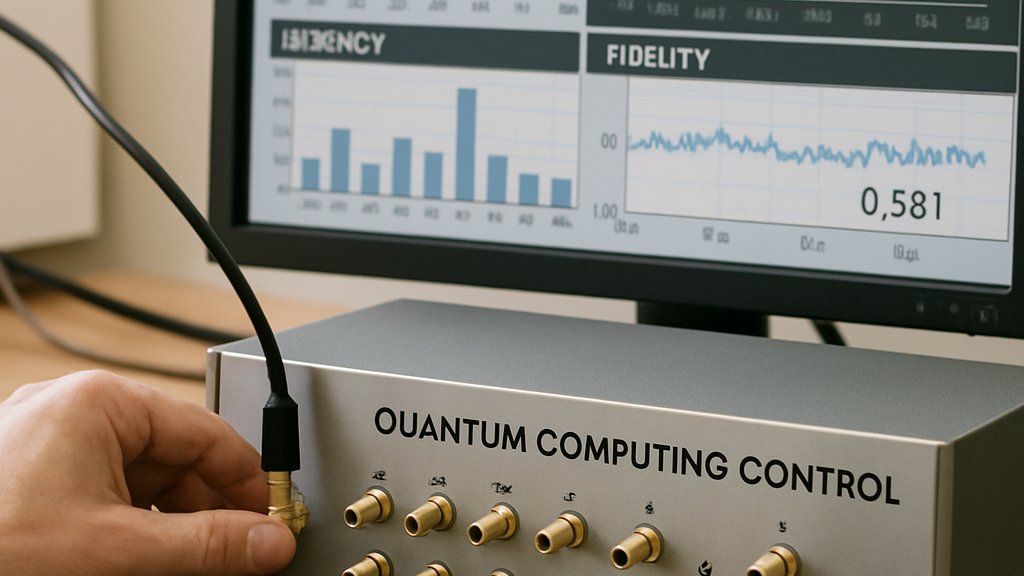
Recent ACGP simulations quantify the problem across mesh topologies. For Quantum Fourier Transform circuits, on-demand generation delayed execution by 103 nanoseconds per interaction on average. Moreover, adaptive pre-generation sliced that figure by 61 percent. Similar patterns emerged for the Cuccaro adder, underscoring consistent benefits for quantum multi-core designs.
Industry roadmaps suggest thousands of distributed qubits per rack within five years. Therefore, teleportation latency multiplies across billions of remote gates each second. Engineers predict that without optimization, throughput collapses before reaching that scale. Adaptive strategies therefore counter this looming wall.
Reduced latency widens algorithm windows before decoherence wins. However, Adaptive Entanglement shows speed alone cannot decide architecture choices, guiding us to adaptive models next.
Adaptive Models Explained Clearly
Adaptive models adjust entanglement generation probabilities in real time. Specifically, ACGP monitors recent traffic among distributed qubits and updates a neighbor table. Therefore, cores likely to communicate soon receive more pre-generated pairs. Meanwhile, low-traffic links see reduced allocation, conserving quantum memories.
Classical control loops drive the policy using lightweight Bayesian updates. In contrast, Constant-rate Generation Policies create pairs blindly, often wasting buffers. On-demand methods remain reactive, yet incur unavoidable wait times. Consequently, Adaptive Entanglement combines proactive supply with informed targeting, achieving balanced performance. Such policies strongly benefit quantum multi-core clusters under realistic traffic assumptions.
The ModEn-Hub study extends this idea with a centralized orchestration layer. Moreover, a photonic hub distributes high-fidelity Bell pairs to up to 128 quantum systems. Adaptive scheduling within the hub maintained about 90 percent teleportation success. That figure dwarfed the 30 percent success recorded under naive policies.
Adaptive controllers thus exploit traffic locality without expensive hardware overhauls. Next, we scrutinize concessions demanded by these gains.
Trade-Offs And Key Mitigations
Pre-generation extends storage time and encourages decoherence. Consequently, fidelity falls roughly ten percent on average in ACGP simulations. Some circuits experienced up to sixteen percent degradation. Nevertheless, entanglement purification can rescue quality within Adaptive Entanglement workflows at moderate overhead.
Purification consumes spare Bell pairs to distill higher-fidelity resources. Furthermore, background execution hides most latency, preserving overall gains. However, extra pair generation raises resource consumption from three to around twelve attempts per success. Effective entanglement management therefore requires balanced budgets for memories, detectors, and photonic links.
Key Statistics Snapshot Now
- Latency reduction: 61 percent for QFT circuits under ACGP versus on-demand.
- Teleportation success: 90 percent under ModEn-Hub adaptive orchestration.
- Fidelity drop: average ten percent, peak sixteen percent without purification.
- Purification recovery: quality improved from twelve to six percent loss.
- Resource cost: up to twelve entanglement attempts per successful teleportation.
These figures expose clear cost-benefit dynamics for every quantum architecture. Subsequently, hardware realities deepen the conversation.
Simulation Data In Numbers
Simulators modeled mean EPR generation at 103 nanoseconds, dwarfing the 0.01 nanosecond distribution hop. Consequently, control software and classical messaging dominate many teleportation paths.
Mesh topologies amplified benefits because adjacent cores share high traffic. Meanwhile, irregular workloads saw smaller yet still substantial improvements.
Researchers fed Cuccaro adder traces and Quantum Fourier Transform traces into the SeQUeNCe framework. Moreover, benchmark diversity strengthened confidence that Adaptive Entanglement generalizes.
However, all results remain simulation based; hardware validation lags. Therefore, readers must interpret percentages as directional guidance, not guarantees.
Simulated evidence favors adaptive policies across representative quantum architecture workloads. Nevertheless, hardware feasibility decides real-world adoption, which we examine next.
Hardware Roadmap And Gaps
Building quantum multi-core hardware with fast photonic interconnects remains challenging. Superconducting processors like IBM Osprey already rely on chiplet integration. Moreover, multicore fibers and on-chip converters promise low-loss Bell distribution at telecom wavelengths.
Photon-matter interfaces still struggle with efficiency and detector dark counts. In contrast, trapped-ion vendors report higher fidelities yet slower gate times. Consequently, engineering teams must align memory lifetimes with anticipated pre-generation windows.
Adaptive Entanglement also requires real-time state tracking across quantum systems. Therefore, orchestration stacks need scalable telemetry channels and probabilistic routing engines. Additionally, error mitigation logic must inform entanglement management decisions dynamically.
Professionals can boost expertise through the AI+ Quantum Specialist™ certification. The program covers architecture design, entanglement management, and performance simulation.
Memory technology remains a decisive bottleneck for quantum multi-core scalability. Current solid-state memories retain states for milliseconds, yet some traffic models need seconds. Nevertheless, advances in rare-earth doped crystals indicate possible 10-second storage within laboratory settings. Researchers therefore investigate hybrid architectures that pair fast cavities with longer lived spin ensembles.
Hardware progress underpins adaptive software value. Subsequently, we explore industry consequences and investment signals.
Industry Impact And Outlook
Adaptive Entanglement shifts optimization focus from qubit coherence to traffic analytics. Consequently, software teams can extract speedups without waiting for radical material advances.
Cloud vendors could integrate adaptive controllers as subscription features. Meanwhile, enterprise developers gain transparent acceleration for distributed qubits workflows via Adaptive Entanglement.
Venture funding may flow toward orchestration middleware and performance telemetry startups. Moreover, hardware makers will market compatibility layers for quantum architecture agnostic toolkits.
Standards groups such as QIRG already discuss common entanglement management APIs. In contrast, security analysts warn about side-channel risks in shared hubs.
Analysts estimate a 40 percent total cost of ownership reduction when Adaptive Entanglement halves latency. Moreover, fewer idle cycles increase cluster utilization, improving revenue per qubit hour. Cloud marketplaces could soon tier pricing based on orchestration sophistication. Consequently, early adopters may secure competitive advantages that persist for years.
Market forces seem aligned with adaptive strategies. Nevertheless, rigorous benchmarks will determine winners.
Conclusion And Next Steps
Adaptive Entanglement research signals a pivotal shift in modular quantum design. Simulations prove that smart pre-generation halves teleportation latency across key benchmarks. Furthermore, purification and orchestration layers mitigate fidelity loss without heavy penalties. Hardware challenges persist, yet photonic interconnect advances appear promising. Consequently, software teams can extract near-term gains while materials scientists chase longer coherence. Standards bodies and cloud vendors already prepare common entanglement management interfaces. Professionals who master these tools will influence next-generation quantum architecture decisions. Achieve validation through the AI+ Quantum Specialist™ certification and lead future deployments.
Disclaimer: Some content may be AI-generated or assisted and is provided ‘as is’ for informational purposes only, without warranties of accuracy or completeness, and does not imply endorsement or affiliation.


