

AI CERTS
2 hours ago
Frailty Screening Robots Transform Elder Care Screening
Meanwhile, industry observers see broader elder care implications as prices decline and AI models mature. However, experts caution that small samples, data privacy, and reimbursement gaps still hinder scale. This report examines the evidence, market forces, and unanswered questions behind the emerging field of Frailty Screening Robots.
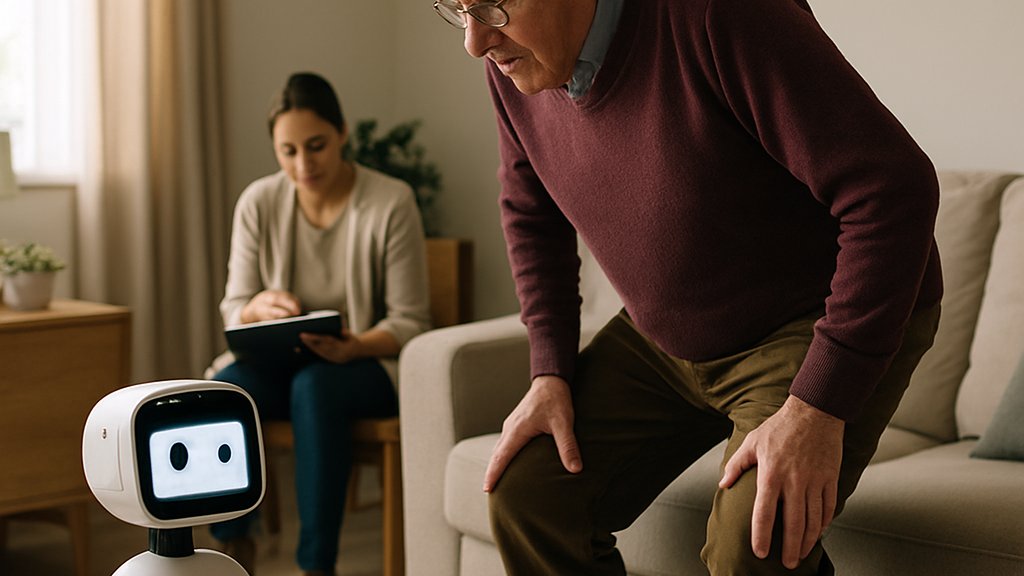
Frailty Screening Robots Rise
Researchers at Universitat Politècnica de Catalunya built a vision-based platform that runs SPPB and TUG autonomously. Additionally, the six-month in-situ study with 81 older adults produced ICC scores above 0.9 for test durations. In contrast, therapist-scored SPPB classifications matched the robot with a respectable kappa of 0.67. Therefore, the project demonstrated that Frailty Screening Robots can reach clinical agreement under real-world conditions.
Subsequently, similar prototypes appeared in Korea, Sweden, and the United States. These projects rely on affordable depth cameras and lightweight healthcare robotics stacks. Nevertheless, deployment numbers remain modest when compared with smartwatch rollouts. The evidence still points to early but promising momentum.
Pilot metrics confirm technical feasibility. However, sustained outcomes depend on user acceptance, the next topic under review.
Standard Tests, Robot Accuracy
Every evaluated prototype guides participants through timed stands, short walks, and balance holds. Furthermore, most systems store skeletal landmarks or inertial signals rather than raw video, easing privacy concerns. Wearable studies report comparable predictive power, yet Frailty Screening Robots provide richer coaching cues. Consequently, older adults receive immediate auditory feedback if a step is missed.
Robotic assessments also capture subtle gait parameters linked to fall risk, such as cadence variability. Moreover, continuous passive logging can augment active tests, building longitudinal baselines. Clinical teams value standardized prompts because staff turnover often hampers manual test reliability. In contrast, algorithmic scoring yields repeatable numbers that integrate with electronic health records.
- ICC exceeded 0.9 for SPPB times across 81 participants.
- Cohen’s kappa 0.67 versus therapist classifications.
- Hyodol home study sensitivity reached 0.939 for symptomatic cases.
- Wearable gait trials reported 10–15% frailty prevalence confirmation.
- Prototype costs currently range from $5,000 to $30,000 per unit.
Robots match or exceed human timing fidelity. The analysis now shifts toward home deployments that stress usability.
Home Trials Reveal Potential
The Hyodol project placed socially assistive units inside 215 apartments across two cohorts. Additionally, the embedded model flagged depression risk with 0.939 sensitivity, triggering remote nurse calls. Although mental health differs from frailty, the study validates distributed social robotics workflows. Similar pipelines allow Frailty Screening Robots to request follow-up telehealth reviews.
User diaries noted that older adults treated the device as a friendly companion, which increased adherence. However, false positives produced unnecessary anxiety until clinicians clarified results. Design teams now refine alert thresholds to balance sensitivity and precision. Consequently, stakeholders emphasize integrating clear referral pathways into elder care routines.
Home pilots spotlight engagement benefits. Market economics will determine whether promising prototypes reach scale, as the following section explains.
Market Forces And Costs
Commercial vendors price mobile companions like Hello Robot’s Stretch near $30,000, limiting household adoption. Meanwhile, component costs decline as Frailty Screening Robots and broader healthcare robotics demand drives manufacturing. Experts predict sub-$10,000 units within five years if production ramps. Moreover, subscription software models could shift capital expense into operating budgets.
Reimbursement remains uncertain because payers classify screening under preventative services. Nevertheless, value-based care contracts may reward early fall risk detection, creating new billing codes. Policy analysts urge developers to generate economic evidence paralleling clinical metrics. Professionals can enhance their expertise with the AI Nurse™ certification.
Affordability and reimbursement dictate commercial uptake. Yet ethical and equity questions also shape public perception, addressed next.
Ethical And Equity Hurdles
Privacy advocates worry about continuous audio and video streams inside private residences. In contrast, on-device processing can curb data export, an approach shared by many Frailty Screening Robots. Furthermore, most published trials occur in high-income countries, overlooking marginalized elder care communities. Equity researchers call for inclusive co-design that accounts for language, mobility, and digital literacy.
Safety also matters because moving hardware may collide with frail bodies. Consequently, pragmatic tabletop designs often outperform humanoid forms in user trust. Aaron Edsinger notes that unrealistic shapes inflate expectations and disappointment. Nevertheless, social robotics designers continue experimenting with expressive faces to foster adherence.
Ethical diligence builds sustainable trust. Looking forward, research gaps highlight where innovators should focus next.
Future Research Roadmap
Methodologists recommend multi-site randomized trials exceeding several thousand participants. Additionally, external validation can expose algorithmic bias before broad rollouts within healthcare robotics ecosystems. Regulatory pathways must define performance benchmarks, maintenance protocols, and liability boundaries. Subsequently, open data challenges could accelerate benchmarking across Frailty Screening Robots vendors.
Industry councils also push for interoperable APIs that transmit fall risk alerts directly into clinical dashboards. Moreover, joint geriatric-AI fellowships could train researchers who appreciate both code and bedside nuance. Meanwhile, professional societies suggest cross-training through micro-credentials covering ethics and deployment. Such opportunities align with rising demand for scalable elder care technologies.
Coordinated trials, standards, and talent pipelines will unlock impact. The concluding section distills practical insights for decision makers.
Frailty Screening Robots now stand on the threshold of clinical and commercial legitimacy. Extensive pilot data confirm accurate timing, rich engagement, and actionable alerts for older adults. However, universal scaling demands lower prices, clear reimbursement, and strict privacy safeguards. Moreover, multidisciplinary teams must confront equity and safety to fully protect elder care populations. Therefore, investors, clinicians, and policymakers should engage early standards efforts and collaborative trials. Professionals can secure insight through the AI Nurse™ certification and drive responsible deployments. Act now to shape healthier, robot-assisted ageing trajectories.
Disclaimer: Some content may be AI-generated or assisted and is provided ‘as is’ for informational purposes only, without warranties of accuracy or completeness, and does not imply endorsement or affiliation.


