

AI CERTS
2 hours ago
Teleoperation Intent Prediction Shapes Next-Gen Remote Robotics
Investors observe similar progress across several teleop systems entering pilot service. However, many professionals still ask how accurate, safe, and scalable these predictive engines truly are. This article answers that question through a deep dive into current research, hard numbers, and industrial signals. Readers will leave with a balanced view of opportunities, limits, and next steps.
Market Drivers Rise Up
Global labor shortages continue to inflate the cost of on-site manipulation tasks. Therefore, organizations turn to remote robotics for safer, round-the-clock operations. Logistics firms already rely on VR consoles and robotic hands to defuse bombs, inspect nuclear rooms, and pick goods. Meanwhile, user surveys reveal frustration when robots lag behind natural arm motions. Teleoperation Intent Prediction addresses that gap by aligning machine latency with human intent timelines.
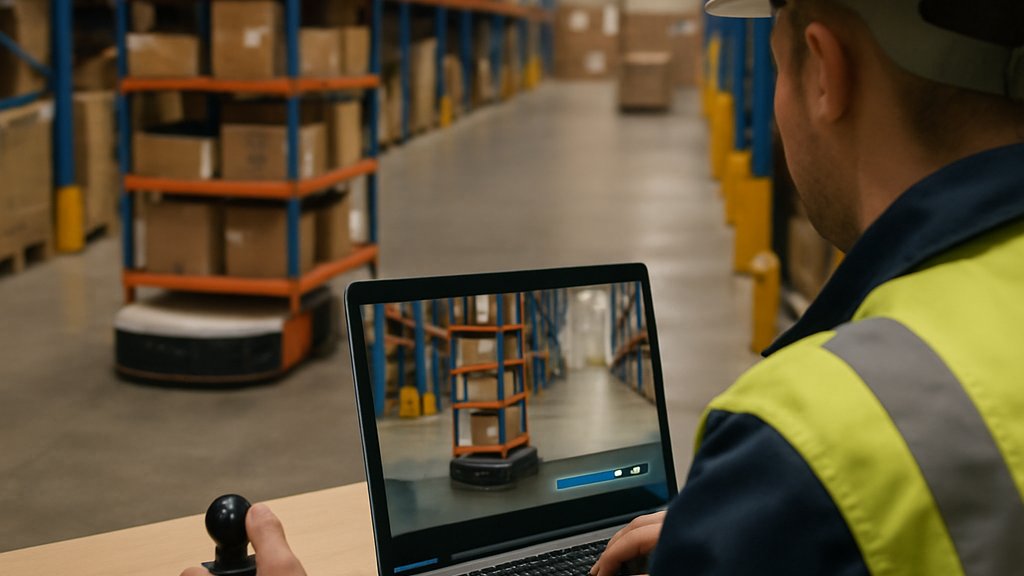
Multiple macro factors support adoption. Firstly, affordable head-mounted displays like Meta Quest 3 supply precise hand and head tracking. Secondly, 5G and emerging 6G links reduce network jitter, enabling stable teleop systems across continents. Thirdly, corporate sustainability targets encourage minimal travel, which further incentivizes high-skill remote robotics roles.
These forces converge to make predictive teleoperation an attractive investment. Nevertheless, stakeholders demand strong data before backing large scale rollouts.
Market pressures create fertile ground for prediction tech. Consequently, researchers raced to validate performance through controlled studies.
AHEAD Study Core Highlights
Georgia Tech’s AHEAD study represents the most detailed benchmark to date. Importantly, the system predicted the operator’s chosen object with 76% Top-1 accuracy. Teleoperation Intent Prediction therefore sits at the heart of the study. Furthermore, placement slot predictions matched that figure and reached 91% within the Top-3 set. By starting motion 0.6 seconds earlier for grasps and 1.4 seconds earlier for placements, AHEAD secured smoother trajectories.
The architecture fuses 3D head pose, finger joints, and scene voxels to infer human intent from 200-millisecond windows. Moreover, anticipatory control logic keeps the robot in preview mode until confidence exceeds a threshold, protecting safety. A fifteen-participant trial reported lower NASA-TLX workload scores than baseline manual control. Participants also preferred the responsive robotic hands, citing reduced micromanagement.
Collectively, these metrics quantify Teleoperation Intent Prediction impact in clear terms.
- Top-1 object accuracy: 76%
- Top-3 object accuracy: 90%
- Reaction time reduction: 0.6 s (object), 1.4 s (slot)
- User count: 15 professionals
- Hardware: Meta Quest 3 headset
These numbers confirm measurable gains under controlled conditions. Nevertheless, rivals offer alternative pipelines that may generalize better.
Competing Academic Approaches Compared
Several groups pursued different routes to Teleoperation Intent Prediction beyond AHEAD’s VR twin. In contrast, the GUIDER framework splits navigation and manipulation, using probabilistic models for each phase. The method delivered earlier confident predictions, leaving 20.31 seconds for corrections in one task, against 3.89 seconds for baselines.
Another June study introduced uncertainty estimates through conformal prediction. Consequently, the robot flagged low-confidence frames, preventing hazardous premature moves. Human-to-robot fine-tuning raised Edit scores from 70.50 to 80.70 with only 16 robot demonstrations, showcasing data efficiency.
Large language models also enter the arena. An IEEE article documented a dual-arm assistant that lifted task success by 240.8% over solo teleoperation. Moreover, the LLM provided natural language tips that aligned with human intent and reduced workload.
Academic diversity guards against overfitting to single labs. However, benefits mean little without clear commercial value.
Benefits And Key Tradeoffs
Predictive pipelines promise tangible gains for remote robotics operations. Firstly, earlier motion reduces idle manipulator time, raising throughput. Secondly, anticipatory control can smooth trajectories, trimming energy peaks. Thirdly, operators experience lighter cognitive strain because they supervise goals, not every joint. Teleoperation Intent Prediction adds autonomy yet keeps people responsible.
Nevertheless, false predictions remain costly. An errant robot may grasp the wrong component and collide with fixtures. Therefore, safety engineers insist on conservative preview phases, explicit cancel gestures, and uncertainty metrics. They also highlight that AHEAD’s 76% Top-1 object accuracy still leaves one error every four attempts.
Trust also hinges on agency. If the machine dismisses late corrections, human intent feels ignored. Robust predictive platforms must let users override predictions without friction.
Stakeholders appreciate real efficiency gains yet fear misaligned autonomy. Consequently, commercial pilots emphasize fail-safe design and explainable feedback before scaling further.
Industrial Momentum Builds Up
Corporate labs now translate academic prototypes into production remote robotics lines. For example, automotive suppliers test predictive pick-and-place cells that synchronize robotic hands with expert assemblers a continent away. Moreover, logistics giants explore warehouse teleop systems that cut training time for seasonal staff.
Meanwhile, venture funding flows toward start-ups offering Teleoperation Intent Prediction as a subscription cloud API. These platforms bundle scene understanding, anticipatory control, and fleet dashboards. Investors cite the strong precedent set by cloud vision APIs in adjacent markets.
Professionals can enhance their expertise with the AI-Robotics™ certification, which covers intent inference pipelines and safety protocols.
Industry momentum signals approaching mainstream adoption. However, unresolved technical gaps still slow full deployment.
Technical Hurdles Remain
Real factories rarely match tidy lab scenes. Objects vary, lighting shifts, and occlusions break markerless trackers. Consequently, predictive models trained on curated data may misread human intent in clutter.
Network instability presents another risk. Packet loss can desynchronize VR streams, leaving the robot committed to outdated predictions. Therefore, researchers explore edge buffering and semantic compression to maintain stability.
Scaling also demands broader object vocabularies. AHEAD evaluated ten items, yet warehouses handle thousands. Hybrid perception that fuses vision-language models with tactile self-calibration may extend coverage.
Current technical blockers include:
- Cluttered scenes distort hand tracking.
- Network jitter delays command streams.
- Massive object catalogs strain classifiers.
- Operator trust requires transparent feedback.
Without such advances, anticipatory control might default to idle mode, negating its benefits. Nevertheless, active research suggests solutions within reach.
Technical hurdles are serious but not insurmountable. Consequently, teams now draft deployment playbooks. Despite those challenges, Teleoperation Intent Prediction remains the guiding North Star for most engineering groups.
Adoption Roadmap Moves Forward
Successful rollouts follow a staged approach. First, teams benchmark baseline rigs to measure reaction delays and error patterns. Next, they integrate a small scale Teleoperation Intent Prediction module and log confidence metrics.
Subsequently, safety layers add conformal prediction sets that wrap anticipatory control decisions. Data from pilot shifts then fine-tune human intent classifiers for local workflows. Finally, operators receive dashboard alerts that flag when robotic hands act autonomously.
Milestones include 85% accuracy, 20% workload drop, and zero safety violations across 100 hours.
Following this roadmap converts research novelty into routine practice. Therefore, organizations can unlock new service models and upskill staff rapidly.
The field has advanced far from simple joysticks. Current evidence proves that Teleoperation Intent Prediction boosts accuracy, trims latency, and supports large-scale remote robotics. Moreover, frameworks like AHEAD, GUIDER, and uncertainty-aware pipelines yield repeatable gains with little robot data. Nevertheless, safety, trust, and generalization challenges persist. Disciplined engineering and certified skills remain essential. Professionals who master human intent modeling, anticipatory control, and fail-safe design will guide future teleop fronts. For structured learning, explore the earlier AI-Robotics™ certification link. Act now and place your team at the forefront of predictive teleoperation.
Disclaimer: Some content may be AI-generated or assisted and is provided ‘as is’ for informational purposes only, without warranties of accuracy or completeness, and does not imply endorsement or affiliation.


