

AI CERTS
1 day ago
VLA Model Shaping Redefines Action Interfaces
This article answers that question for a professional audience. It dissects the method, situates the numbers, and connects findings to ongoing vision-language-action trends. Furthermore, it highlights strategic implications for embodied AI programs now scaling toward commercial fleets. Readers will leave with a clear view of risks, next steps, and certification paths that strengthen deployment readiness.
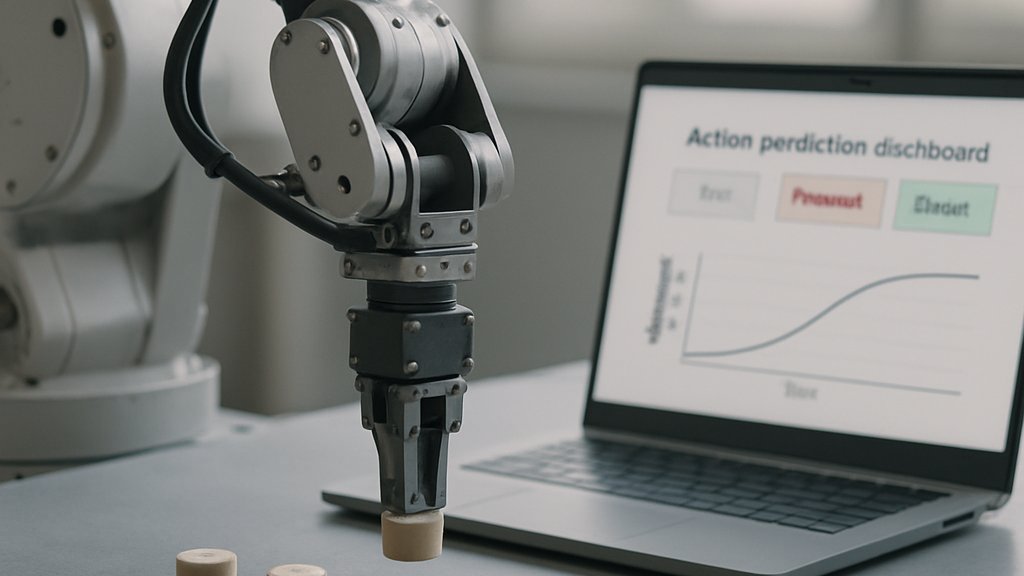
Interfaces Drive Robot Success
System designers often focus on bigger backbones or extra data. In contrast, the Action QFormer paper argues that interface placement decides whether learned features remain useful under action supervision. Specifically, the module inserts instruction-conditioned queries between a frozen multimodal encoder and the policy head. Consequently, upstream representations stay intact while the queries absorb task pressure.
This logic resonates with teams battling unstable robot perception. Moreover, it supports calls for modular designs that localize change rather than rewrite everything. Therefore, VLA Model Shaping emerges as a structural discipline, not merely a training trick.
These insights redefine architectural priorities. However, we still need concrete mechanics. The next section explains how the module actually works.
The interface concept simplifies pipeline tuning. Nevertheless, implementation details determine real value. Let’s examine them closely.
Action QFormer Core Mechanics
Action QFormer adapts the BLIP-2 Q-Former pattern. However, it expands each query with the current language instruction, producing tokens already biased toward downstream actions. Each query cross-attends to visual features, then feeds a lightweight transformer producing a structured representation set that drives the policy head.
Meanwhile, the pretrained vision and language encoders remain frozen. Consequently, language grounding and object details carry forward untouched. Additionally, the authors introduce a minor alignment loss that discourages drift away from original semantics.
This architecture supports graceful action supervision. Furthermore, it contains any destructive gradient flow inside the small query network. Therefore, developers gain a safety valve without losing flexibility.
Action QFormer’s simplicity encourages quick prototyping. Nonetheless, practitioners demand data. The paper supplies that evidence, covered next.
The component design seems elegant. However, claims matter only when numbers confirm them. Performance metrics provide the decisive proof.
Quantifying Real Performance Gains
The authors benchmark sim-to-real ObjectNav navigation. Baseline average success sat at 18.8 percent. After inserting Action QFormer, success jumped to 56.3 percent. Moreover, fixed instruction correctness climbed from 22.5 percent to 75.5 percent.
- 3× higher closed-loop task completion
- 53-point rise in instruction adherence
- Near elimination of out-of-distribution commands
Furthermore, the team observed stable attention maps, indicating healthier robot perception. These numbers convince many that VLA Model Shaping can unlock hidden capacity already present in large backbones.
Performance margins highlight practical value. However, gains invite questions about side effects. The following section tackles representational safety.
Numbers look impressive at first glance. Nevertheless, representation drift can lurk beneath metrics. Addressing that risk is critical for enterprise rollout.
Mitigating Harmful Representation Drift
Directly training policy heads sometimes rewires shared features, harming language alignment. In contrast, Action QFormer confines gradient updates. Consequently, upstream embeddings preserve critical vision-language-action grounding.
Mechanistic analyses measured token rewriting, effective rank, and attention variance. Moreover, the authors report sharp reductions in global rewriting while allowing focused adaptation inside query tokens. Therefore, structured representations remain interpretable and robust.
This stability addresses compliance and safety audits often required for commercial embodied AI products. Furthermore, predictable representations simplify downstream debugging.
Stable features build trust. However, stakeholders still compare new ideas with existing giants like RT-2. The next section provides that context.
Representation health offers peace of mind. Yet decision makers need broader market mapping to justify investment changes.
Comparisons With Prior Work
RT-1 and RT-2 showcase scale benefits, training billions of parameters on web and robot data. However, they still struggle with long-tail edge cases. Action QFormer suggests that smarter interfaces can recover similar gains without massive retraining.
In contrast with scale-heavy approaches, the paper swaps a single module and freezes the rest. Consequently, training costs drop, and teams re-use existing checkpoints. Moreover, interface modularity enables rapid A/B testing across tasks, positively influencing iterative vision-language-action research.
Industry conversations now frame VLA Model Shaping as a complementary axis: data, backbone, and interface. Additionally, early adopters report easier hyperparameter sweeps because fewer components change.
Competitive landscapes shift quickly. However, practical deployment questions still determine rollouts. We address those next.
Contextual comparisons clarify positioning. Nevertheless, operational leaders require concrete guidance on risks and logistics.
Deployment Questions And Caveats
The paper’s experiments use Qwen2.5-VL and ObjectNav tasks. Therefore, generalization to manipulation or outdoor driving needs further testing. Additionally, query counts and conditioning strategies introduce new tuning knobs. Engineers must benchmark those choices against latency budgets.
Moreover, sim-to-real claims hinge on calibration quality and sensor drift handling. Consequently, replication on diverse robot platforms remains vital. Independent labs should validate robust robot perception under lighting variation and hardware noise.
Nevertheless, the plug-in nature eases field trials. Teams can A/B test Action QFormer within existing stacks with minimal retraining. Professionals can enhance their expertise with the AI Robotics Specialist™ certification and prepare for such evaluations.
These caveats remind leaders to balance optimism with rigor. However, strategic implications remain compelling, discussed next.
Caveats underscore due diligence needs. Still, they do not diminish the transformative potential outlined earlier.
Strategic Takeaways For Leaders
First, interface innovation now sits alongside data scale in the VLA Model Shaping toolkit. Secondly, localized action supervision protects global semantics, easing regulatory reviews. Thirdly, modular swaps shorten iteration cycles, supporting agile product releases.
Moreover, the findings encourage structured monitoring of representation drift, a practice aligned with many corporate ML governance frameworks. In contrast, ignoring interface effects can stall progress despite larger models.
Executives should therefore allocate budget for interface research. Additionally, training staff through targeted programs strengthens organizational readiness for next-generation embodied AI solutions.
Strategic insights crystallize investment priorities. Nevertheless, a concise recap helps finalize action items.
Conclusion And Next Steps
Action QFormer shows that small modules can deliver large gains. Moreover, its results prove that VLA Model Shaping deserves equal attention alongside scale.
Consequently, professionals should monitor interface research, replicate reported numbers, and pursue structured certification pathways. Furthermore, leaders must integrate drift metrics into validation suites, ensuring safe, scalable vision-language-action rollouts.
Ready teams will capture emerging value swiftly. Explore the linked certification to prepare for upcoming deployments and stay ahead in the evolving robotics landscape.
Disclaimer: Some content may be AI-generated or assisted and is provided ‘as is’ for informational purposes only, without warranties of accuracy or completeness, and does not imply endorsement or affiliation.


