

AI CERTS
1 day ago
Temporal KG Reasoning Advances Fuel Reachability Breakthroughs
Moreover, new bi-level indexes push temporal reachability queries toward real-time latencies. Investors notice the gains as enterprise pilots begin scaling across compliance, risk, and supply chain knowledge graphs. This article dissects key breakthroughs, benchmarks, and remaining gaps. It highlights why reachability thinking now underpins advanced relational inference roadmaps. Finally, it offers actionable advice and a certification pathway for professionals.
Why Reachability Now Matters
Firstly, multi-hop reachability defines whether an entity remains discoverable along time-respecting edges. Researchers show that over twenty-five percent of temporal queries fail when systems ignore those paths. Therefore, Temporal KG Reasoning workflows now sample deeper history and validate answers with semantic rules. Consequently, knowledge graphs in finance and defense regain missing links that once reduced analytic trust.
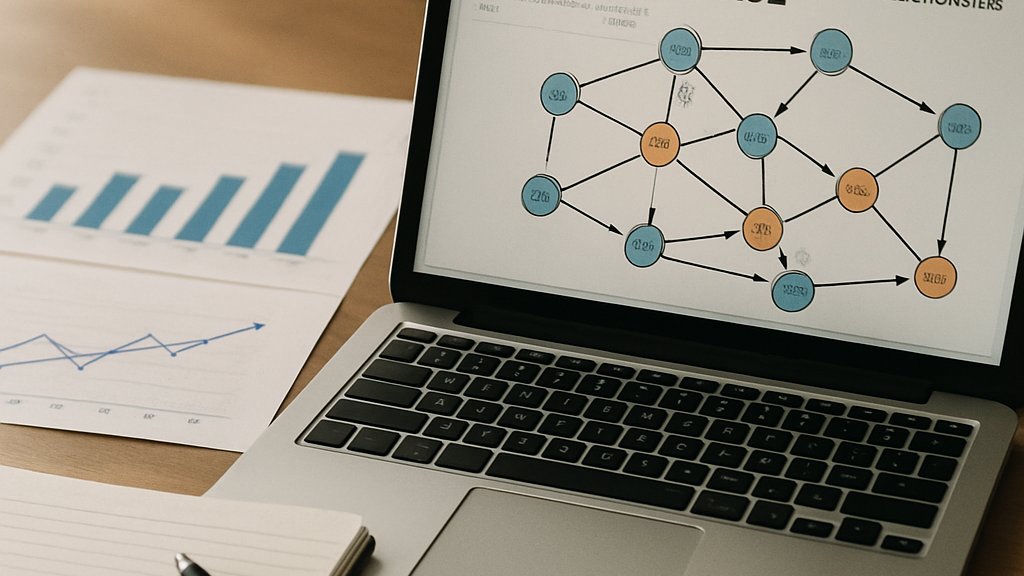
Reachability awareness lifts accuracy and faithfulness across industries. Meanwhile, new papers provide the technical playbook explored next.
Recent Key Paper Breakthroughs
Several 2026 studies create measurable momentum. RECIPE-TKG couples rule-based multi-hop sampling with contrastive fine-tuning and test-time filtering. Moreover, the framework boosts Hits@10 by twenty-two percent on ICEWS14 compared with earlier LLM baselines. Chain-of-Relations attacks question answering differently. Instead of entity expansion, it follows relation chains then applies global entity filtering. Consequently, Hits@1 rises to eighty-four on WebQSP while the KGR faithfulness metric hits ninety-two.
Hybrid Bi-Level Index research tackles scalability by partitioning vertices according to reachable-set size. In contrast, prior flat indexes either wasted memory or degraded query latency. Together, these breakthroughs expand the frontier of Temporal KG Reasoning across multiple reasoning systems. Furthermore, reachability pretraining emerges as a unifying theme joining all three contributions.
These papers validate deeper retrieval, relation-centric search, and optimized indexes. Therefore, the next section unpacks the common technical patterns underpinning that progress.
Core Technical Patterns Emerging
Every breakthrough shares three architectural shifts. Firstly, retrieval spans multiple hops while respecting timestamp order. Secondly, exploration becomes relation-centric, delaying entity pruning until a global filter phase. Thirdly, models embed reachability priors through reachability pretraining or hybrid index heuristics. Moreover, LoRA adapters keep parameter footprints manageable for production reasoning systems. Consequently, Temporal KG Reasoning pipelines can deploy on GPUs once reserved for standard graph AI.
These patterns formalize reachable reasoning design principles. Subsequently, we inspect the performance numbers demonstrating their value.
Performance Numbers Explained Clearly
Numbers persuade budget holders faster than abstractions. On ICEWS14, RECIPE-TKG lifts Hits@10 from fifty-three to sixty-five. Meanwhile, Hits@1 climbs to thirty-nine, underscoring tangible precision gains. CoR reports WebQSP Hits@1 above eighty-three and KGR above ninety-one. Moreover, hybrid indexes cut average reachability query latency by forty percent on synthetic temporal graphs. The following list summarizes headline statistics that resonate with executives:
- RECIPE-TKG: +22% Hits@10 versus LLM baseline on ICEWS14.
- CoR: 83.8 Hits@1, 91.6 KGR on WebQSP.
- Hybrid Index: optimal threshold halves memory while keeping sub-second queries.
Consequently, board members see a clear accuracy-to-cost trajectory. Temporal KG Reasoning performance numbers thus justify further investment in advanced relational inference initiatives. Therefore, enterprises adopting Temporal KG Reasoning can anticipate double-digit precision improvements relative to legacy graph AI.
Benchmarks reveal consistent benefits across datasets and tasks. Nevertheless, several obstacles still slow wider deployment, as examined next.
Challenges And Current Limitations
Real-world knowledge graphs are noisy, incomplete, and frequently inconsistent. Consequently, reachable paths might include erroneous edges that mislead reasoning systems. Moreover, multi-hop retrieval inflates compute budgets because each hop spawns new candidate entities. Inference latency rises by sixteen percent in RECIPE-TKG when semantic filtering activates. In contrast, Hybrid Index strategies cut time yet demand careful parameter tuning. Without such tuning, Temporal KG Reasoning can still stall during large reachability pretraining workloads.
These issues require tooling, benchmarks, and standardized metrics for relational inference pipelines. Subsequently, we explore adoption outlooks under those constraints.
Enterprise Adoption Outlook 2026
Enterprise teams already pilot temporal question answering for regulatory change tracking and supply disruption alerts. Furthermore, insurers mine evolving risk relations using hybrid indexes in production graph AI clusters. Analysts expect commercial tools with built-in reachability pretraining to reach general availability by mid-2027. Meanwhile, open-source communities extend adapters that integrate LLaMA3 checkpoints into reasoning systems. Firms embracing Temporal KG Reasoning early may secure analytic advantages and regulatory insights ahead of slower rivals. Consequently, upskilling remains urgent. Professionals can enhance their expertise with the AI Data Robotics™ certification.
Adoption forecasts look positive yet depend on talent and cost optimization. Therefore, the final section outlines pragmatic next steps.
Actionable Next Steps Forward
Organizations should begin with dataset audits to gauge noise levels. Secondly, teams must benchmark baseline retrieval before layering multi-hop enhancements. Moreover, integrating reachability pretraining early reduces exploration cost during later optimization. Engineering leads should prototype hybrid indexes on a representative time slice. Meanwhile, product managers must align accuracy metrics with KGR or similar faithfulness measures. Finally, rolling out Temporal KG Reasoning in phased pilots ensures traceability and cost visibility.
These steps translate research into measurable business outcomes. Consequently, the conclusion below synthesizes the article and issues a call to action.
In summary, Temporal KG Reasoning now marries reachability pretraining, relation-centric search, and optimized indexes to deliver verifiable insights. Moreover, recent benchmarks show double-digit gains across diverse knowledge graphs and tasks. Nevertheless, noise, latency, and metric gaps still threaten production rollouts. Consequently, enterprises must adopt systematic audits, hybrid indexing, and phased pilots. Professionals who secure targeted certifications will guide those initiatives with authority. Therefore, visit the linked program and start advancing your graph AI career today.
Disclaimer: Some content may be AI-generated or assisted and is provided ‘as is’ for informational purposes only, without warranties of accuracy or completeness, and does not imply endorsement or affiliation.


